 Que dino es ti? O test
 Batalla de dinos
 Carreira de dinos
 Minixogos de dinos
 Álbum de cromos
 Listas TOP de dinos
 Sorpréndeme!
Cimoliopterus
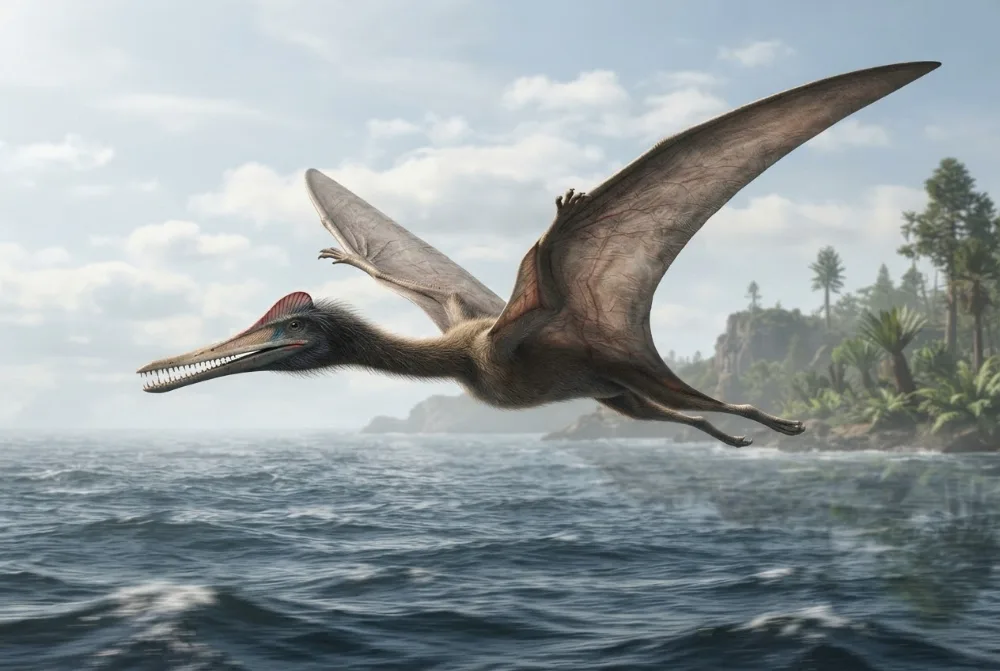
Cimoliopterus was a flying reptile that soared over the seas during the time of the dinosaurs. It had a long, toothy snout and a thin crest on its beak. It probably caught fish by swooping down and snatching them from the water.51
Cando viviu?
Como era de grande?
Que anchura tiñan as súas ás?
 ás tan anchas coma 3 bicicletas en fila⚽podería voar sobre un campo de fútbol enteiro en 5,5 segundos
Como era de grande Cimoliopterus comparado CONTIGO?
Só son contas no teu navegador. Non se garda nin se envía nada.
Que velocidade alcanzaba?


Datos curiosos
Cimoliopterus had a thin crest on the top of its snout that started above the fourth pair of teeth.1
The tip of its snout was small and blunt, and the front of the upper jaw sloped downward at about a 45-degree angle.1
One species, Cimoliopterus dunni, was discovered in Texas and is the first North American record of this pterosaur genus.1
It had at least 26 teeth in its upper jaw, and the first pair pointed more downward than forward.1
As preguntas máis frecuentes sobre Cimoliopterus
?How big was Cimoliopterus?
Cimoliopterus cuvieri had a wingspan of about 3.5 metres (11 feet), and Cimoliopterus dunni was similar in size. One Cimoliopterus specimen had a wingspan of about 5 metres (16 feet).3
?What did Cimoliopterus eat?
It probably ate fish. It may have flown over the water and dipped its long jaws in to catch fish with its interlocking teeth.34
?Could Cimoliopterus fly?
Yes, it was a flying reptile. It was probably good at long-distance soaring over oceans, and its fossils are mostly found in marine rocks.3
?Why did Cimoliopterus have a crest?
Scientists are not sure. Some think the crest helped steady its jaws in the water while fishing, but it may have been for display.3
Para expertos en dinos
- Nome científico
- Cimoliopterus
- Bautizado por
- Rodrigues and Kellner 20135
- Grupo
- Réptiles voadores
- Familia / clado
- Pteranodontoidea5
- Clasificación
- Pterosauria > Pterodactyloidea5
- Idade das rochas
- de 100 a 90 millóns de anos (Cenomanian / Turonian)5
- Formacións rochosas
- Britton5
- Países
- Reino Unido, EUA5
- Rexistros fósiles
- 2 na Paleobiology Database5
- Descubrimento
- The genus Cimoliopterus was named in 2013 by paleontologists Taissa Rodrigues and Alexander Kellner based on fossils from England. A second species, Cimoliopterus dunni, was described in 2015 by Timothy Myers from a partial snout found in Texas.51
- Aínda en debate
- Scientists are not sure exactly how large Cimoliopterus grew, because only parts of the skull have been found so far.1
De onde veñen os datos
- First North American occurrence of the toothed pteranodontoid pterosaur Cimoliopterus: Journal of Vertebrate Paleontology: Vol 35 , No 6 - Get Access (tandfonline.com)
- PBDB Taxon (paleobiodb.org)
- Cimoliopterus (en.wikipedia.org)
- New North American pterosaur is a Texan -- but flying reptile's closest cousin is English | EurekAlert! (eurekalert.org)
- Cimoliopterus in The Paleobiology Database (CC BY 4.0): idade, lugares, formacións rochosas, clasificación.
Cada dato desta páxina ten un número que leva á súa fonte. Se nos equivocamos nalgo, sentímolo, somos fans dos dinos, non unha revista científica. Escríbenos a [email protected] e arranxámolo.
 Rex ten fame! Dino Wiki é o proxecto dun pai para o seu fillo, que adora os dinosauros, gratis, sen anuncios e sen rastrexadores. Os adultos poden darlle un petisco a Rex para mantelo en liña.Dálle de comer a Rex
 Pteranodon
 Quetzalcoatlus
 Dorygnathus
 Rhamphorhynchus
 Anhanguera
 Pterodactylus
 Tyrannosaurus
 Triceratops
 Velociraptor
 Spinosaurus
 Ankylosaurus
 Parasaurolophus