 Que dino es ti? O test
 Batalla de dinos
 Carreira de dinos
 Minixogos de dinos
 Álbum de cromos
 Listas TOP de dinos
 Sorpréndeme!
Coloborhynchus
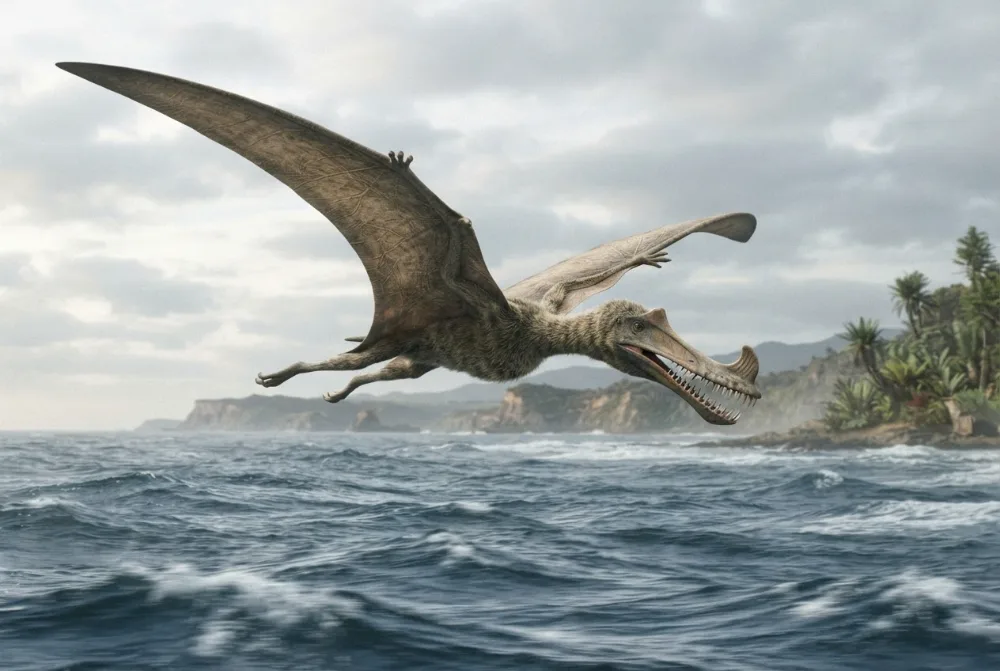
Coloborhynchus was a flying reptile with a long, toothed snout that lived near the sea. It soared over the waves and snatched fish with its sharp teeth. Some scientists think it was one of the biggest toothed pterosaurs ever!1
Cando viviu?
Como era de grande?
Que anchura tiñan as súas ás?
 ás tan anchas coma 4 bicicletas en fila⚽podería voar sobre un campo de fútbol enteiro en 4,8 segundos
Como era de grande Coloborhynchus comparado CONTIGO?
Só son contas no teu navegador. Non se garda nin se envía nada.
Que velocidade alcanzaba?


Datos curiosos
Coloborhynchus lived about 140 to 94 million years ago, during the Cretaceous Period.4
Its name means 'maimed beak' because the first fossil found was a damaged snout.1
The first Coloborhynchus fossil was a piece of the upper jaw with tooth sockets, found in England.12
Coloborhynchus belonged to a group called Anhangueridae, which were fish-eating pterosaurs with crests on their snouts.41
Some scientists now think only one species, Coloborhynchus clavirostris, truly belongs to this genus.2
Fossils of Coloborhynchus have been found in both England and Morocco, showing it lived in different parts of the world.41
Coloborhynchus had a flat, squared-off tip on its upper jaw, which helped it catch fish.2
As preguntas máis frecuentes sobre Coloborhynchus
?How big was Coloborhynchus?
It could have a wingspan of about 7 metres (23 feet), which is as long as a small boat. The largest toothed pterosaur specimen, Coloborhynchus capito, had a skull up to 75 centimetres long.13
?What did Coloborhynchus eat?
It ate fish, just like many other pterosaurs that lived near the sea. Its sharp teeth and long snout helped it catch them.1
?When did Coloborhynchus live?
It lived during the Early Cretaceous Period, about 140 to 94 million years ago.1
?Why is it called Coloborhynchus?
Its name means 'maimed beak' because the first fossil found was a damaged snout. The name was given by Richard Owen in 1874.1
Cazamitos
Mito: Coloborhynchus was the largest flying animal ever.
Verdade: It was once thought to be the largest toothed pterosaur, but a close relative called Tropeognathus is now believed to have had a bigger wingspan.1
Para expertos en dinos
- Nome científico
- Coloborhynchus
- Bautizado por
- Owen 18744
- Grupo
- Réptiles voadores
- Familia / clado
- Anhangueridae4
- Clasificación
- Pterosauria > Pterodactyloidea4
- Idade das rochas
- de 139 a 94 millóns de anos (Berriasian / Cenomanian)4
- Formacións rochosas
- Wessex, Ifezouane4
- Países
- Marrocos, Reino Unido4
- Rexistros fósiles
- 5 na Paleobiology Database4
- Tamén coñecido como
- Amblydectes (nomes antigos que agora contan como o mesmo animal)4
- Descubrimento
- Richard Owen named Coloborhynchus in 1874 based on a partial snout from East Sussex, England. The fossil was damaged, so Owen called it 'maimed beak'.14
- Aínda en debate
- Scientists are still debating which species belong to Coloborhynchus and which should be placed in other genera like Nicorhynchus or Uktenadactylus.2
De onde veñen os datos
- Coloborhynchus (en.wikipedia.org)
- A taxonomic and phylogenetic review of the anhanguerid pterosaur group Coloborhynchinae and the new clade (ddd.uab.cat)
- The world’s largest toothed pterosaur, NHMUK R481, an incomplete rostrum of Coloborhynchus capito (Seeley, 1870) from the Cambridge Greensand of England (sciencedirect.com)
- Coloborhynchus in The Paleobiology Database (CC BY 4.0): idade, lugares, formacións rochosas, clasificación.
Cada dato desta páxina ten un número que leva á súa fonte. Se nos equivocamos nalgo, sentímolo, somos fans dos dinos, non unha revista científica. Escríbenos a [email protected] e arranxámolo.
 Rex ten fame! Dino Wiki é o proxecto dun pai para o seu fillo, que adora os dinosauros, gratis, sen anuncios e sen rastrexadores. Os adultos poden darlle un petisco a Rex para mantelo en liña.Dálle de comer a Rex
 Pteranodon
 Quetzalcoatlus
 Dorygnathus
 Rhamphorhynchus
 Anhanguera
 Pterodactylus
 Stegosaurus
 Iguanodon
 Archaeopteryx
 Giganotosaurus
 Microraptor
 Deinonychus