 Que dino es ti? O test
 Batalla de dinos
 Carreira de dinos
 Minixogos de dinos
 Álbum de cromos
 Listas TOP de dinos
 Sorpréndeme!
Dimorphodon
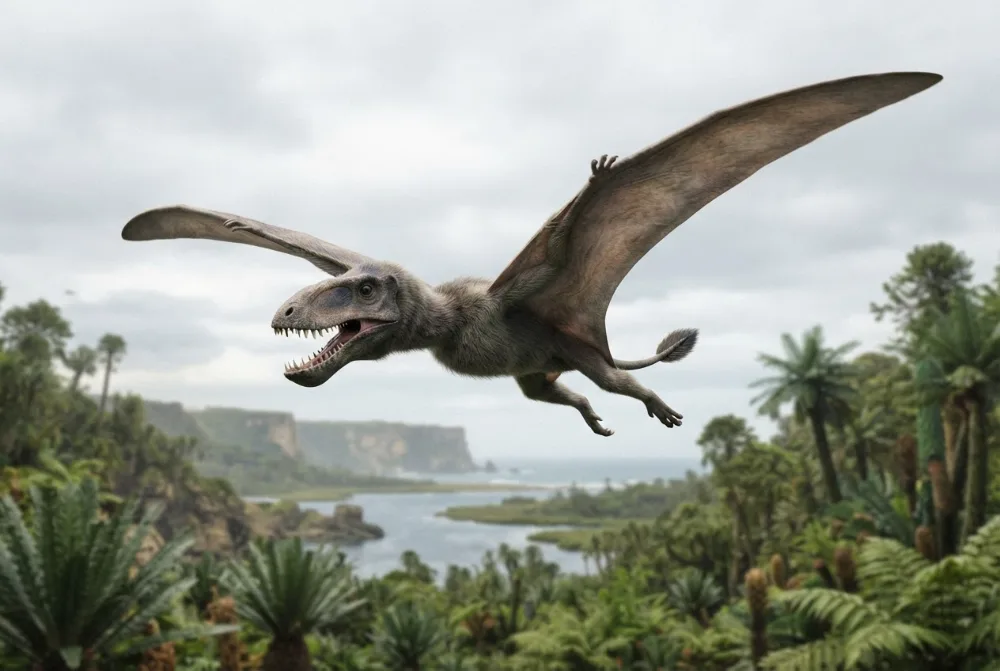
Dimorphodon was a flying reptile that lived during the Early Jurassic, about 201 to 191 million years ago. It had two different kinds of teeth in its jaws, which is rare for reptiles. It probably hunted small animals and insects.1
Cando viviu?
Como era de grande?
Canto medía de longo?
 tan longo coma 2 gatos domésticos do fociño á cola🍌tan longo coma 6 plátanos postos un tras outro⚽podería voar sobre un campo de fútbol enteiro en 8,4 segundos
Como era de grande Dimorphodon comparado CONTIGO?
Só son contas no teu navegador. Non se garda nin se envía nada.
Que velocidade alcanzaba?


Datos curiosos
Dimorphodon was named by famous paleontologist Richard Owen in 1859.1
The first fossils of Dimorphodon were found by fossil collector Mary Anning in Lyme Regis, England, in 1828.1
Dimorphodon had a large, light skull with big openings and large eyes.3
Its wings were made of skin stretched from an extra-long fourth finger to its hip or hind legs.3
Dimorphodon was not a strong flier; it probably made short, frantic flights like modern chickens or woodpeckers.1
On the ground, Dimorphodon likely walked on two legs and folded its wings like birds and bats do.3
A second species, Dimorphodon weintraubi, was named in 1998 from fossils found in Mexico.1
As preguntas máis frecuentes sobre Dimorphodon
?How big was Dimorphodon?
About 1 metre long, with a wingspan of about 1.45 metres.1
?What did Dimorphodon eat?
It probably hunted small vertebrates and also ate insects. Some scientists think it was an insectivore, but recent studies suggest it was a vertebrate predator.1
?Could Dimorphodon fly well?
No, it was not a strong flier. It likely made short, frantic flights like modern chickens or woodpeckers, and could not fly for long distances.1
?When did Dimorphodon live?
It lived during the Early Jurassic Period, about 201 to 191 million years ago.1
?Where was Dimorphodon found?
The first fossils were found in Lyme Regis, England, by Mary Anning in 1828. A second species was later found in Mexico.1
?Why is it called Dimorphodon?
Its name means 'two-form tooth' because it had two different types of teeth in its jaws: long fangs at the front and smaller pointed teeth behind.1
?Is Dimorphodon a dinosaur?
No, it is a pterosaur, a flying reptile that is not a dinosaur.1
?How did Dimorphodon walk on the ground?
It likely walked on all fours, using its wings as front limbs, rather than walking on two legs.1
Cazamitos
Mito: Dimorphodon was a seabird-like glider that soared over the ocean.
Verdade: Recent studies show it had short, robust wings and was a poor glider, relying on short, flapping flights.1
Para expertos en dinos
- Nome científico
- Dimorphodon
- Bautizado por
- Owen 18594
- Grupo
- Réptiles voadores
- Familia / clado
- Dimorphodontidae4
- Clasificación
- Pterosauria4
- Idade das rochas
- de 201 a 184 millóns de anos (Hettangian / Pliensbachian)4
- Formacións rochosas
- Blue Lias, La Boca4
- Países
- Reino Unido, México4
- Rexistros fósiles
- 3 na Paleobiology Database4
- Descubrimento
- The first fossils were found by Mary Anning in 1828 in England. Richard Owen named the genus Dimorphodon in 1859 after studying skulls that showed two types of teeth.1
- Aínda en debate
- Scientists still debate whether Dimorphodon mainly ate insects or small vertebrates, though recent studies lean toward a vertebrate diet.1
De onde veñen os datos
- Dimorphodon (en.wikipedia.org)
- PBDB Taxon (paleobiodb.org)
- Dimorphodon | Pterosaur, Jurassic, Flying Reptile (britannica.com)
- Dimorphodon in The Paleobiology Database (CC BY 4.0): idade, lugares, formacións rochosas, clasificación.
Cada dato desta páxina ten un número que leva á súa fonte. Se nos equivocamos nalgo, sentímolo, somos fans dos dinos, non unha revista científica. Escríbenos a [email protected] e arranxámolo.
 Rex ten fame! Dino Wiki é o proxecto dun pai para o seu fillo, que adora os dinosauros, gratis, sen anuncios e sen rastrexadores. Os adultos poden darlle un petisco a Rex para mantelo en liña.Dálle de comer a Rex
 Pteranodon
 Quetzalcoatlus
 Dorygnathus
 Rhamphorhynchus
 Anhanguera
 Pterodactylus
 Dilophosaurus
 Stenopterygius
 Lufengosaurus
 Scutellosaurus
 Yunnanosaurus
 Sinosaurus