 Que dino es ti? O test
 Batalla de dinos
 Carreira de dinos
 Minixogos de dinos
 Álbum de cromos
 Listas TOP de dinos
 Sorpréndeme!
Fortipesavis
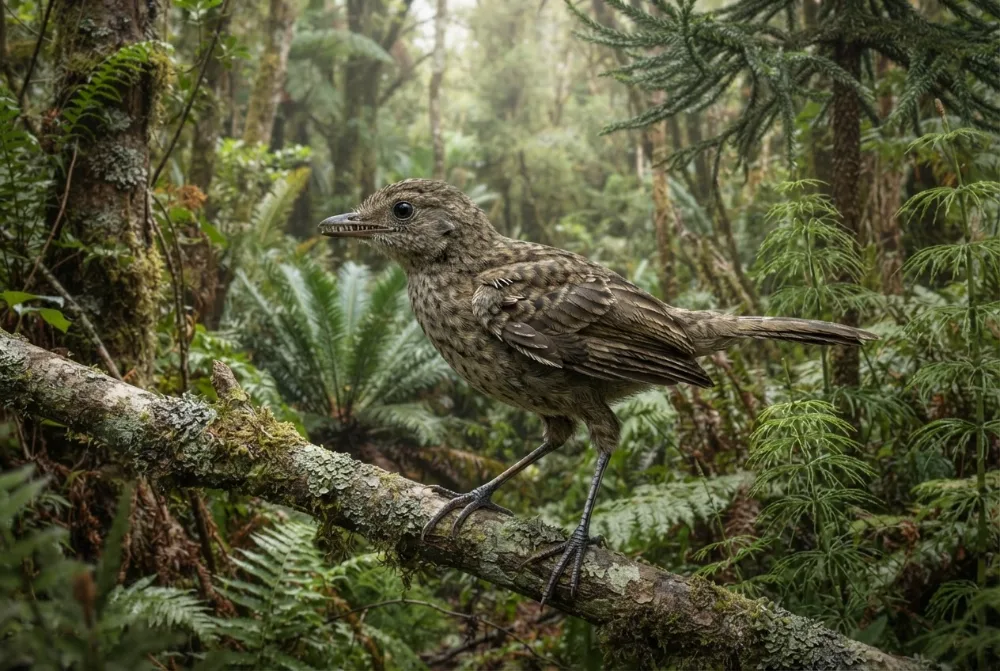
Fortipesavis was a tiny bird that lived about 98 million years ago. It had a very strong and wide fourth toe, which helped it grip onto thin, wobbly branches like a kingfisher. Its foot was so unusual that scientists named it the 'strong-footed bird'.12
Cando viviu?
Que velocidade alcanzaba?


Datos curiosos
Fortipesavis is known only from a partial left foot preserved in amber, which is a piece of fossilized tree resin.1
Its fourth toe was almost twice as wide as its second toe, a feature not seen in any other bird, living or extinct.12
The foot of Fortipesavis had thick, padded toes with deep grooves between them, which helped it grip tightly onto branches.2
This bird lived in a mangrove forest environment, where it probably perched on thin, swaying branches while hunting for insects.12
The fossil of Fortipesavis was found in a piece of amber that weighs only 2.68 grams and is about the size of a large coin.1
Scientists used micro-CT scanning to study the foot inside the amber without damaging the fossil.1
Para expertos en dinos
- Nome científico
- Fortipesavis
- Bautizado por
- Clark and O’Connor 20214
- Grupo
- Aves primitivas
- Familia / clado
- Enantiornithes4
- Clasificación
- Theropoda > Avialae4
- Idade das rochas
- de 100 a 94 millóns de anos (Cenomanian)4
- Países
- Myanmar4
- Rexistros fósiles
- 1 na Paleobiology Database4
- Descubrimento
- Fortipesavis was named in 2021 by Alexander Clark and Jingmai O'Connor based on a foot preserved in amber from Myanmar. The fossil was first described in 2019 by Lida Xing and colleagues.13
- Aínda en debate
- Scientists are not sure whether Fortipesavis ate insects or fish, because its foot is similar to both modern kingfishers (which eat fish) and bee-eaters (which eat insects).2
De onde veñen os datos
- Fortipesavis (en.wikipedia.org)
- Frontiers | Exploring the Ecomorphology of Two Cretaceous Enantiornithines With Unique Pedal Morphology (frontiersin.org)
- PBDB Taxon (paleobiodb.org)
- Fortipesavis in The Paleobiology Database (CC BY 4.0): idade, lugares, formacións rochosas, clasificación.
Cada dato desta páxina ten un número que leva á súa fonte. Se nos equivocamos nalgo, sentímolo, somos fans dos dinos, non unha revista científica. Escríbenos a [email protected] e arranxámolo.
 Rex ten fame! Dino Wiki é o proxecto dun pai para o seu fillo, que adora os dinosauros, gratis, sen anuncios e sen rastrexadores. Os adultos poden darlle un petisco a Rex para mantelo en liña.Dálle de comer a Rex
 Archaeopteryx
 Hesperornis
 Ichthyornis
 Baptornis
 Jurapteryx
 Gobipteryx
 Tyrannosaurus
 Triceratops
 Velociraptor
 Spinosaurus
 Ankylosaurus
 Parasaurolophus