 Que dino es ti? O test
 Batalla de dinos
 Carreira de dinos
 Minixogos de dinos
 Álbum de cromos
 Listas TOP de dinos
 Sorpréndeme!
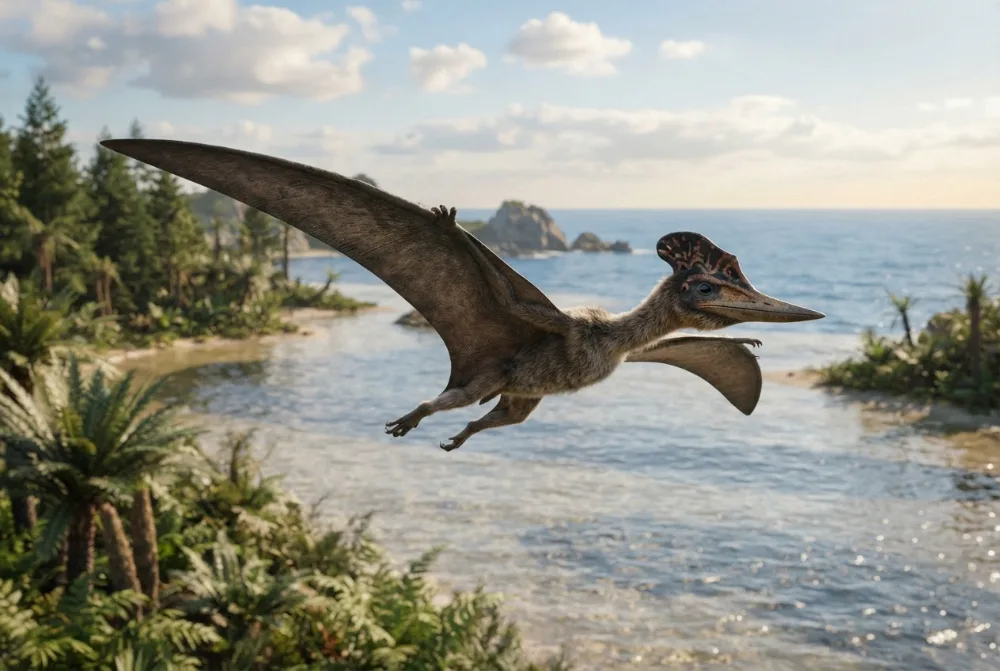
Germanodactylus
Germanodactylus was a small pterosaur that flew over warm lagoons during the Late Jurassic. It had a pointed beak and a fancy crest on its head, which may have been used to attract mates.1
Cando viviu?
Como era de grande?
Que anchura tiñan as súas ás?
 tan longo coma 2 gatos domésticos do fociño á cola⚽podería voar sobre un campo de fútbol enteiro en 10 segundos
Como era de grande Germanodactylus comparado CONTIGO?
Só son contas no teu navegador. Non se garda nin se envía nada.
Que velocidade alcanzaba?


Datos curiosos
Germanodactylus had a head crest with a bony part and a soft-tissue part that more than doubled its height. The soft part was probably made of skin-like material.1
Its skull was about 13 centimeters (5.1 inches) long for G. cristatus, and 21 centimeters (8.3 inches) for G. rhamphastinus.1
Germanodactylus had sharp teeth, with about 13 teeth in each side of the upper jaw for G. cristatus, and 16 for G. rhamphastinus.1
For a long time, scientists thought Germanodactylus was just a species of Pterodactylus, but it got its own genus in 1964.1
Some scientists think the two species of Germanodactylus might not be closely related, and one might belong to a different group.1
Germanodactylus lived about 150 to 148 million years ago, during the Late Jurassic period.1
As preguntas máis frecuentes sobre Germanodactylus
?Was Germanodactylus a dinosaur?
No, Germanodactylus was a pterosaur, a flying reptile that lived during the time of dinosaurs, but it is not a dinosaur.1
?How big was Germanodactylus?
Germanodactylus was about the size of a raven. G. cristatus had a wingspan of about 0.98 meters (3.2 feet), and G. rhamphastinus was a bit larger with a wingspan of 1.08 meters (3.5 feet).1
?What did Germanodactylus eat?
Scientists are not sure exactly what it ate, but its sharp teeth suggest it may have eaten fish or other small animals.1
?Why did Germanodactylus have a crest?
The crest may have been used to attract mates, like a peacock's tail. It had a bony part and a soft part that more than doubled its height.1
Cazamitos
Mito: Germanodactylus was a dinosaur.
Verdade: Germanodactylus was a pterosaur, a flying reptile that is not a dinosaur.1
Para expertos en dinos
- Nome científico
- Germanodactylus
- Bautizado por
- Young 19642
- Grupo
- Réptiles voadores
- Familia / clado
- Lophocratia2
- Clasificación
- Pterosauria > Pterodactyloidea2
- Idade das rochas
- de 155 a 145 millóns de anos (Kimmeridgian / Tithonian)2
- Formacións rochosas
- Solnhofen, Kimmeridge Clay, Altmühltal2
- Países
- Alemaña, Reino Unido2
- Rexistros fósiles
- 5 na Paleobiology Database2
- Descubrimento
- The first specimen was found in the Solnhofen Limestone of Germany and was named Pterodactylus cristatus by Carl Wiman in 1925. Yang Zhongjian gave it its own genus, Germanodactylus, in 1964.1
- Aínda en debate
- Scientists still debate whether the two species of Germanodactylus belong in the same genus, or if one should be moved to a new genus.1
De onde veñen os datos
- Germanodactylus (en.wikipedia.org)
- Germanodactylus in The Paleobiology Database (CC BY 4.0): idade, lugares, formacións rochosas, clasificación.
Cada dato desta páxina ten un número que leva á súa fonte. Se nos equivocamos nalgo, sentímolo, somos fans dos dinos, non unha revista científica. Escríbenos a [email protected] e arranxámolo.
 Rex ten fame! Dino Wiki é o proxecto dun pai para o seu fillo, que adora os dinosauros, gratis, sen anuncios e sen rastrexadores. Os adultos poden darlle un petisco a Rex para mantelo en liña.Dálle de comer a Rex
 Pteranodon
 Quetzalcoatlus
 Dorygnathus
 Rhamphorhynchus
 Anhanguera
 Pterodactylus
 Brachiosaurus
 Diplodocus
 Allosaurus
 Brontosaurus
 Compsognathus
 Camarasaurus