 Que dino es ti? O test
 Batalla de dinos
 Carreira de dinos
 Minixogos de dinos
 Álbum de cromos
 Listas TOP de dinos
 Sorpréndeme!
Harpactognathus
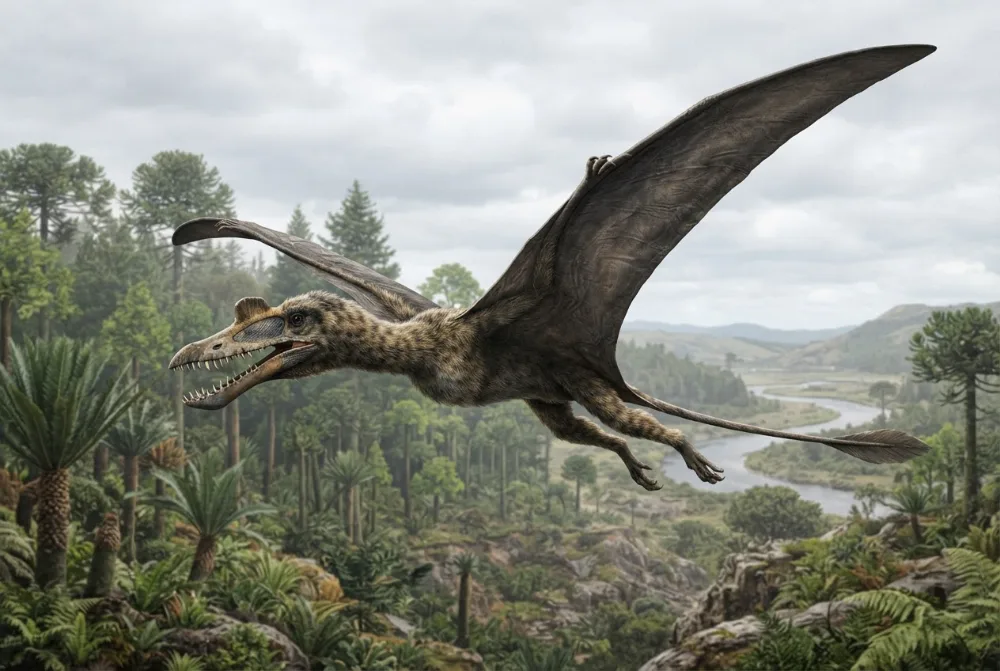
Harpactognathus was a large flying reptile that lived during the Jurassic period. It had a strong, wide beak and sharp teeth for grabbing prey. This pterosaur was one of the biggest of its kind that did not belong to the short-tailed pterodactyl group.1
Cando viviu?
Como era de grande?
Que anchura tiñan as súas ás?
 ás tan anchas coma 1,5 bicicletas en fila⚽podería voar sobre un campo de fútbol enteiro en 7,3 segundos
Como era de grande Harpactognathus comparado CONTIGO?
Só son contas no teu navegador. Non se garda nin se envía nada.
Que velocidade alcanzaba?


Datos curiosos
Harpactognathus is known from only a partial skull and a few other bones, so scientists are still learning about its full appearance.1
It had a crest on the front of its skull that might have been used for display to attract mates or show off to rivals.1
With a wingspan of about 2.5 metres (8.2 feet), Harpactognathus was among the largest non-pterodactyloid pterosaurs.1
Its fossils were found in the Morrison Formation, the same rock layer that contains famous dinosaurs like Stegosaurus and Diplodocus.1
Unlike many other pterosaurs that ate fish, Harpactognathus probably hunted small animals on land near rivers and lakes.1
The name Harpactognathus comes from Greek words meaning 'seizing jaw', which describes its strong, grabbing beak.1
As preguntas máis frecuentes sobre Harpactognathus
?Was Harpactognathus a dinosaur?
No, Harpactognathus was a pterosaur, a flying reptile, not a dinosaur.1
?How big was Harpactognathus?
It had an estimated wingspan of about 2.5 metres (8.2 feet) and a skull length of 280 to 300 millimetres (11 to 12 inches).1
?What did Harpactognathus eat?
It was a terrestrial carnivore that probably hunted small animals on land near rivers and lakes, not fish like many other pterosaurs.1
?Where was Harpactognathus found?
Its fossils were found in the Morrison Formation in Wyoming, USA, the same rock layer as Stegosaurus and Diplodocus.1
?Did Harpactognathus have a crest?
Yes, it had a thin crest on the front of its skull that may have been used for display to attract mates or show off to rivals.1
?When did Harpactognathus live?
It lived during the Kimmeridgian stage of the Late Jurassic period, about 157 to 152 million years ago.1
Cazamitos
Mito: Harpactognathus is often thought to be a dinosaur.
Verdade: Harpactognathus was a pterosaur, a flying reptile that is not a dinosaur.1
Para expertos en dinos
- Nome científico
- Harpactognathus
- Bautizado por
- Carpenter et al. 20032
- Grupo
- Réptiles voadores
- Familia / clado
- Lonchognatha2
- Clasificación
- Pterosauria2
- Idade das rochas
- de 152 a 145 millóns de anos (Kimmeridgian / Tithonian)2
- Formacións rochosas
- Morrison2
- Países
- EUA2
- Rexistros fósiles
- 1 na Paleobiology Database2
- Descubrimento
- Harpactognathus was named in 2003 by paleontologist Kenneth Carpenter and his team. The first fossil, a partial snout, was found in 1996 at Bone Cabin Quarry in Wyoming, USA. The species name honors Joe Gentry, a volunteer who helped with fossil preparation.1
- Aínda en debate
- Scientists are not sure whether Harpactognathus belongs to the scaphognathine or rhamphorhynchine group of pterosaurs, because its fossils are so incomplete.1
De onde veñen os datos
- Harpactognathus (en.wikipedia.org)
- Harpactognathus in The Paleobiology Database (CC BY 4.0): idade, lugares, formacións rochosas, clasificación.
Cada dato desta páxina ten un número que leva á súa fonte. Se nos equivocamos nalgo, sentímolo, somos fans dos dinos, non unha revista científica. Escríbenos a [email protected] e arranxámolo.
 Rex ten fame! Dino Wiki é o proxecto dun pai para o seu fillo, que adora os dinosauros, gratis, sen anuncios e sen rastrexadores. Os adultos poden darlle un petisco a Rex para mantelo en liña.Dálle de comer a Rex
 Pteranodon
 Quetzalcoatlus
 Dorygnathus
 Rhamphorhynchus
 Anhanguera
 Pterodactylus
 Brachiosaurus
 Diplodocus
 Allosaurus
 Brontosaurus
 Compsognathus
 Camarasaurus