 Que dino es ti? O test
 Batalla de dinos
 Carreira de dinos
 Minixogos de dinos
 Álbum de cromos
 Listas TOP de dinos
 Sorpréndeme!
Hatzegopteryx
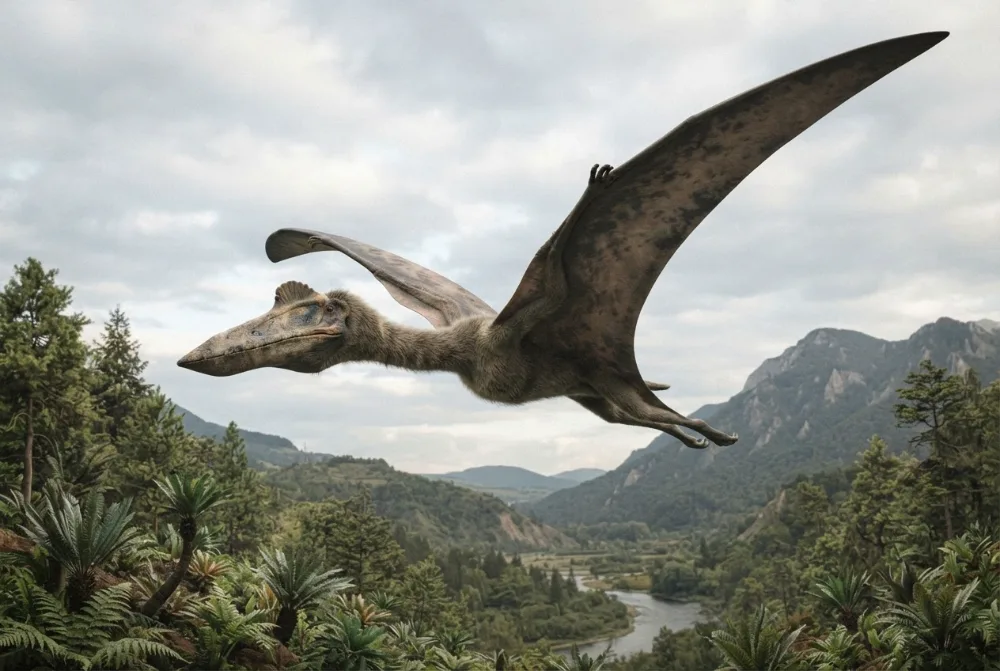
Hatzegopteryx was a giant flying reptile that lived on an island in what is now Romania. It had a huge, strong skull and a short, muscular neck, and it was probably the top predator on its island home.1
Cando viviu?
Como era de grande?
Que anchura tiñan as súas ás?
Canto pesaba?

 ás tan anchas coma 2,5 coches en fila🍉tan pesado coma 50 sandías🧸tan pesado coma 13 nenos de infantil🎒tan pesado coma 8 nenos de primaria⚽podería voar sobre un campo de fútbol enteiro en 3,9 segundos
Como era de grande Hatzegopteryx comparado CONTIGO?
Só son contas no teu navegador. Non se garda nin se envía nada.
Que velocidade alcanzaba?


Datos curiosos
Hatzegopteryx had a skull that was about 2.5 meters (8 feet) long, one of the largest skulls of any non-marine animal.1
Its neck was only 1.5 meters (5 feet) long, which is half the length of other giant pterosaurs with the same wingspan.1
The bones of Hatzegopteryx were filled with tiny pits and hollows, making them lightweight but strong, like Styrofoam.1
It lived on Hațeg Island, a subtropical island in the ancient Tethys Sea, where dinosaurs were small due to island dwarfism.1
Hatzegopteryx was probably the top predator on its island because there were no large meat-eating dinosaurs there.1
The first fossils of Hatzegopteryx were found in the late 1970s by students, but were at first mistaken for dinosaur bones.1
As preguntas máis frecuentes sobre Hatzegopteryx
?How big was Hatzegopteryx?
It had a wingspan of about 10 to 12 meters (33 to 39 feet), making it one of the biggest pterosaurs ever.1
?Could Hatzegopteryx fly?
Yes, it could fly. Its wing bones were similar to other flying pterosaurs, and its skull was lightweight thanks to a spongy internal structure.14
?What did Hatzegopteryx eat?
It was a predator that probably ate dwarf dinosaurs like titanosaurs and iguanodontians, and it could tackle prey too big to swallow whole.1
?Is Hatzegopteryx a dinosaur?
No, it is a pterosaur, which is a flying reptile and not a dinosaur.1
?When did Hatzegopteryx live?
It lived about 72 million years ago, during the Late Cretaceous Period.1
?Where was Hatzegopteryx found?
Its fossils were found in Transylvania, Romania, on what was once Hațeg Island.1
?How heavy was Hatzegopteryx?
Its weight has been estimated at around 250 kilograms (550 pounds).4
?Was Hatzegopteryx bigger than Quetzalcoatlus?
It was about the same size or slightly smaller. Both had wingspans around 10 to 12 meters, but Hatzegopteryx had a shorter, stronger neck.1
?Why did Hatzegopteryx have a short neck?
Its short, thick neck was very strong and helped it hunt large prey, like dwarf dinosaurs, by catching them.15
?Could Hatzegopteryx swim?
Nobody knows for sure, but it probably spent most of its time on land hunting, like other azhdarchid pterosaurs.1
Cazamitos
Mito: Hatzegopteryx was too heavy to fly.
Verdade: Its bones had a spongy, lightweight internal structure that made the skull strong but light enough for flight.1
Para expertos en dinos
- Nome científico
- Hatzegopteryx
- Bautizado por
- Buffetaut et al. 20026
- Grupo
- Réptiles voadores
- Familia / clado
- Azhdarchidae6
- Clasificación
- Pterosauria > Pterodactyloidea > Azhdarchidae6
- Idade das rochas
- de 72 a 66 millóns de anos (Maastrichtian)6
- Formacións rochosas
- Densuș-Ciula, Sebeş, Râul Mare6
- Países
- Romanía6
- Rexistros fósiles
- 4 na Paleobiology Database6
- Descubrimento
- Hatzegopteryx was named in 2002 by paleontologists Eric Buffetaut, Dan Grigorescu, and Zoltan Csiki, based on skull fragments and a wing bone found in Romania.1
- Aínda en debate
- Scientists are not sure exactly how wide its wingspan was, with estimates ranging from 10 to 12 meters (33 to 39 feet).1
De onde veñen os datos
- Hatzegopteryx (en.wikipedia.org)
- PBDB Taxon (paleobiodb.org)
- A new giant pterosaur with a robust skull from the latest cretaceous of Romania (pubmed.ncbi.nlm.nih.gov)
- Eons | When a Giant Pterosaur Ruled the European Islands | Season 4 | Episode 23 | PBS (pbs.org)
- Neck biomechanics indicate that giant Transylvanian azhdarchid pterosaurs were short-necked arch predators (pmc.ncbi.nlm.nih.gov)
- Hatzegopteryx in The Paleobiology Database (CC BY 4.0): idade, lugares, formacións rochosas, clasificación.
Cada dato desta páxina ten un número que leva á súa fonte. Se nos equivocamos nalgo, sentímolo, somos fans dos dinos, non unha revista científica. Escríbenos a [email protected] e arranxámolo.
 Rex ten fame! Dino Wiki é o proxecto dun pai para o seu fillo, que adora os dinosauros, gratis, sen anuncios e sen rastrexadores. Os adultos poden darlle un petisco a Rex para mantelo en liña.Dálle de comer a Rex
 Pteranodon
 Quetzalcoatlus
 Dorygnathus
 Rhamphorhynchus
 Anhanguera
 Pterodactylus
 Tyrannosaurus
 Triceratops
 Velociraptor
 Spinosaurus
 Ankylosaurus
 Parasaurolophus