 Que dino es ti? O test
 Batalla de dinos
 Carreira de dinos
 Minixogos de dinos
 Álbum de cromos
 Listas TOP de dinos
 Sorpréndeme!
Henodus
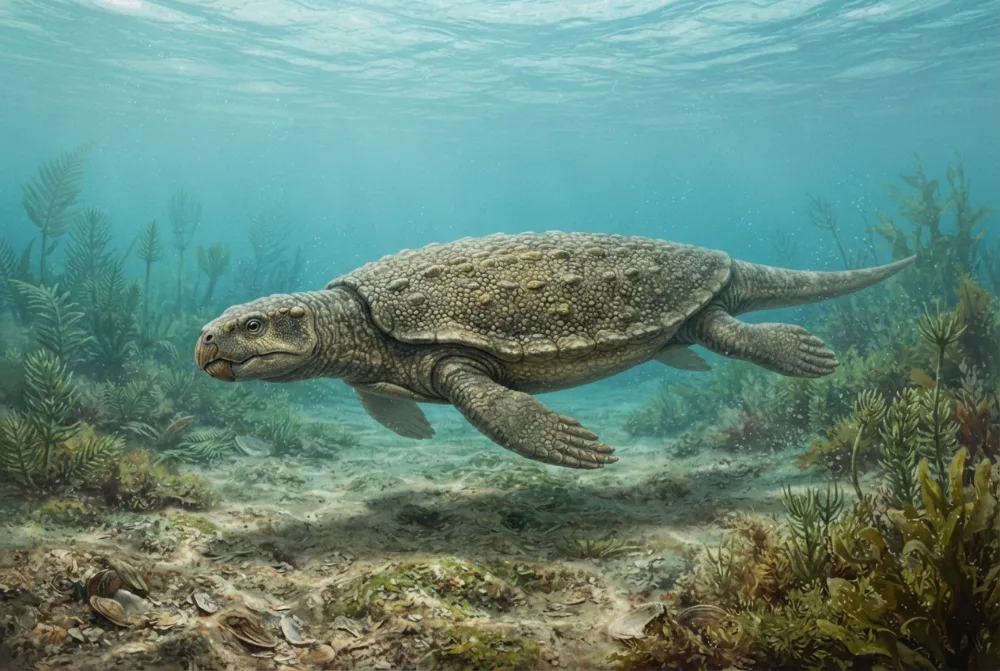
Henodus was a strange reptile that looked a bit like a turtle, but it wasn't one. It lived in shallow, salty lagoons during the Late Triassic, about 237 to 227 million years ago. It had a flat shell and a beak, and it probably used its special jaws to filter food from the water.13
Cando viviu?
Como era de grande?
Canto medía de longo?
 tan longo coma 2 gatos domésticos do fociño á cola🍌tan longo coma 6 plátanos postos un tras outro🏊podería nadar o longo dunha piscina grande (50 m) en 30 segundos
Como era de grande Henodus comparado CONTIGO?
Só son contas no teu navegador. Non se garda nin se envía nada.
Que velocidade alcanzaba?


Datos curiosos
Henodus is the only placodont found in rocks that were not from the open sea, so it probably lived in brackish or freshwater lagoons.1
Its shell was made of many small bony plates that formed a mosaic pattern, unlike a turtle's shell.1
Henodus had only one tooth on each side of its mouth, and the rest of its jaws were a beak.1
It had baleen-like denticles along its jaws, similar to some whales, which helped it filter small food from the water.1
Its weak limbs suggest it spent little or no time on land.1
Scientists think Henodus could close its jaws very quickly, which helped it catch small prey.1
Small snail shells were found near the skulls of Henodus, so it might have eaten those tiny snails.2
As preguntas máis frecuentes sobre Henodus
?How big was Henodus?
About 1 metre (3.3 feet) long.1
?What did Henodus eat?
It probably ate tiny snails, small crustaceans, and maybe plants. It had a beak and baleen-like denticles to filter food from the water.12
?Was Henodus a dinosaur?
No, it was a marine reptile called a placodont, not a dinosaur.1
?Could Henodus walk on land?
Probably not much. Its weak limbs suggest it spent little or no time on land.1
?When did Henodus live?
It lived during the Late Triassic period, about 237 to 227 million years ago.1
?Why did Henodus have a shell?
Its shell was made of many small bony plates that formed a mosaic pattern, and it probably protected Henodus from predators.1
Cazamitos
Mito: Henodus was a turtle.
Verdade: Henodus looked like a turtle, but it was a different kind of reptile called a placodont. Its shell was made of many more bones, and its limbs were not inside its ribcage like a turtle's.1
Para expertos en dinos
- Nome científico
- Henodus
- Bautizado por
- Huene 19363
- Grupo
- Réptiles mariños
- Familia / clado
- Henodontidae3
- Clasificación
- Placodontia > Sauropterygia3
- Idade das rochas
- de 237 a 227 millóns de anos (Carnian)3
- Formacións rochosas
- Grabfeld3
- Países
- Alemaña3
- Rexistros fósiles
- 1 na Paleobiology Database3
- Descubrimento
- Henodus was named by Friedrich von Huene in 1936. The first fossils were found in the Grabfeld Formation near Tübingen, Germany.31
- Aínda en debate
- Scientists are not sure exactly what Henodus ate. Some think it was a filter feeder, others think it ate plants, and some think it ate small animals. It might have done all of these.2
De onde veñen os datos
- Henodus (en.wikipedia.org)
- Dentition and feeding in Placodontia: tooth replacement in Henodus chelyops | BMC Ecology and Evolution | Springer Nature Link (link.springer.com)
- Henodus in The Paleobiology Database (CC BY 4.0): idade, lugares, formacións rochosas, clasificación.
Cada dato desta páxina ten un número que leva á súa fonte. Se nos equivocamos nalgo, sentímolo, somos fans dos dinos, non unha revista científica. Escríbenos a [email protected] e arranxámolo.
 Rex ten fame! Dino Wiki é o proxecto dun pai para o seu fillo, que adora os dinosauros, gratis, sen anuncios e sen rastrexadores. Os adultos poden darlle un petisco a Rex para mantelo en liña.Dálle de comer a Rex
 Nothosaurus
 Placodus
 Lariosaurus
 Cyamodus
 Cymatosaurus
 Proneusticosaurus
 Massospondylus
 Plateosaurus
 Coelophysis
 Podokesaurus
 Thecodontosaurus
 Eudimorphodon