 Que dino es ti? O test
 Batalla de dinos
 Carreira de dinos
 Minixogos de dinos
 Álbum de cromos
 Listas TOP de dinos
 Sorpréndeme!
Placodus
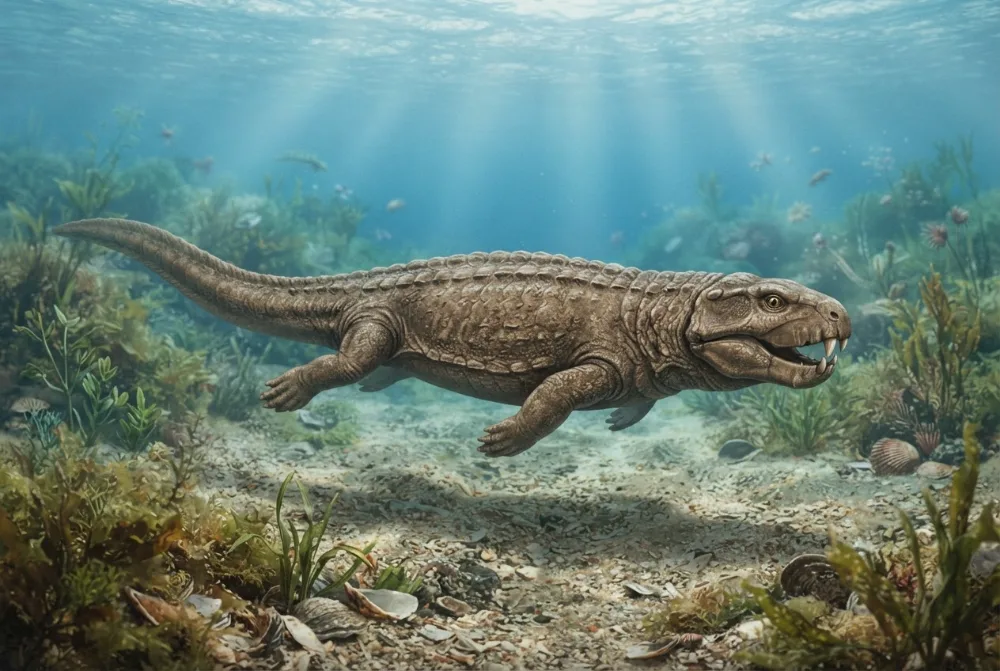
Placodus was a marine reptile that lived about 240 million years ago, during the Middle Triassic. It had a stocky body, a long tail, and a heavy skull with flat teeth for crushing shellfish. It swam in shallow seas and probably spent most of its time on the seafloor looking for food.1
Cando viviu?
Como era de grande?
Canto medía de longo?
 tan longo coma 3 cans do fociño á cola🍌tan longo coma 17 plátanos postos un tras outro🏊podería nadar o longo dunha piscina grande (50 m) en 11 segundos
Como era de grande Placodus comparado CONTIGO?
Só son contas no teu navegador. Non se garda nin se envía nada.
Que velocidade alcanzaba?


Datos curiosos
Placodus had a rigid body because the bones in its spine were dovetailed together, making its trunk stiff.1
Its belly was covered with special armor made of bent, right-angled abdominal ribs, and it had a row of bony knobs above its backbone.1
Placodus was negatively buoyant, meaning it was heavy and could easily stay on the seafloor without floating up.1
Before scientists knew what Placodus looked like, its teeth were mistaken for fish teeth.1
Placodus was slow and clumsy on land because of its heavy body armor, so it probably only came ashore to lay eggs.1
Its short legs probably ended in webbed feet, and it used its flattened tail to push through the water.1
As preguntas máis frecuentes sobre Placodus
?How big was Placodus?
About 2.5 to 3 metres (8.2 to 9.8 ft) long.1
?What did Placodus eat?
Shellfish like bivalves, plus other hard-shelled prey such as molluscs, brachiopods and crustaceans. It used its chisel-like front teeth to pluck them from the sea floor and its broad, flat back teeth to crush their shells.1
?Was Placodus a dinosaur?
No, Placodus was a marine reptile called a placodont, not a dinosaur. It lived in the sea during the Triassic period.12
?Could Placodus swim?
Yes, it swam using its flattened tail and short legs that probably ended in webbed feet. It was not as good at swimming as later marine reptiles like plesiosaurs, but it was comfortable in the water.1
?Why did Placodus have a rigid body?
Its spine had dovetailed bones that locked together, making its trunk stiff. This helped it stay heavy on the sea floor so it could feed without floating up.1
?When did Placodus live?
About 240 million years ago, in the Middle Triassic period.1
Para expertos en dinos
- Nome científico
- Placodus
- Bautizado por
- Agassiz 18333
- Grupo
- Réptiles mariños
- Familia / clado
- Placodontidae3
- Clasificación
- Placodontia > Sauropterygia3
- Idade das rochas
- de 251 a 227 millóns de anos ()3
- Formacións rochosas
- Jena, Wellenkalk, Vossenveld3
- Países
- Alemaña, Israel, Polonia, Países Baixos, Italia, China3
- Rexistros fósiles
- 34 na Paleobiology Database3
- Tamén coñecido como
- Anomosaurus, Crurosaurus (nomes antigos que agora contan como o mesmo animal)3
- Descubrimento
- Placodus was named by the Swiss naturalist Louis Agassiz in 1833. He originally thought the fossils were fish teeth.13
De onde veñen os datos
- Placodus (en.wikipedia.org)
- Fossil Focus: Placodonts – PALAEONTOLOGY[online] (palaeontologyonline.com)
- Placodus in The Paleobiology Database (CC BY 4.0): idade, lugares, formacións rochosas, clasificación.
Cada dato desta páxina ten un número que leva á súa fonte. Se nos equivocamos nalgo, sentímolo, somos fans dos dinos, non unha revista científica. Escríbenos a [email protected] e arranxámolo.
 Rex ten fame! Dino Wiki é o proxecto dun pai para o seu fillo, que adora os dinosauros, gratis, sen anuncios e sen rastrexadores. Os adultos poden darlle un petisco a Rex para mantelo en liña.Dálle de comer a Rex
 Nothosaurus
 Lariosaurus
 Cyamodus
 Cymatosaurus
 Proneusticosaurus
 Simosaurus
 Chonespondylus
 Cymbospondylus
 Phalarodon
 Mixosaurus
 Chaohusaurus
 Chensaurus