 Que dino es ti? O test
 Batalla de dinos
 Carreira de dinos
 Minixogos de dinos
 Álbum de cromos
 Listas TOP de dinos
 Sorpréndeme!
Imparavis
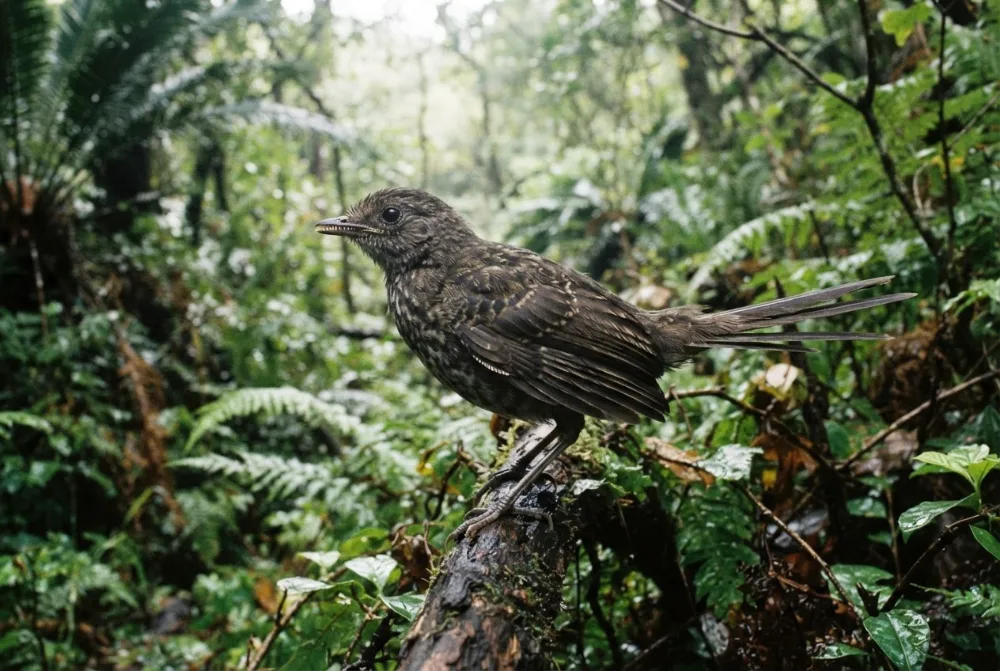
Imparavis was a tiny, toothless bird that lived about 120 million years ago in what is now China. It was one of the first of its kind to lose its teeth, and it had strong wings that might have let it flap really fast, like a modern quail or puffin.2
Cando viviu?
Como era de grande?
Canto medía de longo?
Canto medía de alto?
estimación
Como era de grande Imparavis comparado CONTIGO?
Só son contas no teu navegador. Non se garda nin se envía nada.
Que velocidade alcanzaba?


Datos curiosos
Imparavis is the earliest known toothless bird from a group called enantiornithines, or 'opposite birds'. Scientists used to think toothlessness in this group appeared only about 72 million years ago, but Imparavis pushes that back by 48 to 50 million years.2
Its name means 'odd bird' in Latin, and it was named after the famous naturalist Sir David Attenborough.1
Imparavis had a large bony crest on its upper arm bone where muscles attached. This might have let it flap its wings with extra power, similar to modern birds like puffins or quails.2
The fossil was found by an amateur collector and donated to the Shandong Tianyu Museum of Nature in China.2
Imparavis lived alongside many other early birds and dinosaurs in the Early Cretaceous period, about 120 million years ago.13
Unlike most other enantiornithines, which lived mainly in trees, Imparavis might have spent time on the ground foraging for food, like a modern robin.2
Cazamitos
Mito: All early birds had teeth.
Verdade: Imparavis shows that some early birds, like enantiornithines, lost their teeth much earlier than scientists thought. It was toothless about 120 million years ago.2
Para expertos en dinos
- Nome científico
- Imparavis
- Bautizado por
- Wang et al. 20244
- Grupo
- Aves primitivas
- Familia / clado
- Enantiornithes4
- Clasificación
- Theropoda > Avialae4
- Idade das rochas
- de 121 a 120 millóns de anos (Aptian)4
- Formacións rochosas
- Jiufotang4
- Países
- China4
- Rexistros fósiles
- 1 na Paleobiology Database4
- Descubrimento
- Imparavis was named in 2024 by Wang and colleagues. The fossil was found by an amateur collector near Toudaoyingzi village in China and later studied by scientists at the Field Museum and Shandong Tianyu Museum.12
- Aínda en debate
- Scientists are still debating why Imparavis lost its teeth and what it ate, since its toothless beak and lack of a gizzard make its diet unclear.2
De onde veñen os datos
- Imparavis (en.wikipedia.org)
- Fossil named “Attenborough’s strange bird” was the first of its kind without teeth - Field Museum (fieldmuseum.org)
- PBDB Taxon (paleobiodb.org)
- Imparavis in The Paleobiology Database (CC BY 4.0): idade, lugares, formacións rochosas, clasificación.
Cada dato desta páxina ten un número que leva á súa fonte. Se nos equivocamos nalgo, sentímolo, somos fans dos dinos, non unha revista científica. Escríbenos a [email protected] e arranxámolo.
 Rex ten fame! Dino Wiki é o proxecto dun pai para o seu fillo, que adora os dinosauros, gratis, sen anuncios e sen rastrexadores. Os adultos poden darlle un petisco a Rex para mantelo en liña.Dálle de comer a Rex
 Archaeopteryx
 Hesperornis
 Ichthyornis
 Baptornis
 Jurapteryx
 Gobipteryx
 Stegosaurus
 Iguanodon
 Giganotosaurus
 Microraptor
 Deinonychus
 Baryonyx