 Que dino es ti? O test
 Batalla de dinos
 Carreira de dinos
 Minixogos de dinos
 Álbum de cromos
 Listas TOP de dinos
 Sorpréndeme!
Leptonectes
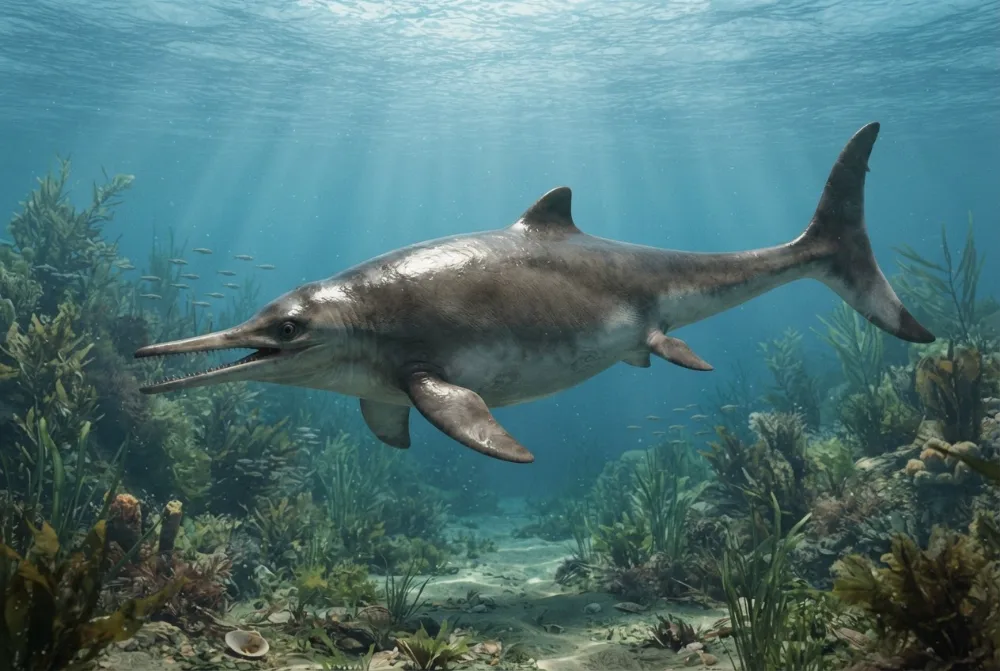
Leptonectes was a sleek, long-snouted marine reptile that swam in the seas during the time of the dinosaurs. It was not a dinosaur, but a type of ichthyosaur, with a body shaped like a fish and flippers for steering. It hunted small sea creatures with its slender jaws.12
Cando viviu?
Como era de grande?
Canto medía de longo?
 tan longo coma 6 cans do fociño á cola🍌tan longo coma 33 plátanos postos un tras outro🏊podería nadar o longo dunha piscina grande (50 m) en 4,2 segundos
Como era de grande Leptonectes comparado CONTIGO?
Só son contas no teu navegador. Non se garda nin se envía nada.
Que velocidade alcanzaba?


Datos curiosos
Leptonectes had a very long and slender snout, which is why its name means 'slender swimmer'.1
The name Leptonectes was proposed in 1996 to replace the older name Leptopterygius, because that name was already used for another animal.1
Leptonectes lived from about 205.7 to 182.9 million years ago, during the Late Triassic and Early Jurassic periods.2
Its front flippers were longer than its back flippers, but not twice as long.2
Leptonectes had large eyes and a slightly raised area on its skull near the cheekbones.2
The bones in its flippers were rounded and spaced apart, which may have made its flippers flexible.2
Leptonectes gave birth to live young, just like other ichthyosaurs, instead of laying eggs.2
As preguntas máis frecuentes sobre Leptonectes
?How big was Leptonectes?
The biggest species, Leptonectes solei, was about 5 to 6 metres (16 to 20 ft) long. The type species, L. tenuirostris, reached 4 metres (13 ft), and L. moorei was about 3 metres (9.8 ft).3
?Was Leptonectes a dinosaur?
No, Leptonectes was not a dinosaur. It was an ichthyosaur, a marine reptile that lived in the sea at the same time as dinosaurs.3
?What did Leptonectes eat?
Leptonectes hunted small sea creatures with its long, slender jaws. Its sharp teeth helped it catch fish and other marine animals.3
Cazamitos
Mito: Some people think Leptonectes was a dinosaur because it lived during the time of dinosaurs.
Verdade: Leptonectes was not a dinosaur. It was a marine reptile called an ichthyosaur, which lived in the ocean.2
Para expertos en dinos
- Nome científico
- Leptonectes
- Bautizado por
- McGowan 19964
- Grupo
- Ictiosauros
- Familia / clado
- Neoichthyosauria4
- Clasificación
- Ichthyosauria > Ichthyosauromorpha4
- Idade das rochas
- de 206 a 183 millóns de anos (Rhaetian / Toarcian)4
- Formacións rochosas
- Charmouth Mudstone, Blue Lias, Posidonia Shale4
- Países
- Reino Unido, Suíza, Alemaña, Bélxica, Austria4
- Rexistros fósiles
- 12 na Paleobiology Database4
- Tamén coñecido como
- Leptopterygius (nomes antigos que agora contan como o mesmo animal)4
- Descubrimento
- The name Leptonectes was created by Chris McGowan in 1996 to replace the old name Leptopterygius. The first species, Leptonectes tenuirostris, was originally named by Conybeare in 1822.1
- Aínda en debate
- Scientists still debate exactly which species belong to Leptonectes and how they are related to other ichthyosaurs.1
De onde veñen os datos
- The taxonomic status of Leptopterygius Huene, 1922 (Reptilia: Ichthyosauria) (cdnsciencepub.com)
- PBDB Taxon (paleobiodb.org)
- Leptonectes (en.wikipedia.org)
- Leptonectes in The Paleobiology Database (CC BY 4.0): idade, lugares, formacións rochosas, clasificación.
Cada dato desta páxina ten un número que leva á súa fonte. Se nos equivocamos nalgo, sentímolo, somos fans dos dinos, non unha revista científica. Escríbenos a [email protected] e arranxámolo.
 Rex ten fame! Dino Wiki é o proxecto dun pai para o seu fillo, que adora os dinosauros, gratis, sen anuncios e sen rastrexadores. Os adultos poden darlle un petisco a Rex para mantelo en liña.Dálle de comer a Rex
 Ichthyosaurus
 Platypterygius
 Stenopterygius
 Khudiakovia
 Ophthalmosaurus
 Chonespondylus
 Dilophosaurus
 Dorygnathus
 Lufengosaurus
 Scutellosaurus
 Yunnanosaurus
 Sinosaurus