 Que dino es ti? O test
 Batalla de dinos
 Carreira de dinos
 Minixogos de dinos
 Álbum de cromos
 Listas TOP de dinos
 Sorpréndeme!
Linhevenator
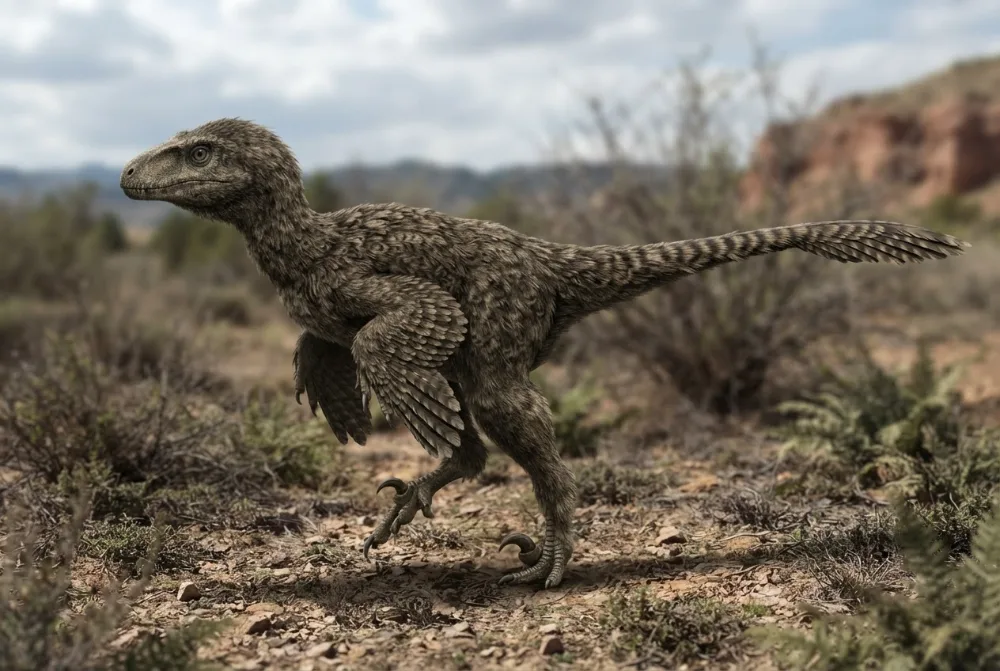
Linhevenator was a small, bird-like dinosaur that lived in what is now China. It had short, strong arms and a big claw on its foot, just like its cousins the raptors. It probably used its arms and claws to catch food.1
Cando viviu?
Como era de grande?
Canto medía de longo?
Canto medía de alto?
estimación
Canto pesaba?

 tan longo coma 2,5 cans do fociño á cola🍌tan longo coma 15 plátanos postos un tras outro🍉tan pesado coma 5 sandías🏃podería correr 100 metros en 8,2 segundos (o humano máis rápido necesita 9,6)
Como era de grande Linhevenator comparado CONTIGO?
Só son contas no teu navegador. Non se garda nin se envía nada.
Que velocidade alcanzaba?


Datos curiosos
Linhevenator had a humerus, the upper arm bone, that was much shorter and sturdier than in most other troodontids.1
Its second toe had a big, curved claw, similar to the killer claw of dromaeosaurids like Velociraptor.1
The deltopectoral crest, a bump on the upper arm bone where muscles attach, was large, suggesting strong arm muscles.1
Linhevenator lived about 83 to 72 million years ago, during the Campanian age of the Late Cretaceous.2
The only known skeleton is partly articulated, meaning some bones were still connected when found.1
Scientists think Linhevenator might have used its strong arms for digging or climbing, not just for catching prey.1
As preguntas máis frecuentes sobre Linhevenator
?How big was Linhevenator?
Linhevenator was about 1.9 to 2.7 metres long (6.2 to 8.9 feet), with an average of 2.2 metres (7.2 feet). It weighed around 23 kilograms (51 pounds).3
?What did Linhevenator eat?
Scientists are not sure. Some think troodontids like Linhevenator ate plants because of their teeth, while others think they were meat-eaters. The strong arms and big claw suggest it could catch prey.43
?Did Linhevenator have feathers?
The sources do not say for sure, but troodontids were bird-like dinosaurs closely related to birds, so many scientists think they probably had feathers.3
?When did Linhevenator live?
Linhevenator lived about 83 to 72 million years ago, during the Campanian age of the Late Cretaceous.3
Cazamitos
Mito: Some people think all raptors had long, grasping arms.
Verdade: Linhevenator shows that some troodontids had short, strong arms, so not all raptor-like dinosaurs had long arms.1
Para expertos en dinos
- Nome científico
- Linhevenator
- Bautizado por
- Xu et al. 20115
- Grupo
- Raptores
- Familia / clado
- Troodontidae5
- Clasificación
- Theropoda > Troodontidae5
- Idade das rochas
- de 84 a 72 millóns de anos (Campanian)5
- Formacións rochosas
- Wulansuhai5
- Países
- China5
- Rexistros fósiles
- 1 na Paleobiology Database5
- Descubrimento
- Linhevenator was named by Xu and colleagues in 2011 based on a partial skeleton found in the Wulansuhai Formation in Inner Mongolia, China.21
- Aínda en debate
- Scientists are not sure if Linhevenator was mainly a meat-eater or if it also ate plants, because its teeth have large serrations that some researchers link to herbivory.1
De onde veñen os datos
- A Short-Armed Troodontid Dinosaur from the Upper (ivpp.cas.cn)
- PBDB Taxon (paleobiodb.org)
- Linhevenator (en.wikipedia.org)
- A Short-Armed Troodontid Dinosaur from the Upper Cretaceous of Inner Mongolia and Its Implications for Troodontid Evolution | PLOS One (journals.plos.org)
- Linhevenator in The Paleobiology Database (CC BY 4.0): idade, lugares, formacións rochosas, clasificación.
Cada dato desta páxina ten un número que leva á súa fonte. Se nos equivocamos nalgo, sentímolo, somos fans dos dinos, non unha revista científica. Escríbenos a [email protected] e arranxámolo.
 Rex ten fame! Dino Wiki é o proxecto dun pai para o seu fillo, que adora os dinosauros, gratis, sen anuncios e sen rastrexadores. Os adultos poden darlle un petisco a Rex para mantelo en liña.Dálle de comer a Rex
 Velociraptor
 Microraptor
 Deinonychus
 Asiamericana
 Richardoestesia
 Saurornitholestes
 Tyrannosaurus
 Triceratops
 Spinosaurus
 Ankylosaurus
 Parasaurolophus
 Pteranodon