 Que dino es ti? O test
 Batalla de dinos
 Carreira de dinos
 Minixogos de dinos
 Álbum de cromos
 Listas TOP de dinos
 Sorpréndeme!
Maaradactylus
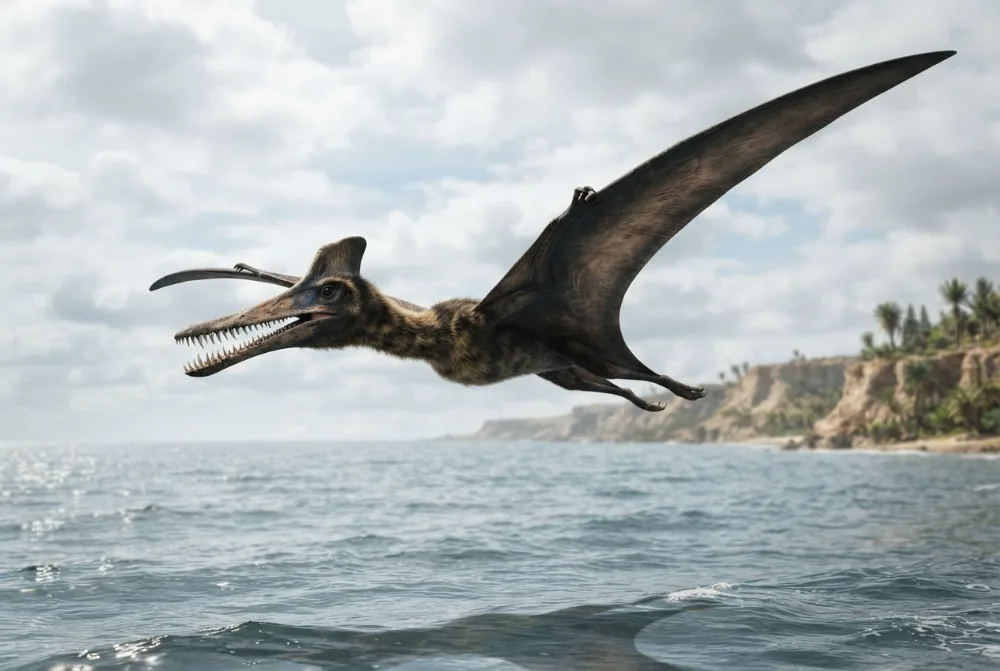
Maaradactylus was a flying reptile with a long, tooth-filled snout and a tall crest on its head. It glided over the ancient sea in what is now Brazil, scooping up fish with its many sharp teeth. Its wings were long and thin, perfect for soaring above the water.1
Cando viviu?
Como era de grande?
Que anchura tiñan as súas ás?
 ás tan anchas coma 3 bicicletas en fila⚽podería voar sobre un campo de fútbol enteiro en 5,1 segundos
Como era de grande Maaradactylus comparado CONTIGO?
Só son contas no teu navegador. Non se garda nin se envía nada.
Que velocidade alcanzaba?


Datos curiosos
The skull of Maaradactylus is one of the largest of any anhanguerid pterosaur, measuring 75 centimetres (30 inches) long.1
It had at least 36 pairs of teeth in its upper jaw, more than any other anhanguerid pterosaur.1
The tip of its snout was expanded and rounded, a bit like a spoon, and the front teeth pointed forward while the rest pointed downward.1
Maaradactylus lived during the Early Cretaceous period, about 119 to 113 million years ago.4
The small teeth at the back of its mouth were arranged in triplets, a feature unique to this animal.1
As preguntas máis frecuentes sobre Maaradactylus
?Was Maaradactylus a dinosaur?
No, Maaradactylus was a pterosaur, a flying reptile that lived during the time of dinosaurs. It is not a dinosaur.1
?How big was Maaradactylus?
Its skull was 75 centimetres long, one of the largest of any anhanguerid pterosaur. The rest of its body is not known, but it was a large flying animal.1
?What did Maaradactylus eat?
It likely ate fish, scooping them up with its long, tooth-filled snout as it glided over the sea.1
?When did Maaradactylus live?
It lived during the Early Cretaceous period, about 119 to 113 million years ago, in what is now Brazil.1
Para expertos en dinos
- Nome científico
- Maaradactylus
- Bautizado por
- Bantim et al. 20144
- Grupo
- Réptiles voadores
- Familia / clado
- Anhangueridae4
- Clasificación
- Pterosauria > Pterodactyloidea4
- Idade das rochas
- de 120 a 113 millóns de anos (Aptian)4
- Formacións rochosas
- Romualdo4
- Países
- Brasil4
- Rexistros fósiles
- 3 na Paleobiology Database4
- Descubrimento
- The first fossil, a skull with the first two neck bones, was found in 2010 in the Romualdo Formation of Brazil. It was named Maaradactylus kellneri in 2014 by Renan Bantim and colleagues, honoring pterosaur expert Alexander Kellner.12
- Aínda en debate
- Scientists are not sure if the species once called Coloborhynchus spielbergi really belongs to Maaradactylus or to another genus like Anhanguera.1
De onde veñen os datos
- Maaradactylus (en.wikipedia.org)
- A new toothed pterosaur (Pterodactyloidea: Anhangueridae) from the Early Cretaceous Romualdo Formation, NE Brazil (mapress.com)
- Maaradactylus kellneri - Atlas Virtual da Pré-História (atlasvirtual.com.br)
- Maaradactylus in The Paleobiology Database (CC BY 4.0): idade, lugares, formacións rochosas, clasificación.
Cada dato desta páxina ten un número que leva á súa fonte. Se nos equivocamos nalgo, sentímolo, somos fans dos dinos, non unha revista científica. Escríbenos a [email protected] e arranxámolo.
 Rex ten fame! Dino Wiki é o proxecto dun pai para o seu fillo, que adora os dinosauros, gratis, sen anuncios e sen rastrexadores. Os adultos poden darlle un petisco a Rex para mantelo en liña.Dálle de comer a Rex
 Pteranodon
 Quetzalcoatlus
 Dorygnathus
 Rhamphorhynchus
 Anhanguera
 Pterodactylus
 Stegosaurus
 Iguanodon
 Archaeopteryx
 Giganotosaurus
 Microraptor
 Deinonychus