 Que dino es ti? O test
 Batalla de dinos
 Carreira de dinos
 Minixogos de dinos
 Álbum de cromos
 Listas TOP de dinos
 Sorpréndeme!
Mythunga
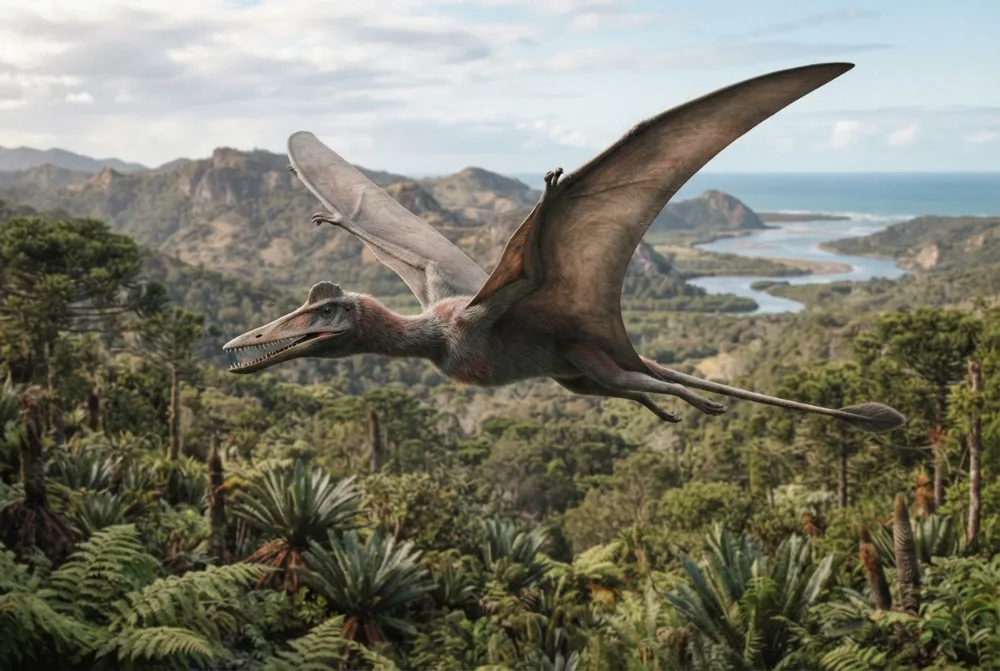
Mythunga was a big flying reptile that soared over an ancient sea in Australia. It had a long, hollow snout and sharp teeth for catching fish. It was one of the largest pterosaurs from its region!1
Cando viviu?
Como era de grande?
Que anchura tiñan as súas ás?
 ás tan anchas coma 2,5 bicicletas en fila⚽podería voar sobre un campo de fútbol enteiro en 5,6 segundos
Como era de grande Mythunga comparado CONTIGO?
Só son contas no teu navegador. Non se garda nin se envía nada.
Que velocidade alcanzaba?


Datos curiosos
Mythunga is the most complete pterosaur skull known from Australasia, even though only part of the skull and jaws are preserved.1
Its snout was hollow and box-like inside, with thin-walled chambers separated by struts, which made the skull light for flying.1
Mythunga had only three teeth between the last enlarged tooth and the opening in its snout, and these teeth were spaced widely apart.1
The fossil was found in 1991 by Philip Gilmore, and it may be from a young animal, so adults could have been even larger.1
Mythunga lived near the coast of the Eromanga Sea, a shallow inland sea that covered central Australia during the Early Cretaceous.1
Its teeth interlocked in a way typical of fish-eating pterosaurs, and the wide spacing may have helped it catch large fish.1
As preguntas máis frecuentes sobre Mythunga
?How big was Mythunga?
Its wingspan was between 4 and 6 metres (13 to 20 ft). Its skull was about 80 centimetres to 1 metre (2.6 to 3.3 ft) long.21
?What did Mythunga eat?
It ate fish. Its interlocking teeth were typical of fish-eating pterosaurs, and the wide spacing may have helped it catch large fish.1
Cazamitos
Mito: Some people think Mythunga was a dinosaur.
Verdade: Mythunga was a pterosaur, a flying reptile that is not a dinosaur. Pterosaurs are a separate group of reptiles that evolved flight independently.1
Para expertos en dinos
- Nome científico
- Mythunga
- Bautizado por
- Molnar and Thulborn 20073
- Grupo
- Réptiles voadores
- Familia / clado
- Anhangueridae3
- Clasificación
- Pterosauria > Pterodactyloidea3
- Idade das rochas
- de 106 a 100 millóns de anos (Albian)3
- Formacións rochosas
- Toolebuc3
- Países
- Australia3
- Rexistros fósiles
- 1 na Paleobiology Database3
- Descubrimento
- The partial skull was discovered in 1991 by Philip Gilmore on Dunluce Station in Queensland, Australia. It was named by Molnar and Thulborn in 2007.13
- Aínda en debate
- Scientists are not sure if Mythunga had a crest on its head, because the top of the snout is missing from the fossil.1
De onde veñen os datos
- Mythunga camara - The Australian Museum (australian.museum)
- Mythunga (en.wikipedia.org)
- Mythunga in The Paleobiology Database (CC BY 4.0): idade, lugares, formacións rochosas, clasificación.
Cada dato desta páxina ten un número que leva á súa fonte. Se nos equivocamos nalgo, sentímolo, somos fans dos dinos, non unha revista científica. Escríbenos a [email protected] e arranxámolo.
 Rex ten fame! Dino Wiki é o proxecto dun pai para o seu fillo, que adora os dinosauros, gratis, sen anuncios e sen rastrexadores. Os adultos poden darlle un petisco a Rex para mantelo en liña.Dálle de comer a Rex
 Pteranodon
 Quetzalcoatlus
 Dorygnathus
 Rhamphorhynchus
 Anhanguera
 Pterodactylus
 Stegosaurus
 Iguanodon
 Archaeopteryx
 Giganotosaurus
 Microraptor
 Deinonychus