 Que dino es ti? O test
 Batalla de dinos
 Carreira de dinos
 Minixogos de dinos
 Álbum de cromos
 Listas TOP de dinos
 Sorpréndeme!
Paludidraco
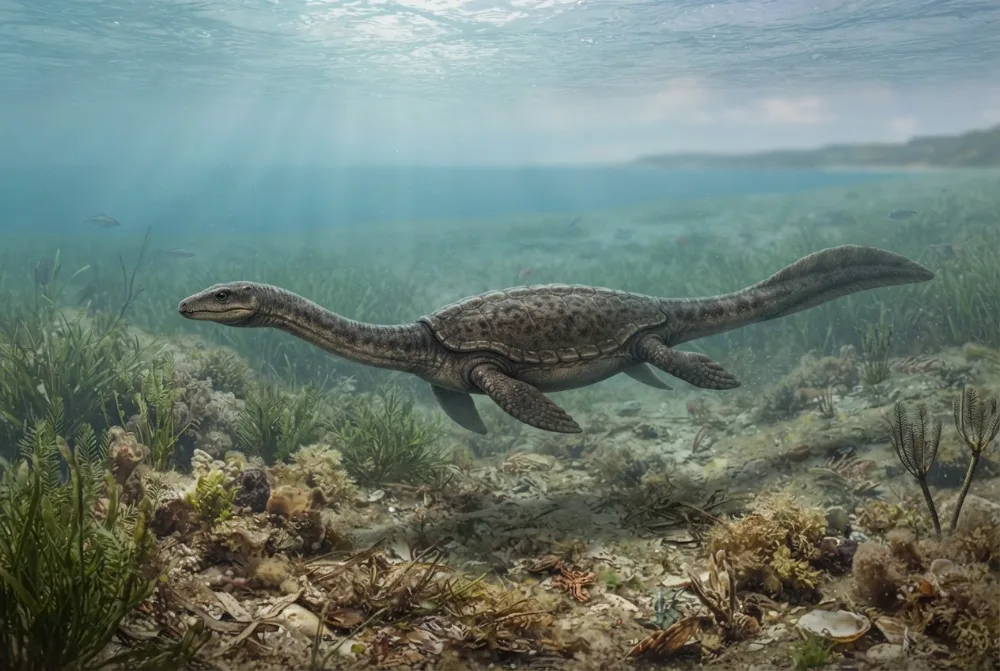
Paludidraco was a strange marine reptile that lived in shallow seas over 200 million years ago. It had a very heavy, dense skeleton that helped it stay underwater without swimming much, like a manatee. Its jaws were weak and filled with many tiny teeth, so it probably sucked up soft plants or small animals from the seafloor.2
Cando viviu?
Como era de grande?
Canto medía de longo?
 tan longo coma 2,5 cans do fociño á cola🍌tan longo coma 14 plátanos postos un tras outro🏊podería nadar o longo dunha piscina grande (50 m) en 8,6 segundos
Como era de grande Paludidraco comparado CONTIGO?
Só son contas no teu navegador. Non se garda nin se envía nada.
Que velocidade alcanzaba?


Datos curiosos
Paludidraco had an extremely heavy, pachyostotic skeleton, meaning its bones were very thick and dense. This helped it float at shallow depths without using much energy, just like modern manatees.2
Its jaws were very slender and weak, and its teeth were small, curved, and set in a groove (pleurodont implantation). This is very different from most other marine reptiles of its time.1
Paludidraco had more than 15 teeth in its premaxilla (the front part of the upper jaw), which is a unique feature among its family, Simosauridae.1
Scientists think Paludidraco was not an active predator. Its weak jaws could not catch struggling prey, and its heavy body made it slow and not very maneuverable.1
The name Paludidraco comes from Latin words meaning 'marshy dragon', because its fossils were found near a reservoir called El Atance in Spain.1
Paludidraco lived during the Late Triassic period, about 237 to 205 million years ago, in what is now central Spain.4
Para expertos en dinos
- Nome científico
- Paludidraco
- Bautizado por
- de Miguel Chaves et al. 20184
- Grupo
- Réptiles mariños
- Familia / clado
- Simosauridae4
- Clasificación
- Nothosauria > Sauropterygia4
- Idade das rochas
- de 237 a 206 millóns de anos (Carnian / Norian)4
- Formacións rochosas
- Keuper4
- Países
- España4
- Rexistros fósiles
- 1 na Paleobiology Database4
- Descubrimento
- Paludidraco multidentatus was named in 2018 by scientists de Miguel Chaves, Ortega, and Pérez-García. They described it from two well-preserved skeletons found at the El Atance site in central Spain.41
- Aínda en debate
- Scientists are not sure whether Paludidraco was a true filter feeder like some whales, or if it used its comb-like teeth to scrape soft plants from the seafloor. Its skull lacks some features seen in modern filter feeders.1
De onde veñen os datos
- New highly pachyostotic nothosauroid interpreted as a filter ... (pmc.ncbi.nlm.nih.gov)
- New highly pachyostotic nothosauroid interpreted as a filter-feeding Triassic (royalsocietypublishing.org)
- Paludidraco (en.wikipedia.org)
- Paludidraco in The Paleobiology Database (CC BY 4.0): idade, lugares, formacións rochosas, clasificación.
Cada dato desta páxina ten un número que leva á súa fonte. Se nos equivocamos nalgo, sentímolo, somos fans dos dinos, non unha revista científica. Escríbenos a [email protected] e arranxámolo.
 Rex ten fame! Dino Wiki é o proxecto dun pai para o seu fillo, que adora os dinosauros, gratis, sen anuncios e sen rastrexadores. Os adultos poden darlle un petisco a Rex para mantelo en liña.Dálle de comer a Rex
 Nothosaurus
 Placodus
 Lariosaurus
 Cyamodus
 Cymatosaurus
 Proneusticosaurus
 Massospondylus
 Plateosaurus
 Coelophysis
 Podokesaurus
 Thecodontosaurus
 Eudimorphodon