 Que dino es ti? O test
 Batalla de dinos
 Carreira de dinos
 Minixogos de dinos
 Álbum de cromos
 Listas TOP de dinos
 Sorpréndeme!
Pararcus
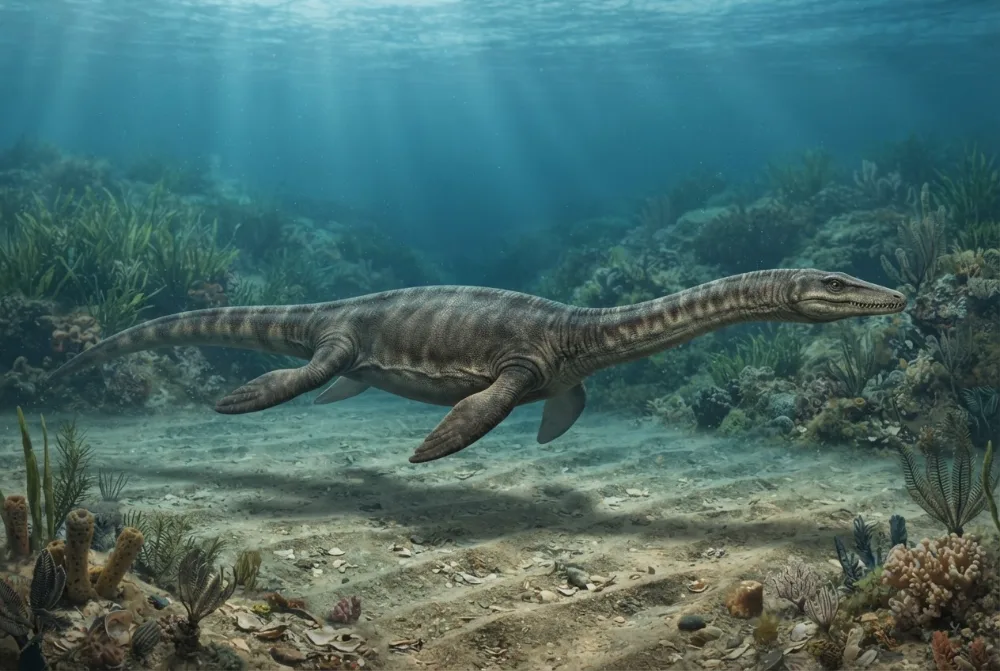
Pararcus was a marine reptile that lived in the shallow seas of the Netherlands about 245 million years ago. It had a flat body and strong, paddle-like limbs for swimming. Unlike many other placodonts, it did not have a heavy shell on its back.12
Cando viviu?
Como era de grande?
Canto medía de longo?
 tan longo coma 2,5 gatos domésticos do fociño á cola🍌tan longo coma 8 plátanos postos un tras outro🏊podería nadar o longo dunha piscina grande (50 m) en 16 segundos
Como era de grande Pararcus comparado CONTIGO?
Só son contas no teu navegador. Non se garda nin se envía nada.
Que velocidade alcanzaba?


Datos curiosos
Pararcus had a special backbone where the neural arches (the parts that protect the spinal cord) were not fused together, even in adults. This is called paedomorphosis and is common in animals that live in the sea.1
Its hip bones (pubis and ischium) were flat and plate-like, which helped it swim efficiently.1
The only known fossil of Pararcus was found by a fossil collector named Gerben Diepenbroek, and the species is named after him.1
Pararcus lived during the Middle Triassic period, about 247 to 241 million years ago, when the Netherlands was covered by a shallow sea.2
Unlike some other placodonts that had heavy armour plates, Pararcus only had a few small, unfused armour plates scattered in its skin.1
The vertebrae of Pararcus were deeply hollowed out on both ends (amphicoelous) and still had a notochord, a flexible rod that runs through the spine.1
Para expertos en dinos
- Nome científico
- Pararcus
- Bautizado por
- Klein and Scheyer 20142
- Grupo
- Réptiles mariños
- Familia / clado
- Placodontia2
- Clasificación
- Placodontia > Sauropterygia2
- Idade das rochas
- de 247 a 241 millóns de anos ()2
- Formacións rochosas
- Vossenveld2
- Países
- Países Baixos2
- Rexistros fósiles
- 1 na Paleobiology Database2
- Descubrimento
- Pararcus was named in 2014 by Nicole Klein and Torsten Scheyer. The only fossil was found by Gerben Diepenbroek in a quarry near Winterswijk, the Netherlands.21
- Aínda en debate
- Scientists are not sure exactly how Pararcus swam. Its flexible backbone and flat hip bones suggest it might have moved differently from other placodonts.1
De onde veñen os datos
- Klein_20120147.indd (zora.uzh.ch)
- Pararcus in The Paleobiology Database (CC BY 4.0): idade, lugares, formacións rochosas, clasificación.
Cada dato desta páxina ten un número que leva á súa fonte. Se nos equivocamos nalgo, sentímolo, somos fans dos dinos, non unha revista científica. Escríbenos a [email protected] e arranxámolo.
 Rex ten fame! Dino Wiki é o proxecto dun pai para o seu fillo, que adora os dinosauros, gratis, sen anuncios e sen rastrexadores. Os adultos poden darlle un petisco a Rex para mantelo en liña.Dálle de comer a Rex
 Nothosaurus
 Placodus
 Lariosaurus
 Cyamodus
 Cymatosaurus
 Proneusticosaurus
 Chonespondylus
 Cymbospondylus
 Phalarodon
 Mixosaurus
 Chaohusaurus
 Chensaurus