 Que dino es ti? O test
 Batalla de dinos
 Carreira de dinos
 Minixogos de dinos
 Álbum de cromos
 Listas TOP de dinos
 Sorpréndeme!
Cando viviu?

Como era de grande?
Canto medía de longo?
Canto medía de alto?
estimación
Canto pesaba?

 tan longo coma 2,5 cans do fociño á cola🍌tan longo coma 14 plátanos postos un tras outro🍉tan pesado coma 6 sandías🏃podería correr 100 metros en 6,2 segundos (o humano máis rápido necesita 9,6)
Como era de grande Pelecanimimus comparado CONTIGO?
Só son contas no teu navegador. Non se garda nin se envía nada.
Que velocidade alcanzaba?


Datos curiosos
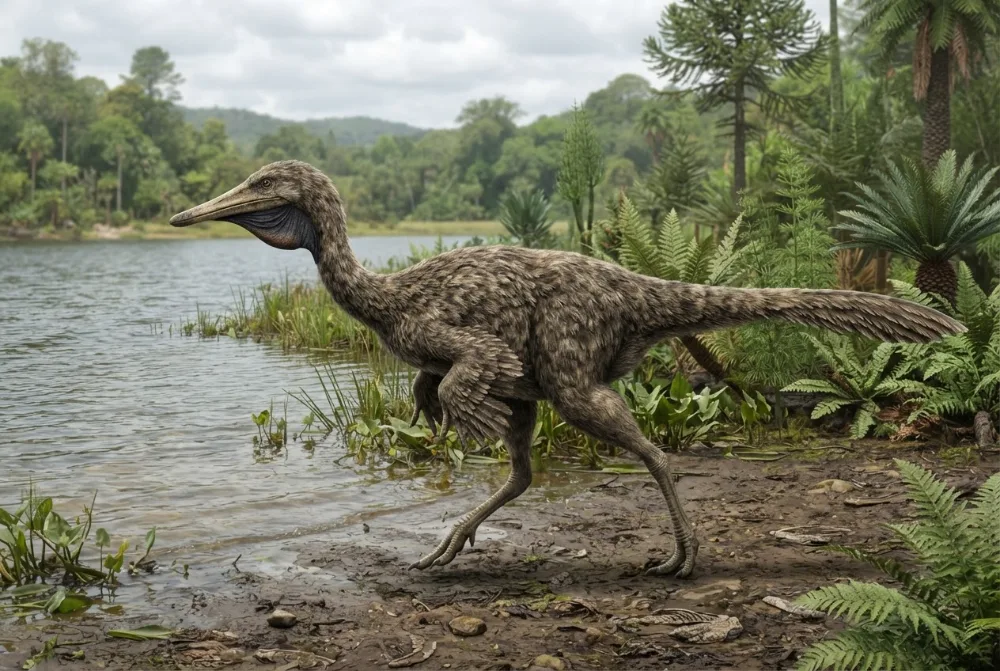
Pelecanimimus had about 220 tiny teeth in its mouth, more than any other meat-eating dinosaur.1
Its teeth were different shapes: front teeth were broad and D-shaped, while back teeth were blade-like.1
It also had a small crest on the back of its head, made of skin or keratin.1
Pelecanimimus lived about 125 million years ago during the Early Cretaceous in what is now Spain.13
Only the front half of one skeleton has been found, but it includes amazing details like skin impressions and throat bones.1
As preguntas máis frecuentes sobre Pelecanimimus
?How big was Pelecanimimus?
About 1.9 to 2.5 metres long and weighed 17 to 30 kilograms. That is about as long as a large bicycle.12
?What did Pelecanimimus eat?
It was carnivorous, meaning it ate meat. It probably waded in lakes or ponds to catch fish with its claws and many teeth, storing them in its throat pouch.12
?Did Pelecanimimus have feathers?
No, the preserved skin impressions show wrinkled skin that lacked scales or feathers. Some filament-like structures were once thought to be feathers, but they are now seen as muscle fibers.1
?When did Pelecanimimus live?
It lived during the Early Cretaceous period, about 127 to 121 million years ago.2
Cazamitos
Mito: Some people think Pelecanimimus could fly because of its large chest bones.
Verdade: Scientists are not sure, but most think it was a ground dinosaur, not a flier.1
Para expertos en dinos
- Nome científico
- Pelecanimimus
- Bautizado por
- Pérez-Moreno et al. 19943
- Grupo
- Dinos avestruz
- Familia / clado
- Ornithomimosauria3
- Clasificación
- Theropoda > Ornithomimosauria3
- Idade das rochas
- de 126 a 121 millóns de anos (Barremian)3
- Formacións rochosas
- La Huérguina3
- Países
- España3
- Rexistros fósiles
- 1 na Paleobiology Database3
- Descubrimento
- Armando Díaz Romeral found the first skeleton in 1993 in Spain. Scientists named it Pelecanimimus polyodon in 1994.12
- Aínda en debate
- Scientists still debate whether Pelecanimimus could fly or if its large chest muscles were for something else.1
De onde veñen os datos
- Pelecanimimus (en.wikipedia.org)
- Pelecanimimus | Natural History Museum (nhm.ac.uk)
- Pelecanimimus in The Paleobiology Database (CC BY 4.0): idade, lugares, formacións rochosas, clasificación.
Cada dato desta páxina ten un número que leva á súa fonte. Se nos equivocamos nalgo, sentímolo, somos fans dos dinos, non unha revista científica. Escríbenos a [email protected] e arranxámolo.
 Rex ten fame! Dino Wiki é o proxecto dun pai para o seu fillo, que adora os dinosauros, gratis, sen anuncios e sen rastrexadores. Os adultos poden darlle un petisco a Rex para mantelo en liña.Dálle de comer a Rex
 Gallimimus
 Ornithomimus
 Struthiomimus
 Deinocheirus
 Dromiceiomimus
 Archaeornithomimus
 Stegosaurus
 Iguanodon
 Archaeopteryx
 Giganotosaurus
 Microraptor
 Deinonychus