 Que dino es ti? O test
 Batalla de dinos
 Carreira de dinos
 Minixogos de dinos
 Álbum de cromos
 Listas TOP de dinos
 Sorpréndeme!
Simosaurus
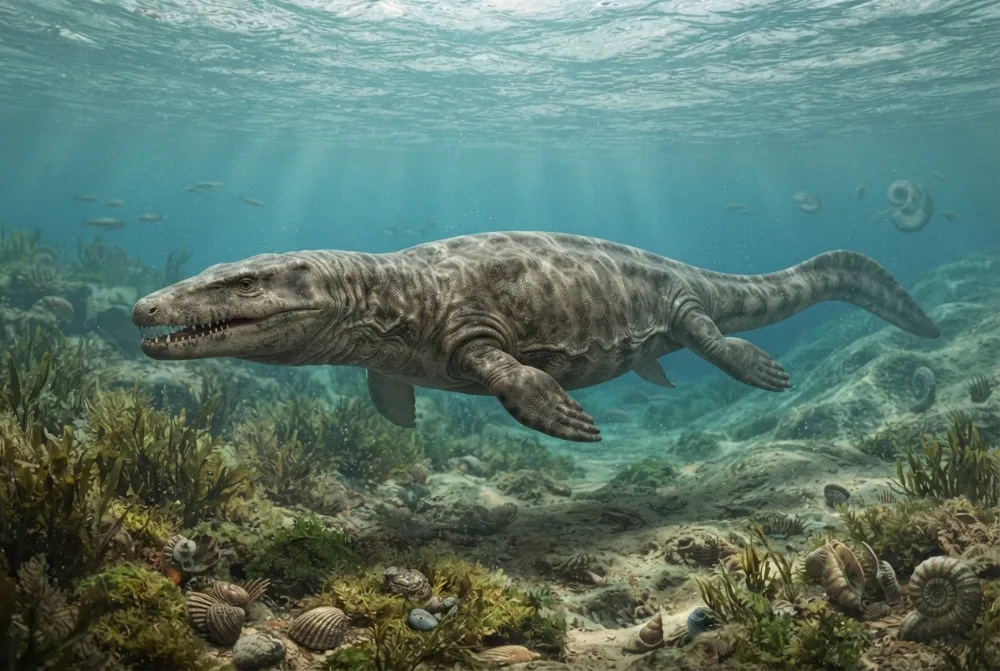
Simosaurus was a marine reptile that swam in warm, shallow seas during the Middle Triassic, about 240 to 230 million years ago. It had a blunt, flattened head and blunt teeth for crushing hard-shelled prey like clams and ammonites.1
Cando viviu?
Como era de grande?
Canto medía de longo?
Canto pesaba?
 tan longo coma 4 cans do fociño á cola🍌tan longo coma 22 plátanos postos un tras outro🍉tan pesado coma 26 sandías🧸tan pesado coma 7 nenos de infantil🎒tan pesado coma 4 nenos de primaria🏊podería nadar o longo dunha piscina grande (50 m) en 7,8 segundos
Como era de grande Simosaurus comparado CONTIGO?
Só son contas no teu navegador. Non se garda nin se envía nada.
Que velocidade alcanzaba?


Datos curiosos
Simosaurus had large openings behind its eyes called upper temporal fossae, which were bigger than its eye sockets.1
Its jaw joint was set far back, projecting beyond the main part of the skull, giving it a unique bite.1
Simosaurus had a flattened trunk that prevented side-to-side swimming, unlike most other nothosaurs.1
It swam using powerful downstrokes of its forelimbs, but its upstroke was weak, making it a moderately strong swimmer.1
The first Simosaurus fossils were found in Lunéville, France, and described by German paleontologist Hermann von Meyer in 1842.1
Simosaurus is known from the Muschelkalk deposits in Germany, where it appears in layers marked by the ammonite Ceratites nodosus.1
As preguntas máis frecuentes sobre Simosaurus
?How big was Simosaurus?
Simosaurus grew from 3 to 4 metres (9.8 to 13.1 ft) in length.1
?What did Simosaurus eat?
It ate hard-shelled organisms like ammonites and holostean fish, using its blunt teeth to crush them.1
?How did Simosaurus swim?
It swam with powerful downstrokes of its forelimbs, but its upstroke was weak, making it a moderately strong swimmer.1
Para expertos en dinos
- Nome científico
- Simosaurus
- Bautizado por
- Meyer 18423
- Grupo
- Réptiles mariños
- Familia / clado
- Simosauridae3
- Clasificación
- Nothosauria > Sauropterygia3
- Idade das rochas
- de 247 a 201 millóns de anos ()3
- Formacións rochosas
- Jilh, Erfurt, Gevanim3
- Países
- Alemaña, Francia, Arabia Saudita, Israel, Italia3
- Rexistros fósiles
- 15 na Paleobiology Database3
- Descubrimento
- German paleontologist Christian Erich Hermann von Meyer named Simosaurus in 1842 based on a skull from Lunéville, France. That original skull has since been lost.1
- Aínda en debate
- Scientists debate whether Simosaurus was a nothosaur, a pachypleurosaur, or a more primitive sauropterygian.1
De onde veñen os datos
- Simosaurus (en.wikipedia.org)
- Bone histology, microanatomy, and growth of the nothosauroid Simosaurus gaillardoti (Sauropterygia) from the Upper Muschelkalk of southern Germany/Baden-Württemberg - Scientific Publications of the Muséum national d'Histoire naturelle, Paris (sciencepress.mnhn.fr)
- Simosaurus in The Paleobiology Database (CC BY 4.0): idade, lugares, formacións rochosas, clasificación.
Cada dato desta páxina ten un número que leva á súa fonte. Se nos equivocamos nalgo, sentímolo, somos fans dos dinos, non unha revista científica. Escríbenos a [email protected] e arranxámolo.
 Rex ten fame! Dino Wiki é o proxecto dun pai para o seu fillo, que adora os dinosauros, gratis, sen anuncios e sen rastrexadores. Os adultos poden darlle un petisco a Rex para mantelo en liña.Dálle de comer a Rex
 Nothosaurus
 Placodus
 Lariosaurus
 Cyamodus
 Cymatosaurus
 Proneusticosaurus
 Massospondylus
 Plateosaurus
 Coelophysis
 Podokesaurus
 Thecodontosaurus
 Eudimorphodon