 Que dino es ti? O test
 Batalla de dinos
 Carreira de dinos
 Minixogos de dinos
 Álbum de cromos
 Listas TOP de dinos
 Sorpréndeme!
Protopteryx
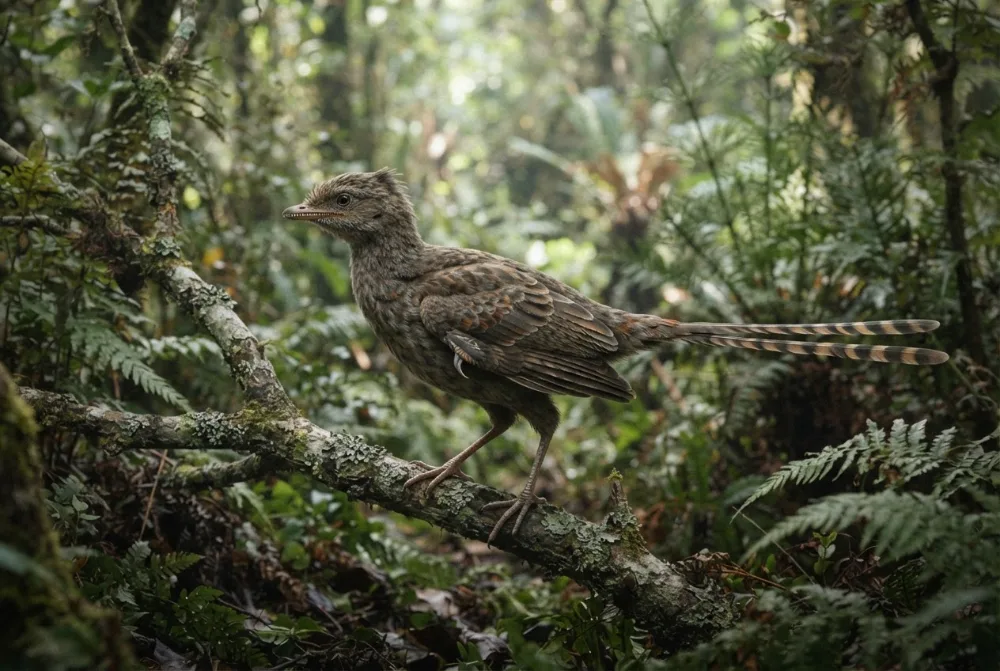
Protopteryx was a tiny early bird that lived about 131 million years ago in what is now China. It had two long, ribbon-like tail feathers that were different from any modern bird's feathers. This little bird could fly and probably ate small animals like insects.14
Cando viviu?
Como era de grande?
Canto medía de longo?
Canto medía de alto?
estimación
Canto pesaba?
Como era de grande Protopteryx comparado CONTIGO?
Só son contas no teu navegador. Non se garda nin se envía nada.
Que velocidade alcanzaba?


Datos curiosos
Protopteryx is one of the oldest and most primitive members of the group Enantiornithes, which were early birds that lived alongside dinosaurs.1
Its two central tail feathers were scalelike without barbs near the body, only having barbs at the tips. This is similar to the tail feathers of the modern red bird-of-paradise.12
Protopteryx was about the size of a modern starling, with a body length of only 10 centimetres (3.9 inches) not counting its long tail feathers.1
Its body was covered in three types of feathers: down feathers, flight feathers, and the long ribbon-like tail feathers.1
The down feathers of Protopteryx had flat, frayed tips instead of the hairlike barbs seen in modern birds.1
Protopteryx had a triosseal canal, a feature in the shoulder that helped with flight, and this is one of the earliest examples in birds.2
As preguntas máis frecuentes sobre Protopteryx
?How big was Protopteryx?
About 10 centimetres long, not counting its long tail feathers. It was roughly the size of a modern starling.1
?What did Protopteryx eat?
It probably ate small animals like insects. Its teeth are similar to those of Archaeopteryx, which suggests a similar diet.1
?Could Protopteryx fly?
Yes, it was adapted for flying. It had a triosseal canal in its shoulder and asymmetric wing feathers, just like modern flying birds.1
?Why did Protopteryx have long tail feathers?
The long, ribbon-like tail feathers were probably used for display, not for flying. They only had barbs at the tips, similar to the red bird-of-paradise today.1
Para expertos en dinos
- Nome científico
- Protopteryx
- Bautizado por
- Zhang and Zhou 20004
- Grupo
- Aves primitivas
- Familia / clado
- Enantiornithes4
- Clasificación
- Theropoda > Avialae4
- Idade das rochas
- de 133 a 121 millóns de anos (Hauterivian / Barremian)4
- Formacións rochosas
- Huajiying4
- Países
- China4
- Rexistros fósiles
- 2 na Paleobiology Database4
- Descubrimento
- Protopteryx was named by Chinese paleontologists Fucheng Zhang and Zhonghe Zhou in 2000 based on a fossil found in the Yixian Formation of Hebei Province, China.14
- Aínda en debate
- Scientists are still debating whether the long, ribbon-like tail feathers of Protopteryx were used for display, thermoregulation, or sensing the environment.1
De onde veñen os datos
- Protopteryx (en.wikipedia.org)
- A Primitive Enantiornithine Bird and the Origin of Feathers (science.org)
- Anatomy and Flight Performance of the Early Enantiornithine Bird Protopteryx fengningensis : Information from New Specimens of the Early Cretaceous Huajiying Formation of China (anatomypubs.onlinelibrary.wiley.com)
- Protopteryx in The Paleobiology Database (CC BY 4.0): idade, lugares, formacións rochosas, clasificación.
Cada dato desta páxina ten un número que leva á súa fonte. Se nos equivocamos nalgo, sentímolo, somos fans dos dinos, non unha revista científica. Escríbenos a [email protected] e arranxámolo.
 Rex ten fame! Dino Wiki é o proxecto dun pai para o seu fillo, que adora os dinosauros, gratis, sen anuncios e sen rastrexadores. Os adultos poden darlle un petisco a Rex para mantelo en liña.Dálle de comer a Rex
 Archaeopteryx
 Hesperornis
 Ichthyornis
 Baptornis
 Jurapteryx
 Gobipteryx
 Stegosaurus
 Iguanodon
 Giganotosaurus
 Microraptor
 Deinonychus
 Baryonyx