 Que dino es ti? O test
 Batalla de dinos
 Carreira de dinos
 Minixogos de dinos
 Álbum de cromos
 Listas TOP de dinos
 Sorpréndeme!
Pterodaustro
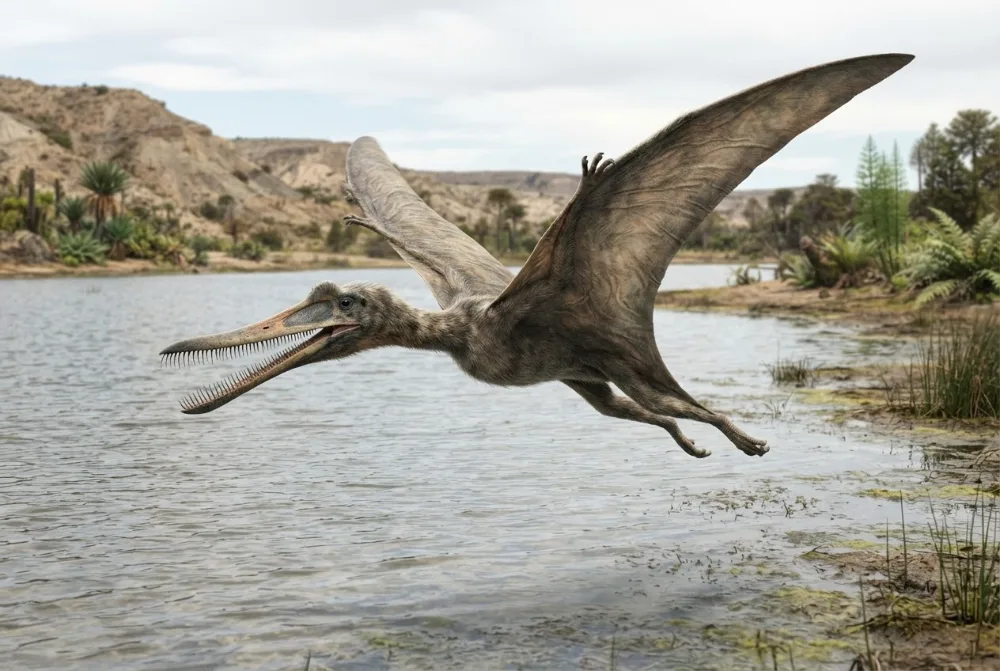
Pterodaustro was a flying reptile that lived near lakes in what is now Argentina. It had a weird mouth with about 1,000 long, bristle-like teeth in its lower jaw, just like a comb! It used those teeth to strain tiny shrimp and other small animals from the water, just like flamingos do today.12
Cando viviu?
Como era de grande?
Que anchura tiñan as súas ás?
Canto pesaba?

 ás tan anchas coma 1,5 bicicletas en fila🍌tan pesado coma 77 plátanos⚽podería voar sobre un campo de fútbol enteiro en 6,8 segundos
Como era de grande Pterodaustro comparado CONTIGO?
Só son contas no teu navegador. Non se garda nin se envía nada.
Que velocidade alcanzaba?


Datos curiosos
Pterodaustro had about 1,000 teeth in its lower jaw, each only 0.2 to 0.3 millimeters wide. That's thinner than a human hair!12
Scientists have found over 750 fossils of Pterodaustro, including eggs and embryos, making it one of the best-known pterosaurs.1
Pterodaustro had a long tail with 22 vertebrae, which is unusual for a pterodactyloid pterosaur. Most others have at most 16.1
Two Pterodaustro fossils were found with gizzard stones in their stomachs. These are the first gizzard stones ever reported for any pterosaur.1
Pterodaustro may have been pink like a flamingo! Its diet of tiny crustaceans could have given it a pink color, just like flamingos get from eating brine shrimp.12
Pterodaustro had a hard time taking off from the ground. Because of its long body and short legs, it needed a lot of open space to launch, like modern geese and swans.1
Juvenile Pterodaustro grew quickly in their first two years, reaching about half of adult size. They then grew more slowly for four to five years until they were fully grown.1
As preguntas máis frecuentes sobre Pterodaustro
?How big was Pterodaustro?
It had a wingspan of about 3 metres (9 ft 10 in) and weighed about 9.2 kilograms (20 lb).1
?What did Pterodaustro eat?
It ate tiny shrimp, crustaceans, and other small water animals. It used its comb-like teeth to strain them from the water, just like flamingos do.214
?Could Pterodaustro swim?
Yes, it had a long body and large, splayed feet that were adaptations for swimming and wading in lakes.1
Cazamitos
Mito: Pterodaustro was a dinosaur.
Verdade: Pterodaustro was a pterosaur, a flying reptile that lived at the same time as dinosaurs but is not a dinosaur.1
Para expertos en dinos
- Nome científico
- Pterodaustro
- Bautizado por
- Bonaparte 19705
- Grupo
- Réptiles voadores
- Familia / clado
- Lophocratia5
- Clasificación
- Pterosauria > Pterodactyloidea5
- Idade das rochas
- de 121 a 100 millóns de anos (Aptian / Albian)5
- Formacións rochosas
- Lagarcito, La Cruz5
- Países
- Arxentina5
- Rexistros fósiles
- 2 na Paleobiology Database5
- Descubrimento
- The first fossils of Pterodaustro were discovered in the late 1960s by paleontologist José Bonaparte in the Lagarcito Formation of San Luis Province, Argentina. Bonaparte named the genus in 1970, with the species name P. guinazui honoring Román Guiñazú.1
- Aínda en debate
- Scientists are still debating whether Pterodaustro was actually pink like a flamingo. While its diet suggests it could have been, no direct fossil evidence of color has been found.12
De onde veñen os datos
- Pterodaustro (en.wikipedia.org)
- Pterosaur of the Day: Pterodaustro | AMNH (amnh.org)
- PBDB Taxon (paleobiodb.org)
- Pterodaustro guinazui (amnh.org)
- Pterodaustro in The Paleobiology Database (CC BY 4.0): idade, lugares, formacións rochosas, clasificación.
Cada dato desta páxina ten un número que leva á súa fonte. Se nos equivocamos nalgo, sentímolo, somos fans dos dinos, non unha revista científica. Escríbenos a [email protected] e arranxámolo.
 Rex ten fame! Dino Wiki é o proxecto dun pai para o seu fillo, que adora os dinosauros, gratis, sen anuncios e sen rastrexadores. Os adultos poden darlle un petisco a Rex para mantelo en liña.Dálle de comer a Rex
 Pteranodon
 Quetzalcoatlus
 Dorygnathus
 Rhamphorhynchus
 Anhanguera
 Pterodactylus
 Stegosaurus
 Iguanodon
 Archaeopteryx
 Giganotosaurus
 Microraptor
 Deinonychus