 Que dino es ti? O test
 Batalla de dinos
 Carreira de dinos
 Minixogos de dinos
 Álbum de cromos
 Listas TOP de dinos
 Sorpréndeme!
Saurornithoides
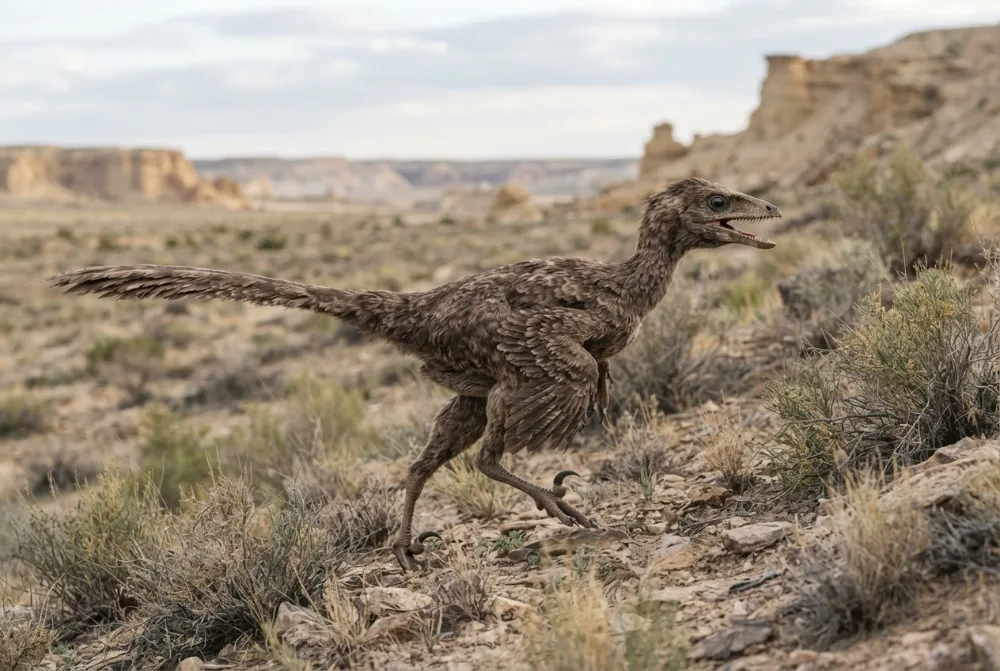
Saurornithoides was a small, fast, bird-like dinosaur that lived in the Late Cretaceous period. It had big eyes for seeing in the dark and a sharp claw on each foot to catch its prey. This smart hunter probably scoured the Gobi Desert for small mammals and reptiles.1
Cando viviu?
Como era de grande?
Canto medía de longo?
Canto medía de alto?
estimación
 tan longo coma 5 gatos domésticos do fociño á cola🍌tan longo coma 13 plátanos postos un tras outro🏃podería correr 100 metros en 8,2 segundos (o humano máis rápido necesita 9,6)
Como era de grande Saurornithoides comparado CONTIGO?
Só son contas no teu navegador. Non se garda nin se envía nada.
Que velocidade alcanzaba?


Datos curiosos
Saurornithoides had a large brain for its size, making it one of the smartest non-bird dinosaurs.1
Its eyes were huge and gave it excellent stereoscopic vision, which helped it judge distances when hunting at night.1
The first Saurornithoides fossil was found on July 9, 1923, by a Chinese employee of an American Museum of Natural History expedition named Chih.1
A baby Saurornithoides had very strong leg bones, suggesting that troodontid babies could walk soon after hatching and needed little parental care.1
It had a retractable sickle claw on the second toe of each foot, like its cousin Troodon.1
The name was originally going to be 'Ornithoides' (bird-like), but Henry Fairfield Osborn changed it to Saurornithoides when he formally described it in 1924.1
As preguntas máis frecuentes sobre Saurornithoides
?How big was Saurornithoides?
About 2 metres (6.6 feet) long. That is roughly the length of a large sofa.3
?What does the name Saurornithoides mean?
It means 'bird-like lizard' in Greek, because its skull looked like a bird's.3
?Was Saurornithoides related to Velociraptor?
Yes, it resembled Velociraptor. Both are theropod dinosaurs.1
?Where was Saurornithoides found?
In Mongolia, in the Gobi Desert. Its fossils come from the Djadochta Formation.1
?When did Saurornithoides live?
It lived during the Late Cretaceous period, about 85 to 80 million years ago.3
?How many species of Saurornithoides were there?
Only one valid species is known: Saurornithoides mongoliensis. Other named species have been moved to different dinosaurs or are no longer considered valid.1
Para expertos en dinos
- Nome científico
- Saurornithoides
- Bautizado por
- Osborn 19244
- Grupo
- Raptores
- Familia / clado
- Troodontidae4
- Clasificación
- Theropoda > Theropoda > Troodontidae > Compsognathidae4
- Idade das rochas
- de 100 a 66 millóns de anos (Cenomanian / Maastrichtian)4
- Formacións rochosas
- Djadokhta, Hell Creek, Bayan Mandahu4
- Países
- Mongolia, EUA, China, Usbequistán4
- Rexistros fósiles
- 8 na Paleobiology Database4
- Descubrimento
- Saurornithoides was named by Henry Fairfield Osborn in 1924 based on a skull and other bones found in Mongolia by a Chinese collector named Chih in 1923.1
- Aínda en debate
- Scientists are not sure whether Saurornithoides is more closely related to North American troodontids like Troodon or to other Asian troodontids.2
De onde veñen os datos
- Saurornithoides (en.wikipedia.org)
- A review of the Mongolian Cretaceous dinosaur Saurornithoides (Troodontidae, Theropoda). (American Museum novitates, no. 3654) (digitallibrary.amnh.org)
- Saurornithoides | Natural History Museum (nhm.ac.uk)
- Saurornithoides in The Paleobiology Database (CC BY 4.0): idade, lugares, formacións rochosas, clasificación.
Cada dato desta páxina ten un número que leva á súa fonte. Se nos equivocamos nalgo, sentímolo, somos fans dos dinos, non unha revista científica. Escríbenos a [email protected] e arranxámolo.
 Rex ten fame! Dino Wiki é o proxecto dun pai para o seu fillo, que adora os dinosauros, gratis, sen anuncios e sen rastrexadores. Os adultos poden darlle un petisco a Rex para mantelo en liña.Dálle de comer a Rex
 Velociraptor
 Microraptor
 Deinonychus
 Asiamericana
 Richardoestesia
 Saurornitholestes
 Tyrannosaurus
 Triceratops
 Spinosaurus
 Ankylosaurus
 Parasaurolophus
 Pteranodon