 Que dino es ti? O test
 Batalla de dinos
 Carreira de dinos
 Minixogos de dinos
 Álbum de cromos
 Listas TOP de dinos
 Sorpréndeme!
Cando viviu?

Como era de grande?
Canto medía de longo?
Canto medía de alto?
Canto pesaba?
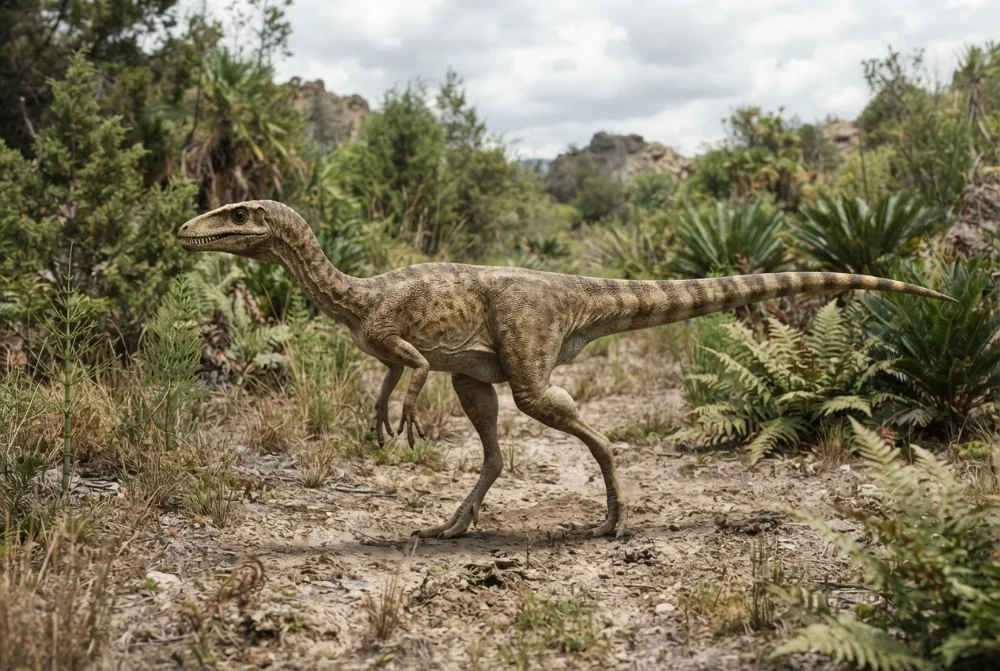
 tan longo coma 3 gatos domésticos do fociño á cola🍌tan longo coma 8 plátanos postos un tras outromáis ou menos tan pesado coma un gato doméstico🍌tan pesado coma 58 plátanos🏃podería correr 100 metros en 12 segundos (o humano máis rápido necesita 9,6)
Como era de grande Segisaurus comparado CONTIGO?
Só son contas no teu navegador. Non se garda nin se envía nada.
Que velocidade alcanzaba?


Datos curiosos
Segisaurus had a wishbone, called a furcula, just like birds do. This was one of the first times such a bone was found in a non-bird dinosaur.2
Its bones were first thought to be solid, but a 2005 study showed they were actually hollow, like other theropods.2
The only known fossil was found by a Navajo man named Max Littlesalt in 1933, who was keeping livestock in the canyon.2
Segisaurus lived in an environment like modern sand dunes, and its fossil was buried in sandstone.2
It had a long tail and long forearms, and its legs were powerful and long compared to its body.2
Scientists think Segisaurus was closely related to Coelophysis, but it had some unusual features that made them question that at first.2
As preguntas máis frecuentes sobre Segisaurus
?How big was Segisaurus?
Segisaurus was about 1 metre (3.3 feet) long, half a metre (1.65 feet) tall, and weighed about 4 to 7 kilograms. That is roughly the size of a goose.2
?What did Segisaurus eat?
Segisaurus was a meat-eater, probably eating insects and small prey. It may also have scavenged meat.21
?When did Segisaurus live?
Segisaurus lived during the Early Jurassic period, about 200 to 174 million years ago.2
?Did Segisaurus have feathers?
The sources do not mention feathers on Segisaurus. It did have a wishbone, or furcula, like birds, which is a feature linked to birds.2
?Was Segisaurus a dinosaur?
Yes, Segisaurus was a small theropod dinosaur, a meat-eating dinosaur that walked on two legs.21
?Where was Segisaurus found?
The only Segisaurus fossil was found in Tsegi Canyon, Arizona, in the Navajo Sandstone. It was discovered by Max Littlesalt in 1933.2
Cazamitos
Mito: Some people thought Segisaurus had solid bones and might not be a true theropod.
Verdade: A 2005 re-examination showed its bones were hollow, and it is firmly classified as a coelophysoid theropod.2
Para expertos en dinos
- Nome científico
- Segisaurus
- Bautizado por
- Camp 19363
- Grupo
- Dinos carnívoros
- Familia / clado
- Coelophysidae3
- Clasificación
- Theropoda > Coelophysoidea3
- Idade das rochas
- de 193 a 175 millóns de anos (Pliensbachian / Toarcian)3
- Formacións rochosas
- Navajo Sandstone3
- Países
- EUA3
- Rexistros fósiles
- 2 na Paleobiology Database3
- Descubrimento
- The fossil was discovered in 1933 by Max Littlesalt in Tsegi Canyon, Arizona. Paleontologist Charles Lewis Camp described and named it in 1936.21
- Aínda en debate
- Because only a sub-adult skeleton has been found, scientists are not sure how big a full-grown Segisaurus could get.2
De onde veñen os datos
- Segisaurus | Natural History Museum (nhm.ac.uk)
- Segisaurus (en.wikipedia.org)
- Segisaurus in The Paleobiology Database (CC BY 4.0): idade, lugares, formacións rochosas, clasificación.
Cada dato desta páxina ten un número que leva á súa fonte. Se nos equivocamos nalgo, sentímolo, somos fans dos dinos, non unha revista científica. Escríbenos a [email protected] e arranxámolo.
 Rex ten fame! Dino Wiki é o proxecto dun pai para o seu fillo, que adora os dinosauros, gratis, sen anuncios e sen rastrexadores. Os adultos poden darlle un petisco a Rex para mantelo en liña.Dálle de comer a Rex
 Allosaurus
 Carnotaurus
 Dilophosaurus
 Giganotosaurus
 Compsognathus
 Paronychodon
 Stenopterygius
 Dorygnathus
 Lufengosaurus
 Scutellosaurus
 Yunnanosaurus
 Temnodontosaurus