 Que dino es ti? O test
 Batalla de dinos
 Carreira de dinos
 Minixogos de dinos
 Álbum de cromos
 Listas TOP de dinos
 Sorpréndeme!
Seitaad
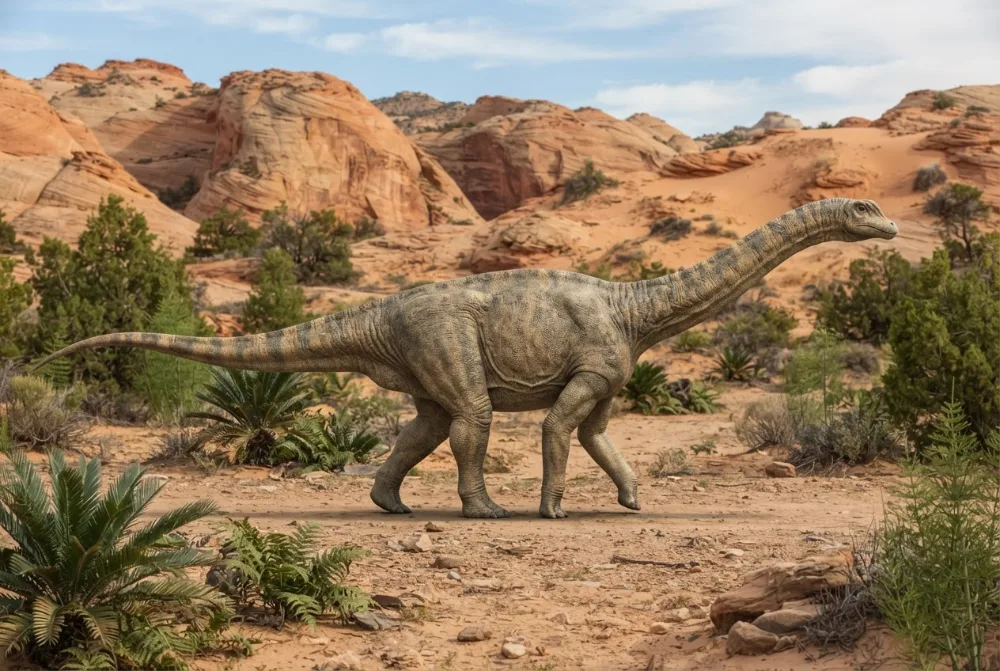
Seitaad was an early long-necked dinosaur that lived about 190 million years ago. It was a plant-eater that walked on two legs and could also use all fours. This dinosaur is one of the most complete fossils ever found in the Navajo Sandstone of Utah.31
Cando viviu?
Como era de grande?
Canto medía de longo?
Canto medía de alto?
Canto pesaba?
 tan longo coma 4 cans do fociño á cola🍌tan longo coma 25 plátanos postos un tras outro🍉tan pesado coma 18 sandías🧸tan pesado coma 5 nenos de infantil🎒tan pesado coma 3 nenos de primaria🏃podería correr 100 metros en 8,8 segundos (o humano máis rápido necesita 9,6)
Como era de grande Seitaad comparado CONTIGO?
Só son contas no teu navegador. Non se garda nin se envía nada.
Que velocidade alcanzaba?


Datos curiosos
Seitaad's name comes from a Navajo legend about a sand monster that buried its victims in dunes.1
The only known fossil of Seitaad was found at the base of a collapsed sand dune, which may have buried the animal after it died.1
Seitaad is one of the few early sauropodomorph dinosaurs known from North America.1
The species name ruessi honors Everett Ruess, a young artist and explorer who disappeared in southern Utah in 1934.1
Seitaad had a plate-like bone on its shoulder blade that helped support its arm.1
This dinosaur lived during the Early Jurassic period, when the climate was warm and deserts covered much of the area.1
As preguntas máis frecuentes sobre Seitaad
?How big was Seitaad?
About 3 to 4.5 metres long and 1 metre tall at the hips. It weighed around 70 to 90 kilograms, about the size of a large human.2
?What did Seitaad eat?
Seitaad ate plants. It had leaf-shaped teeth and a small head, just like its later giant relatives the sauropods.2
?Could Seitaad walk on two legs?
Yes, Seitaad could walk on two legs or on all fours. It had a long neck and tail, and a large curved claw on its thumb.2
?When did Seitaad live?
Seitaad lived during the Early Jurassic Period, about 183 to 190 million years ago. That is millions of years before the famous giant sauropods like Diplodocus.2
Para expertos en dinos
- Nome científico
- Seitaad
- Bautizado por
- Sertich and Loewen 20103
- Grupo
- Pescozos longos
- Familia / clado
- Sauropodiformes3
- Clasificación
- Sauropodomorpha3
- Idade das rochas
- de 193 a 175 millóns de anos (Pliensbachian / Toarcian)3
- Formacións rochosas
- Navajo Sandstone3
- Países
- EUA3
- Rexistros fósiles
- 1 na Paleobiology Database3
- Descubrimento
- Seitaad was named by scientists Joseph Sertich and Michael Loewen in 2010. The partial skeleton was found in the Navajo Sandstone of southern Utah, near a cliff dwelling called Eagle's Nest.31
- Aínda en debate
- Scientists are not sure exactly how Seitaad is related to other early sauropodomorphs, because its fossils do not give a clear family tree.1
De onde veñen os datos
- pone.0009789 1..17 (journals.plos.org)
- New Dinosaur from Utah’s Red Rocks – UNews Archive (archive.unews.utah.edu)
- Seitaad in The Paleobiology Database (CC BY 4.0): idade, lugares, formacións rochosas, clasificación.
Cada dato desta páxina ten un número que leva á súa fonte. Se nos equivocamos nalgo, sentímolo, somos fans dos dinos, non unha revista científica. Escríbenos a [email protected] e arranxámolo.
 Rex ten fame! Dino Wiki é o proxecto dun pai para o seu fillo, que adora os dinosauros, gratis, sen anuncios e sen rastrexadores. Os adultos poden darlle un petisco a Rex para mantelo en liña.Dálle de comer a Rex
 Brachiosaurus
 Diplodocus
 Brontosaurus
 Argentinosaurus
 Camarasaurus
 Morosaurus
 Dilophosaurus
 Stenopterygius
 Dorygnathus
 Scutellosaurus
 Sinosaurus
 Temnodontosaurus