 Que dino es ti? O test
 Batalla de dinos
 Carreira de dinos
 Minixogos de dinos
 Álbum de cromos
 Listas TOP de dinos
 Sorpréndeme!
Shengjingornis
Shengjingornis was a small, toothed bird that lived during the Early Cretaceous in what is now China. It had a long beak and strong wings that helped it fly fast and flap powerfully. This bird was an enantiornithine, a group of ancient birds that went extinct with the dinosaurs.1
Cando viviu?
Que velocidade alcanzaba?


Datos curiosos
Shengjingornis had teeth only in the front of its long beak, unlike many modern birds which have no teeth.1
Its furcula, or wishbone, was Y-shaped with a wide end on the hypocleidium, a feature that helped with flight.1
The sternum, or breastbone, was shaped like a cake and had a low keel that pointed toward the tail.1
Shengjingornis lived around 121 to 113 million years ago during the Aptian age of the Early Cretaceous.2
Its fossils were found in the Jiufotang Formation, which was once a lake environment with sandstones and mudstones.3
Only one specimen of Shengjingornis has been found, and it is kept at the Liaoning Paleontological Museum.3
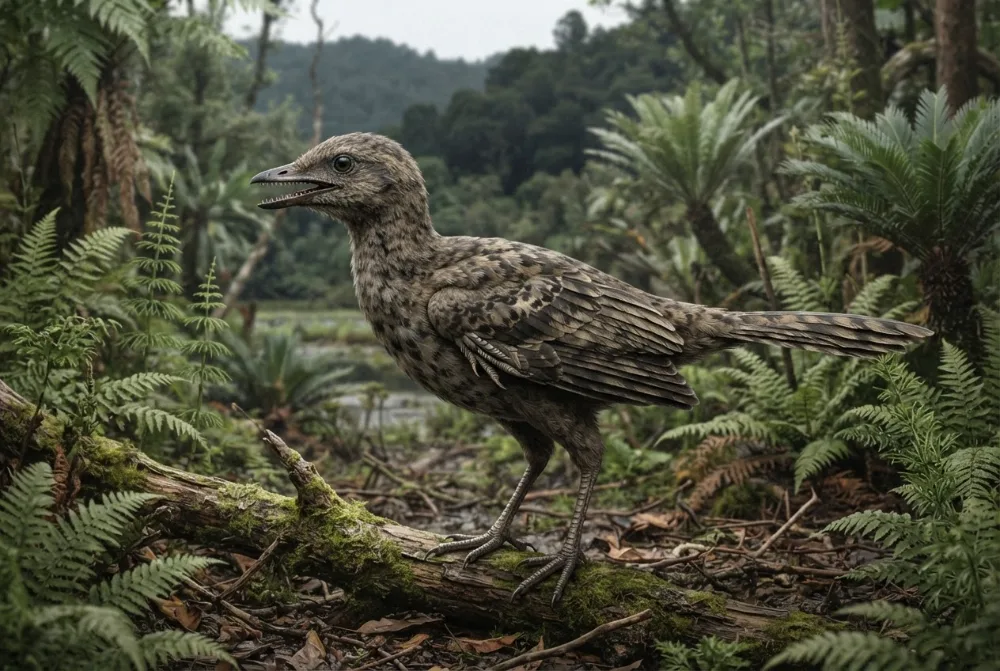
As preguntas máis frecuentes sobre Shengjingornis
?How big was Shengjingornis?
Its size is not exactly known, but its close relative Longipteryx had a wingspan of about 46 cm and weighed about 193 grams. Shengjingornis was probably a similar small bird.4
?Did Shengjingornis have teeth?
Yes, it had teeth only in the front of its long beak, unlike most modern birds which have no teeth.14
?When did Shengjingornis live?
Shengjingornis lived during the Early Cretaceous period, about 125 to 113 million years ago.56
?What did Shengjingornis eat?
The diet of Shengjingornis is not known for sure. Its close relative Longipteryx ate fruits (seeds), so Shengjingornis may have been a seed-eater too.4
Para expertos en dinos
- Nome científico
- Shengjingornis
- Bautizado por
- Li et al. 20126
- Grupo
- Aves primitivas
- Familia / clado
- Longipterygidae6
- Clasificación
- Theropoda > Avialae6
- Idade das rochas
- de 121 a 113 millóns de anos (Aptian)6
- Formacións rochosas
- Jiufotang6
- Países
- China6
- Rexistros fósiles
- 1 na Paleobiology Database6
- Descubrimento
- Shengjingornis was named by Li Li, Wang Jinqi, Zhang Xi, and Hou Shilin in 2012 based on a single fossil from the Jiufotang Formation in Liaoning, China.21
- Aínda en debate
- Scientists are not sure exactly how big Shengjingornis was, because only one partial skeleton has been found.2
De onde veñen os datos
- A New Enantiornithine Bird from the Lower Cretaceous Jiufotang Formation in Jinzhou Area, Western Liaoning Province, China (geojournals.cn)
- PBDB Taxon (paleobiodb.org)
- PBDB Collection (paleobiodb.org)
- Longipteryx (Wikipedia) (Wikipedia)
- Shengjingornis (mindat.org)
- Shengjingornis in The Paleobiology Database (CC BY 4.0): idade, lugares, formacións rochosas, clasificación.
Cada dato desta páxina ten un número que leva á súa fonte. Se nos equivocamos nalgo, sentímolo, somos fans dos dinos, non unha revista científica. Escríbenos a [email protected] e arranxámolo.
 Rex ten fame! Dino Wiki é o proxecto dun pai para o seu fillo, que adora os dinosauros, gratis, sen anuncios e sen rastrexadores. Os adultos poden darlle un petisco a Rex para mantelo en liña.Dálle de comer a Rex
 Archaeopteryx
 Hesperornis
 Ichthyornis
 Baptornis
 Jurapteryx
 Gobipteryx
 Stegosaurus
 Iguanodon
 Giganotosaurus
 Microraptor
 Deinonychus
 Baryonyx