 Que dino es ti? O test
 Batalla de dinos
 Carreira de dinos
 Minixogos de dinos
 Álbum de cromos
 Listas TOP de dinos
 Sorpréndeme!
Shonisaurus
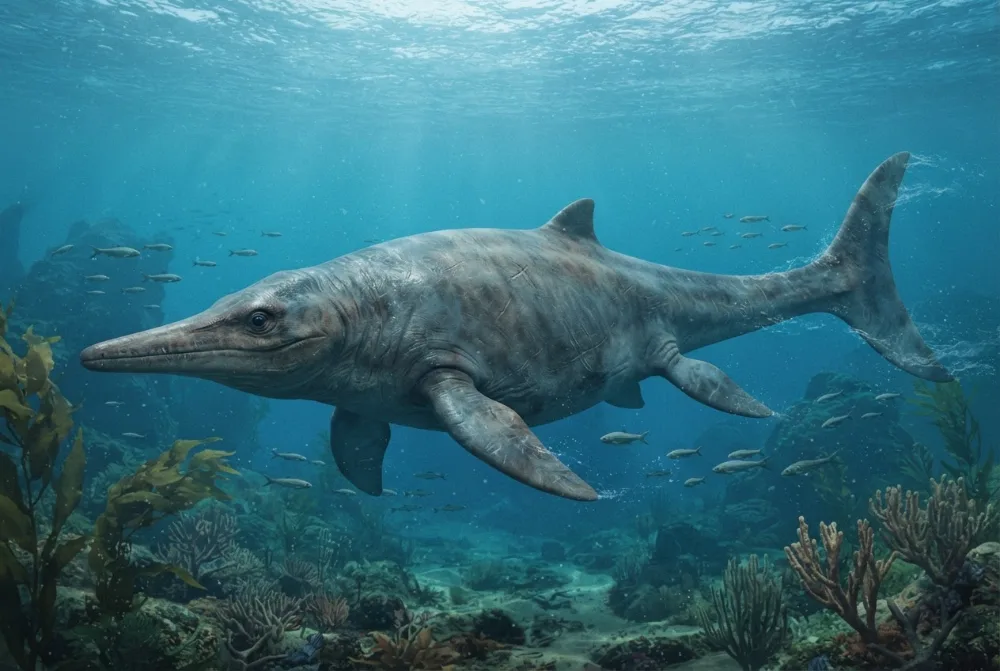
Shonisaurus was a giant marine reptile that swam in the oceans during the Triassic Period. It was not a dinosaur, but a kind of ichthyosaur, with a long body and flippers. It could grow as long as a gray whale!1
Cando viviu?
Como era de grande?
Canto medía de longo?
Canto pesaba?

 tan longo coma 5 coches aparcados en fila🍌tan longo coma 120 plátanos postos un tras outro🍉tan pesado coma 16000 sandías🎒tan pesado coma 100 clases enteiras de nenos🏊podería nadar o longo dunha piscina grande (50 m) en 7,2 segundos
Como era de grande Shonisaurus comparado CONTIGO?
Só son contas no teu navegador. Non se garda nin se envía nada.
Que velocidade alcanzaba?


Datos curiosos
Shonisaurus had a very long body with about 60 vertebrae before its hips, making it look a bit like a giant sea serpent.1
Its tail had only a slight bend, not a strong one like many other ichthyosaurs, so it may have swum differently.1
Adult Shonisaurus may have lost their teeth, because teeth are only found in young fossils. Scientists think adults might have sucked up food instead of biting.2
Its flippers were long and slender, with only two or three main fingers, unlike many other ichthyosaurs.1
Shonisaurus lived about 233 to 201 million years ago, during the Late Triassic.2
About 40 Shonisaurus skeletons have been found in Nevada, but many are incomplete and poorly preserved.1
As preguntas máis frecuentes sobre Shonisaurus
?How big was Shonisaurus?
Shonisaurus popularis was about 13.5 to 15 metres long and weighed 21.6 to 29.7 metric tons. The species Shonisaurus sikanniensis was even larger, reaching 21 metres and 81.5 metric tons.3
?Was Shonisaurus bigger than a blue whale?
No, Shonisaurus was smaller than a blue whale. The largest Shonisaurus was about 21 metres long, while blue whales can reach over 30 metres.3
?What did Shonisaurus eat?
Shonisaurus was a raptorial predator that ate vertebrates and shelled mollusks like cephalopods, and possibly even large-bodied prey. Its teeth were robust and sectorial, good for cutting.3
?Did Shonisaurus have teeth?
Yes, Shonisaurus had teeth in all life stages. Earlier scientists thought adults lost their teeth, but newer finds show teeth throughout the jaws.3
?When did Shonisaurus live?
Shonisaurus lived during the Late Triassic, about 227 million years ago, in the late Carnian to Norian stages.3
?Where were Shonisaurus fossils found?
Most Shonisaurus fossils were found in the Luning Formation of Nevada, USA. Other possible fossils have been found in Canada and Alaska.3
?Is Shonisaurus a dinosaur?
No, Shonisaurus is not a dinosaur. It is an ichthyosaur, a type of marine reptile that lived in the oceans.3
?Could Shonisaurus swim fast?
Nobody knows for sure, but its long, slender flippers and slight tail bend suggest it swam differently from other ichthyosaurs. It may not have been a fast swimmer.1
Cazamitos
Mito: Some people think Shonisaurus was a dinosaur because it lived in the sea and looked like a sea monster.
Verdade: Shonisaurus was not a dinosaur. It was an ichthyosaur, a group of marine reptiles that lived at the same time as dinosaurs but were a different group.2
Para expertos en dinos
- Nome científico
- Shonisaurus
- Bautizado por
- Camp 19764
- Grupo
- Ictiosauros
- Familia / clado
- Shastasauridae4
- Clasificación
- Ichthyosauria > Ichthyosauromorpha4
- Idade das rochas
- de 234 a 201 millóns de anos (Carnian / Rhaetian)4
- Formacións rochosas
- Luning, Durrenstein, Exter4
- Países
- EUA, Italia, Alemaña4
- Rexistros fósiles
- 5 na Paleobiology Database4
- Descubrimento
- Shonisaurus was named by Charles L. Camp in 1976, based on fossils from Nevada, USA. The first fossils were found in the Luning Formation.2
- Aínda en debate
- Scientists still debate how big Shonisaurus really got, with estimates ranging from 15 to 21 metres, and whether it had teeth as an adult.21
De onde veñen os datos
- A reinterpretation of the Upper Triassic ichthyosaur Shonisaurus : Journal of Vertebrate Paleontology: Vol 19, No 1 (tandfonline.com)
- PBDB Taxon (paleobiodb.org)
- Shonisaurus (en.wikipedia.org)
- Shonisaurus in The Paleobiology Database (CC BY 4.0): idade, lugares, formacións rochosas, clasificación.
Cada dato desta páxina ten un número que leva á súa fonte. Se nos equivocamos nalgo, sentímolo, somos fans dos dinos, non unha revista científica. Escríbenos a [email protected] e arranxámolo.
 Rex ten fame! Dino Wiki é o proxecto dun pai para o seu fillo, que adora os dinosauros, gratis, sen anuncios e sen rastrexadores. Os adultos poden darlle un petisco a Rex para mantelo en liña.Dálle de comer a Rex
 Ichthyosaurus
 Platypterygius
 Stenopterygius
 Khudiakovia
 Ophthalmosaurus
 Chonespondylus
 Nothosaurus
 Massospondylus
 Plateosaurus
 Coelophysis
 Podokesaurus
 Simosaurus