 Que dino es ti? O test
 Batalla de dinos
 Carreira de dinos
 Minixogos de dinos
 Álbum de cromos
 Listas TOP de dinos
 Sorpréndeme!
Sinornithoides
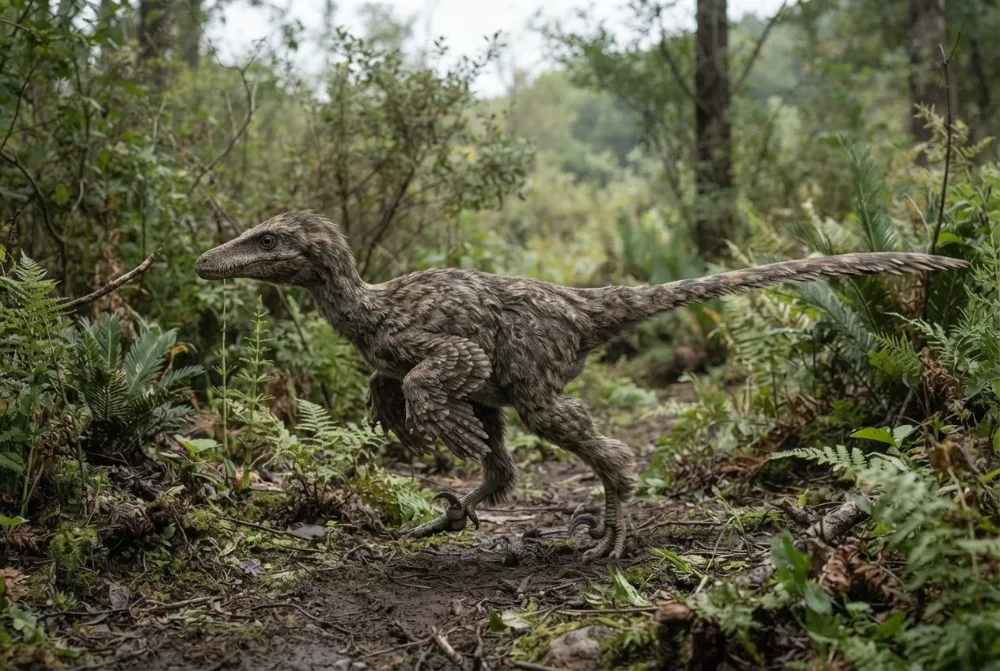
Sinornithoides was a tiny, bird-like dinosaur that lived about 113 million years ago. It was probably a fast hunter of small prey like insects. One fossil was found curled up like a sleeping bird, with its snout tucked under its arm.12
Cando viviu?
Como era de grande?
Canto medía de longo?
Canto medía de alto?
Canto pesaba?
 tan longo coma 2 gatos domésticos do fociño á cola🍌tan longo coma 6 plátanos postos un tras outromáis ou menos tan pesado coma un gato doméstico🍌tan pesado coma 21 plátanos🪑tan pequeno que podería pasar por debaixo dunha cadeira🏃podería correr 100 metros en 14 segundos (o humano máis rápido necesita 9,6)
Como era de grande Sinornithoides comparado CONTIGO?
Só son contas no teu navegador. Non se garda nin se envía nada.
Que velocidade alcanzaba?


Datos curiosos
Sinornithoides had a sickle claw on its second toe, like other troodontids, which it may have used to grip prey.1
The fossil was preserved in a sleeping pose, with its snuck under one hand, just like a modern bird resting.1
Its skull was long and pointed, but the head was short compared to its body length.1
The teeth on the front of its upper jaw had no serrations, but the back teeth had small serrations only on one edge.1
Sinornithoides had a furcula (wishbone) and a basket of fifteen pairs of belly ribs called gastralia.1
Troodontids like Sinornithoides had some of the highest brain-to-body sizes among non-bird dinosaurs, meaning they were probably smart.1
As preguntas máis frecuentes sobre Sinornithoides
?How big was Sinornithoides?
About 1 metre long, and weighed around 2.5 kilograms. That is about the size of a large chicken.13
?What did Sinornithoides eat?
It probably ate invertebrates and other small prey, like insects and lizards.1
?Was Sinornithoides a dinosaur?
Yes, it was a small, bird-like theropod dinosaur from the Early Cretaceous period.1
?Did Sinornithoides have feathers?
The sources do not mention feathers directly, but as a troodontid closely related to birds, it likely had feathers. Many troodontid fossils show evidence of feathers.1
Para expertos en dinos
- Nome científico
- Sinornithoides
- Bautizado por
- Russell and Dong 19944
- Grupo
- Raptores
- Familia / clado
- Troodontidae4
- Clasificación
- Theropoda > Troodontidae4
- Idade das rochas
- de 113 a 110 millóns de anos (Albian)4
- Formacións rochosas
- Zhonggou, Ejinhoro4
- Países
- China4
- Rexistros fósiles
- 2 na Paleobiology Database4
- Descubrimento
- A Chinese-Canadian expedition found the nearly complete skeleton in 1988 near Huamuxiao, in the Ordos Basin of Inner Mongolia. Dale Russell and Dong Zhiming named it Sinornithoides youngi in 1993/1994, honoring paleontologist Yang Zhongjian.12
De onde veñen os datos
- Sinornithoides (en.wikipedia.org)
- cdnsciencepub.com (cdnsciencepub.com)
- SINORNITHOIDES : DinoChecker dinosaur archive (dinochecker.com)
- Sinornithoides in The Paleobiology Database (CC BY 4.0): idade, lugares, formacións rochosas, clasificación.
Cada dato desta páxina ten un número que leva á súa fonte. Se nos equivocamos nalgo, sentímolo, somos fans dos dinos, non unha revista científica. Escríbenos a [email protected] e arranxámolo.
 Rex ten fame! Dino Wiki é o proxecto dun pai para o seu fillo, que adora os dinosauros, gratis, sen anuncios e sen rastrexadores. Os adultos poden darlle un petisco a Rex para mantelo en liña.Dálle de comer a Rex
 Velociraptor
 Microraptor
 Deinonychus
 Asiamericana
 Richardoestesia
 Saurornitholestes
 Stegosaurus
 Iguanodon
 Archaeopteryx
 Giganotosaurus
 Baryonyx
 Paronychodon