 Que dino es ti? O test
 Batalla de dinos
 Carreira de dinos
 Minixogos de dinos
 Álbum de cromos
 Listas TOP de dinos
 Sorpréndeme!
Sordes
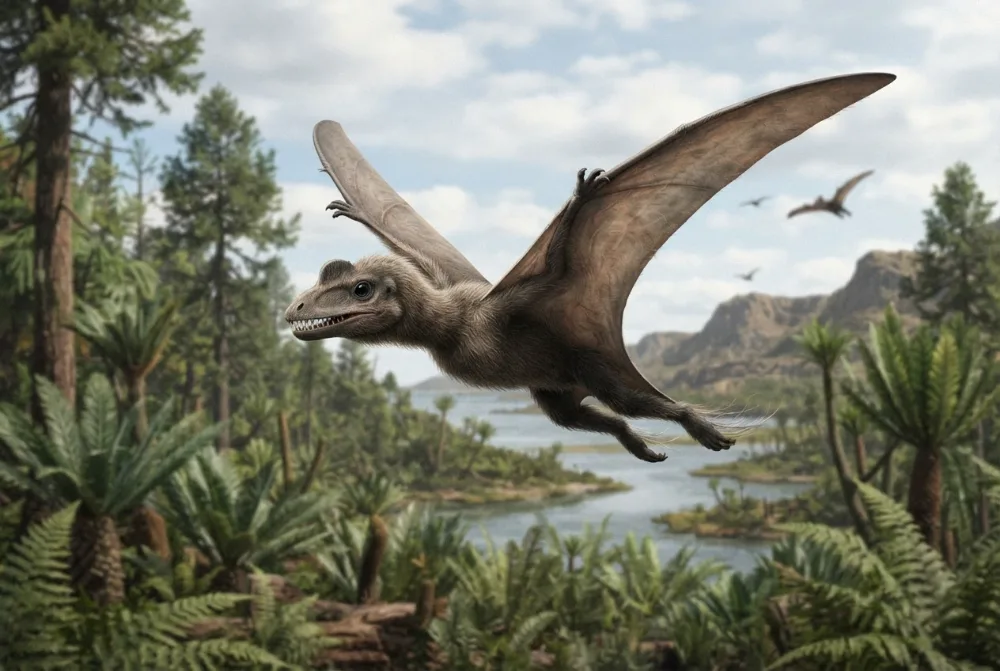
Sordes was a small flying reptile that lived about 155 million years ago. It had furry, hair-like coverings on its body and wings, making it look a bit like a tiny dragon. It was not a dinosaur, but a pterosaur, a close cousin of dinosaurs.13
Cando viviu?
Como era de grande?
Que anchura tiñan as súas ás?
Como era de grande Sordes comparado CONTIGO?
Só son contas no teu navegador. Non se garda nin se envía nada.
Que velocidade alcanzaba?


Datos curiosos
Sordes was the first pterosaur to show clear evidence of hair-like filaments, called pycnofibres, covering its body. This was a big clue that pterosaurs were warm-blooded.1
Its wings were relatively short, and it had a long tail that made up more than half its total length. The tail ended in a diamond-shaped vane.1
The skull of Sordes was about 8 cm (3.2 inches) long, and it had no head crest, unlike many other pterosaurs.1
The wing membrane of Sordes was attached to its legs, and there was also a membrane between its legs, which helped with flying and gliding.1
As preguntas máis frecuentes sobre Sordes
?What did Sordes eat?
It likely ate insects or amphibians. Its front teeth were good for catching slippery prey, and its back teeth were for crushing.1
?How big was Sordes?
About 0.63 metres across the wings, and its skull was only 8 cm long.1
?Why is it called Sordes?
Its name means 'hairy devil' in Latin. 'Sordes' means 'filth' or 'scum', but the scientist who named it intended 'evil spirit'.1
?Did Sordes have feathers?
No, it had hair-like filaments called pycnofibres covering its body and wings, not feathers. These helped keep it warm.1
?Where was Sordes discovered?
In Kazakhstan, in the Karabastau Formation from the Late Jurassic period.1
Cazamitos
Mito: Some people think Sordes was a dinosaur because it lived long ago and had a long tail.
Verdade: Sordes was a pterosaur, a flying reptile, not a dinosaur. Pterosaurs are a separate group of reptiles that lived at the same time as dinosaurs.1
Para expertos en dinos
- Nome científico
- Sordes
- Bautizado por
- Sharov 19713
- Grupo
- Réptiles voadores
- Familia / clado
- Rhamphorhynchidae3
- Clasificación
- Pterosauria > Rhamphorhynchidae3
- Idade das rochas
- de 162 a 155 millóns de anos (Oxfordian)3
- Formacións rochosas
- Karabastau3
- Países
- Casaquistán3
- Rexistros fósiles
- 1 na Paleobiology Database3
- Descubrimento
- Sordes was named in 1971 by Aleksandr Grigorevich Sharov. The first fossil was found in the 1960s in the Karatau mountains of Kazakhstan.13
- Aínda en debate
- Scientists still debate whether the hair-like structures on Sordes were true hairs or just fibres from the wing membrane. Also, its exact place in the pterosaur family tree is not settled.12
De onde veñen os datos
- Sordes (en.wikipedia.org)
- Pterosaur Database - Making Pterosaurs Fly (pterosaur.org.uk)
- Sordes in The Paleobiology Database (CC BY 4.0): idade, lugares, formacións rochosas, clasificación.
Cada dato desta páxina ten un número que leva á súa fonte. Se nos equivocamos nalgo, sentímolo, somos fans dos dinos, non unha revista científica. Escríbenos a [email protected] e arranxámolo.
 Rex ten fame! Dino Wiki é o proxecto dun pai para o seu fillo, que adora os dinosauros, gratis, sen anuncios e sen rastrexadores. Os adultos poden darlle un petisco a Rex para mantelo en liña.Dálle de comer a Rex
 Pteranodon
 Quetzalcoatlus
 Dorygnathus
 Rhamphorhynchus
 Anhanguera
 Pterodactylus
 Brachiosaurus
 Diplodocus
 Allosaurus
 Brontosaurus
 Compsognathus
 Camarasaurus