 Que dino es ti? O test
 Batalla de dinos
 Carreira de dinos
 Minixogos de dinos
 Álbum de cromos
 Listas TOP de dinos
 Sorpréndeme!
Tupandactylus
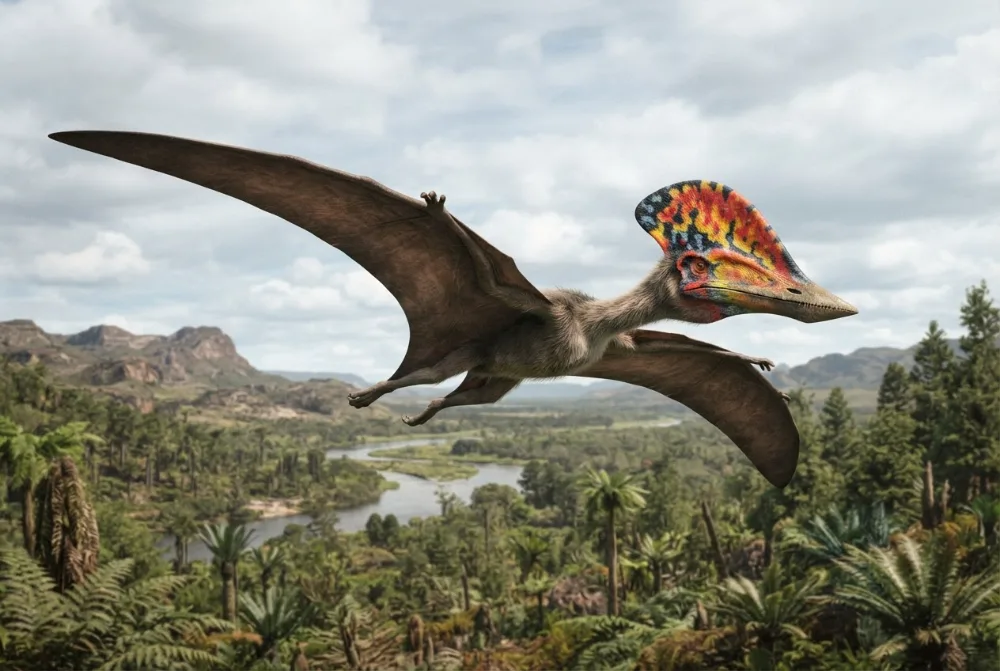
Tupandactylus was a flying reptile with a huge, colorful crest on its head. It lived in what is now Brazil about 115 million years ago and probably ate plants like a flying fruit-lover.12
Cando viviu?
Como era de grande?
Que anchura tiñan as súas ás?
Canto medía de alto?
 ás tan anchas coma 2 bicicletas en fila⚽podería voar sobre un campo de fútbol enteiro en 6 segundos
Como era de grande Tupandactylus comparado CONTIGO?
Só son contas no teu navegador. Non se garda nin se envía nada.
Que velocidade alcanzaba?


Datos curiosos
Tupandactylus had a giant head crest made of soft tissue and supported by bone spines. In T. imperator the crest was round, while in T. navigans it was tall and vertical.1
Its name comes from Tupã, the Tupi thunder god, and daktylos, the Greek word for finger.1
Tupandactylus probably spent a lot of time on the ground and only flew short distances, because its big crest made flying harder.1
The first fossil of Tupandactylus was a skull and partial lower jaw found in the Crato Formation of Brazil.1
Scientists think Tupandactylus may have been a terrestrial forager, walking around on the ground to find food.1
Tupandactylus had a fifth toe on its foot with a single bone, a feature seen in some other azhdarchoid pterosaurs.3
As preguntas máis frecuentes sobre Tupandactylus
?How big was Tupandactylus?
Tupandactylus imperator had a wingspan of about 3 to 4 metres (9.8 to 13.1 feet) and stood about 1.5 metres (4.9 feet) tall to the tip of its crest. The smaller species, T. navigans, had a wingspan of about 2.7 metres (8.9 feet).14
?Why did Tupandactylus have a crest?
Scientists think the crest was used for social or sexual display, like a peacock's tail. It was made of soft tissue and bone, and it was so big it may have made flying harder.14
?What did Tupandactylus eat?
Tupandactylus probably ate plants, like fruit, and may have used its long neck to reach food from higher bushes. Some fossils show plant material near its skull, hinting it was a herbivore.14
?Was Tupandactylus a dinosaur?
No, Tupandactylus was a pterosaur, a flying reptile that is not a dinosaur. It is closely related to dinosaurs but belongs to a separate group.1
?When did Tupandactylus live?
Tupandactylus lived about 112 million years ago, during the Early Cretaceous period, in what is now Brazil.1
Cazamitos
Mito: Some people think Tupandactylus was a dinosaur.
Verdade: Tupandactylus was a pterosaur, a flying reptile that is not a dinosaur.1
Para expertos en dinos
- Nome científico
- Tupandactylus
- Bautizado por
- Kellner and Campos 20075
- Grupo
- Réptiles voadores
- Familia / clado
- Tapejaridae5
- Clasificación
- Pterosauria > Pterodactyloidea5
- Idade das rochas
- de 120 a 113 millóns de anos (Aptian)5
- Formacións rochosas
- Crato5
- Países
- Brasil5
- Rexistros fósiles
- 3 na Paleobiology Database5
- Descubrimento
- Tupandactylus was first described in 1997 as a species of Tapejara by D. A. Campos and Alexander W. A. Kellner. In 2007, Campos and Kellner gave it its own genus name Tupandactylus.1
- Aínda en debate
- Scientists are not sure if Tupandactylus imperator and Tupandactylus navigans are two different species or just males and females of the same species.1
De onde veñen os datos
- Tupandactylus (en.wikipedia.org)
- PBDB Taxon (paleobiodb.org)
- Redescription of Tupandactylus imperator Campos & Keller, 1997 (Pterosauria, Tapejaridae) based on a new complete specimen from the Crato Formation (Aptian-Albian) of the Araripe Basin, Ceará, Brazil (doi.org)
- Pterosaur had a head crest so tall it may have made it hard to fly | New Scientist (newscientist.com)
- Tupandactylus in The Paleobiology Database (CC BY 4.0): idade, lugares, formacións rochosas, clasificación.
Cada dato desta páxina ten un número que leva á súa fonte. Se nos equivocamos nalgo, sentímolo, somos fans dos dinos, non unha revista científica. Escríbenos a [email protected] e arranxámolo.
 Rex ten fame! Dino Wiki é o proxecto dun pai para o seu fillo, que adora os dinosauros, gratis, sen anuncios e sen rastrexadores. Os adultos poden darlle un petisco a Rex para mantelo en liña.Dálle de comer a Rex
 Pteranodon
 Quetzalcoatlus
 Dorygnathus
 Rhamphorhynchus
 Anhanguera
 Pterodactylus
 Stegosaurus
 Iguanodon
 Archaeopteryx
 Giganotosaurus
 Microraptor
 Deinonychus