 Kwizi: Oli dayinoso ki?
 Olutalo lwa dayinoso
 Empaka z'emisinde gya dayinoso
 Emizannyo emitono egya dayinoso
 Alubaamu ya sitika
 Enkalala za dayinoso eza TOP
 Mpa ekyewuunyisa!
Acamptonectes
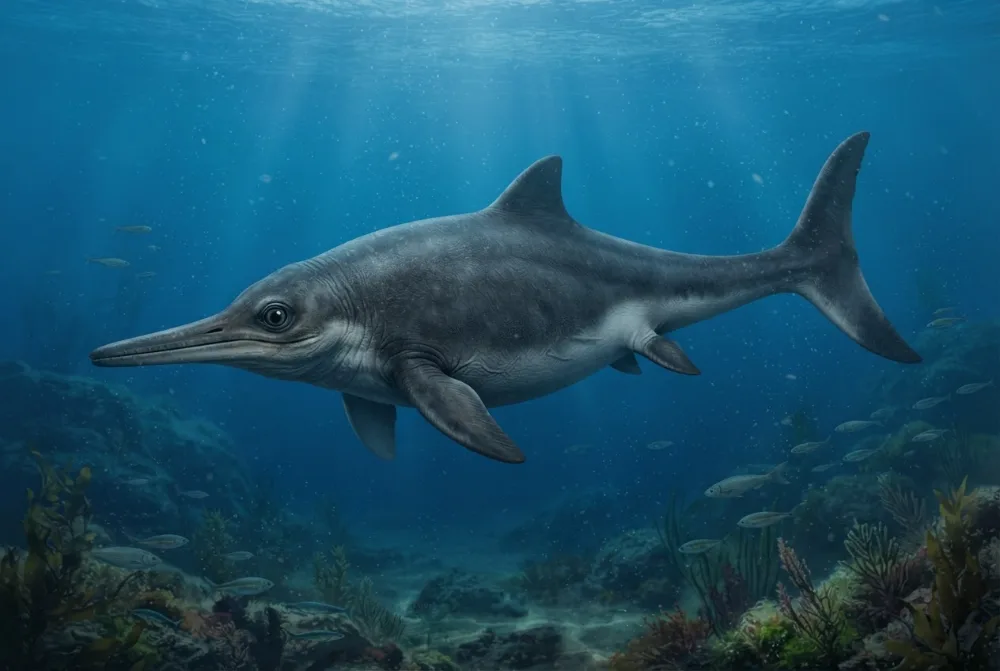
Acamptonectes was a fast-swimming marine reptile that lived in the Early Cretaceous seas. It had a stiff body and large eyes, perfect for hunting fish and squid in the deep ocean.12
Yabeerawo ddi?
Yali munene atya?
Yali muwanvu kwenkana wa?
 obuwanvu ng'embwa 3, ennyindo ku mukira🍌obuwanvu ng'amenvu 17 nga gaddiriŋŋana🏊yandiwuze obuwanvu bw'ekidiba ekinene (50 m) mu sikonda 3.8
Acamptonectes yali munene atya bw'ogeraageranya ku GGWE?
Kubala kwokka mu browser yo. Tewali kiterekebwa wadde okusindikibwa wonna.
Yali wa mbiro kwenkana wa?


Ebyewuunyisa
Acamptonectes belongs to a group called ophthalmosaurids, which had very large eyes for seeing in dark, deep water.12
Its name means 'stiff swimmer' because its body was unusually rigid, helping it move fast through the water.1
Acamptonectes lived about 133 to 129 million years ago, during the Hauterivian stage of the Early Cretaceous.1
Scientists once thought most ichthyosaurs died out at the end of the Jurassic, but Acamptonectes shows they survived and thrived into the Cretaceous.21
The first Acamptonectes fossil was found in 1958 by geology students near Speeton, England, but it was not named until 2012.21
Its teeth had tiny ridges along the length, which helped it grip slippery prey like fish and squid.1
Ebibuuzo ebisinga okubuuzibwa ku Acamptonectes
?Was Acamptonectes a dinosaur?
No, it was a marine reptile called an ichthyosaur, not a dinosaur.1
?How big was Acamptonectes?
It was about 3 metres (9.8 feet) long.1
?What did Acamptonectes eat?
It likely ate soft, fleshy prey like fish and squid, using its slender ridged teeth to impale them.1
?Why did Acamptonectes have a stiff body?
Its stiff body helped it swim fast like a tuna by making it more streamlined in the water.1
Eri abakugu mu dayinoso
- Erinnya lya ssaayansi
- Acamptonectes
- Yatuumibwa
- Fischer et al. 20123
- Ekibinja
- Ikisiyosawulu
- Ekika / ekibinja
- Ophthalmosauridae3
- Engabanya
- Ichthyosauria > Ichthyosauromorpha3
- Emyaka gy'enjazi
- emyaka obukadde 133 okutuuka ku 126 (Hauterivian)3
- Ensengeka z'enjazi
- Speeton Clay3
- Ensi
- Bungereza, Bugirimaani3
- Ebisigalira ebyazuulibwa
- 3 mu The Paleobiology Database3
- Okuzuulibwa
- Acamptonectes was named in 2012 by a team of scientists including V. Fischer, M. W. Maisch, and D. Naish. The first specimen was collected in 1958 by geology students in Speeton, England, but it took decades to study and describe.23
- Kikyakubaganyizibwako ebirowoozo
- Scientists are still debating whether Acamptonectes had a different diet or lifestyle from other Cretaceous ichthyosaurs because of its unusual shallow snout and tooth shape.1
Ebituufu gye biva
- Acamptonectes (en.wikipedia.org)
- New Ophthalmosaurid Ichthyosaurs from the European Lower Cretaceous Demonstrate Extensive Ichthyosaur Survival across the Jurassic, Cretaceous Boundary (pmc.ncbi.nlm.nih.gov)
- Acamptonectes in The Paleobiology Database (CC BY 4.0): emyaka, ebifo, ensengeka z'enjazi, engabanya.
Buli kituufu ku lupapula luno kirina ennamba eraga ensibuko yaakyo. Bwe tuba nga tukoze ensobi, tusonyiwe, ffe tuli bawagizi ba dayinoso, so si magazini ya ssaayansi. Tubuulire ku [email protected] tujja kugitereeza.
 Rex alumwa enjala! Dino Wiki pulojekiti ya taata eri mutabani we ayagala ennyo dayinoso, ya bwereere, tewali bulango era tewali bikulondoola. Abakulu basobola okuwa Rex akantu ak'okulya okuyamba okugikuuma ku mutimbagano.Liisa Rex
 Ichthyosaurus
 Platypterygius
 Stenopterygius
 Khudiakovia
 Ophthalmosaurus
 Chonespondylus
 Stegosaurus
 Iguanodon
 Archaeopteryx
 Giganotosaurus
 Microraptor
 Deinonychus