 Kwizi: Oli dayinoso ki?
 Olutalo lwa dayinoso
 Empaka z'emisinde gya dayinoso
 Emizannyo emitono egya dayinoso
 Alubaamu ya sitika
 Enkalala za dayinoso eza TOP
 Mpa ekyewuunyisa!
Yabeerawo ddi?

Yali munene atya?
Yali muwanvu kwenkana wa?
Yali mugulumivu kwenkana wa?
kuteebereza
Yali muzito kwenkana wa?
 obuwanvu ng'embwa 6, ennyindo ku mukira🍌obuwanvu ng'amenvu 33 nga gaddiriŋŋana🍉obuzito ng'obwa wotamerooni 140🧸obuzito ng'obw'abaana 37 ab'omu nnasale🎒obuzito ng'obw'abaana b'essomero 22🏃yandidduse mita 100 mu sikonda 8.6 (omuntu asinga embiro yeetaaga 9.6)
Alioramus yali munene atya bw'ogeraageranya ku GGWE?
Kubala kwokka mu browser yo. Tewali kiterekebwa wadde okusindikibwa wonna.
Yali wa mbiro kwenkana wa?


Ebyewuunyisa
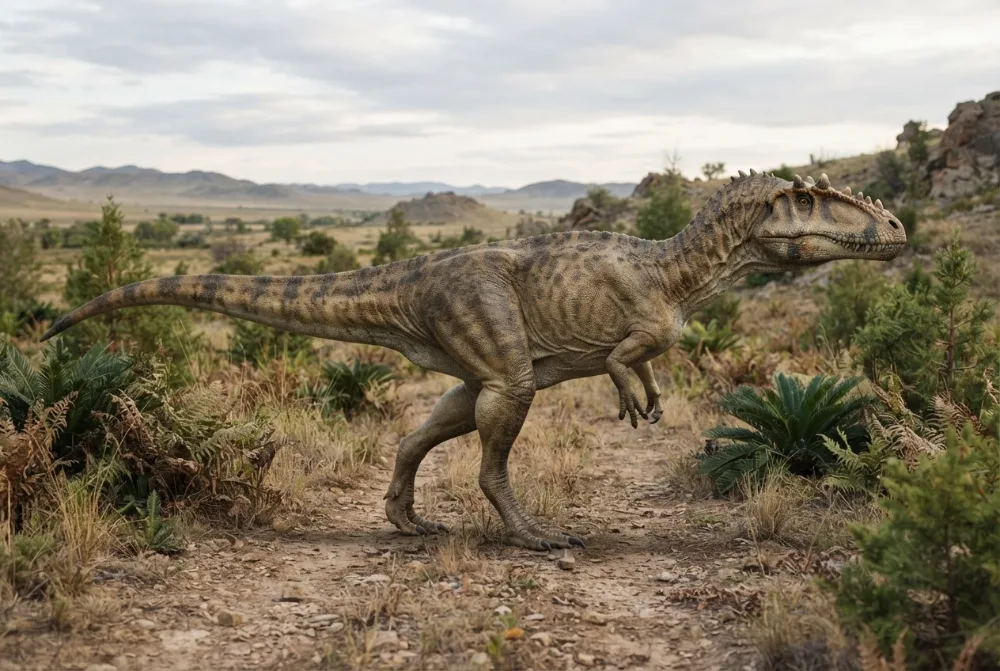
Alioramus had a long, low snout, unlike the deep, powerful skulls of most other tyrannosaurs.2
Its skull was decorated with eight separate horns, more than any other known tyrannosaur.2
One nearly complete skeleton belonged to a nine-year-old animal, but it was still smaller than other tyrannosaurs of the same age.2
Alioramus is closely related to the giant Tarbosaurus and Tyrannosaurus, even though it was much smaller and lighter.2
The name Alioramus means 'other branch', because scientists thought it was a different line of evolution.1
Ebibuuzo ebisinga okubuuzibwa ku Alioramus
?How big was Alioramus?
Alioramus was about 5 to 6 metres (16 to 20 feet) long and weighed around 385 to 700 kilograms (849 to 1,500 pounds), depending on the species and estimate. It was significantly smaller than a T. rex.341
?What did Alioramus eat?
Alioramus was a carnivore that ate meat. It had sharp teeth and probably hunted small prey, since its skull was not built for bone-crushing like larger tyrannosaurs.34
?How fast could Alioramus run?
The sources do not give a specific speed for Alioramus. It probably relied on speed and agility to hunt, but no exact running speed is known.4
?Why did Alioramus have horns on its head?
Alioramus had a row of five bony crests along the top of its snout, which may have been used for display or to attract mates. These crests were more than 1 cm (0.39 in) tall.3
?Is Alioramus a dinosaur?
Yes, Alioramus is a dinosaur. It is a genus of tyrannosaurid theropod dinosaurs from the Late Cretaceous period.31
Eri abakugu mu dayinoso
- Erinnya lya ssaayansi
- Alioramus
- Yatuumibwa
- Kurzanov 19765
- Ekibinja
- Tiranosawulu
- Ekika / ekibinja
- Tyrannosauridae5
- Engabanya
- Theropoda > Tyrannosauroidea > Tyrannosauridae5
- Emyaka gy'enjazi
- emyaka obukadde 72 okutuuka ku 66 (Maastrichtian)5
- Ensengeka z'enjazi
- Beds of Nogon Tsav, Nemegt5
- Ensi
- Mongoliya, Cayina5
- Ebisigalira ebyazuulibwa
- 3 mu The Paleobiology Database5
- Okuzuulibwa
- Alioramus was named by Soviet paleontologist Sergei Kurzanov in 1976, based on fossils from the Nogon Tsav locality in Mongolia.5
- Kikyakubaganyizibwako ebirowoozo
- Scientists still debate whether Alioramus is a juvenile of another tyrannosaur or a distinct, smaller adult species.2
Ebituufu gye biva
- Alioramus | Natural History Museum (nhm.ac.uk)
- pnas.org (pnas.org)
- Alioramus (en.wikipedia.org)
- Dinosaur - Alioramus altai - The Australian Museum (australian.museum)
- Alioramus in The Paleobiology Database (CC BY 4.0): emyaka, ebifo, ensengeka z'enjazi, engabanya.
Buli kituufu ku lupapula luno kirina ennamba eraga ensibuko yaakyo. Bwe tuba nga tukoze ensobi, tusonyiwe, ffe tuli bawagizi ba dayinoso, so si magazini ya ssaayansi. Tubuulire ku [email protected] tujja kugitereeza.
 Rex alumwa enjala! Dino Wiki pulojekiti ya taata eri mutabani we ayagala ennyo dayinoso, ya bwereere, tewali bulango era tewali bikulondoola. Abakulu basobola okuwa Rex akantu ak'okulya okuyamba okugikuuma ku mutimbagano.Liisa Rex
 Tyrannosaurus
 Tarbosaurus
 Albertosaurus
 Daspletosaurus
 Gorgosaurus
 Alectrosaurus
 Triceratops
 Velociraptor
 Spinosaurus
 Ankylosaurus
 Parasaurolophus
 Pteranodon