 Kwizi: Oli dayinoso ki?
 Olutalo lwa dayinoso
 Empaka z'emisinde gya dayinoso
 Emizannyo emitono egya dayinoso
 Alubaamu ya sitika
 Enkalala za dayinoso eza TOP
 Mpa ekyewuunyisa!
Parasaurolophus
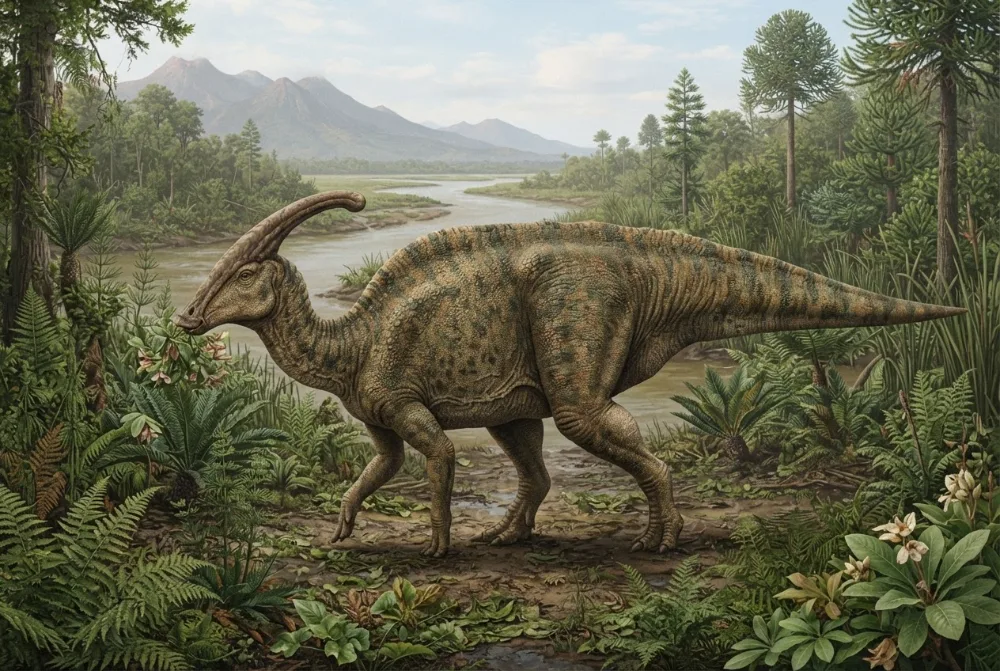
Parasaurolophus was a duck-billed dinosaur with a long, curved crest on its head. It lived in North America during the Late Cretaceous Period, about 77 to 73 million years ago. This plant-eater could walk on two legs or all fours.21
Yabeerawo ddi?
Yali munene atya?
Yali muwanvu kwenkana wa?
Yali mugulumivu kwenkana wa?
Yali muzito kwenkana wa?
 obuwanvu ng'emmotoka 2 ezisimbiddwa mu lunyiriri🍌obuwanvu ng'amenvu 50 nga gaddiriŋŋana
 obuzito ng'obw'enjovu🍉obuzito ng'obwa wotamerooni 1000🎒obuzito ng'obw'ebibiina 6 ebijjuvu eby'abaana b'essomero🐻❄️obuzito ng'obwa ddubu enjeru 11🏃yandidduse mita 100 mu sikonda 17 (omuntu asinga embiro yeetaaga 9.6)
Parasaurolophus yali munene atya bw'ogeraageranya ku GGWE?
Kubala kwokka mu browser yo. Tewali kiterekebwa wadde okusindikibwa wonna.
Yali wa mbiro kwenkana wa?


Ebyewuunyisa
Parasaurolophus had a huge, hollow crest on its head that was shaped like a long tube. Scientists think it may have used the crest to make sounds like a trumpet.1
It had a beak like a duck and cheeks to hold food while chewing. Its teeth were constantly replaced, with hundreds packed together in a 'dental battery'.21
Parasaurolophus could walk on two legs or on all fours. It probably spent most of its time on all fours but could stand on its back legs when needed.2
Three species are known: P. walkeri, P. tubicen, and P. cyrtocristatus. P. tubicen was the largest and had the longest, straightest crest.1
The first Parasaurolophus fossil was found in 1920 near Sand Creek in Alberta, Canada. It was named in 1922 by William Parks.1
Parasaurolophus lived in a warm, swampy environment near the shore of a huge inland sea that split North America in two.1
Ebibuuzo ebisinga okubuuzibwa ku Parasaurolophus
?How big was Parasaurolophus?
Parasaurolophus could reach over 9 metres (30 ft) long and weigh over 5 metric tons (5.5 short tons).1
?What did Parasaurolophus eat?
Parasaurolophus was a herbivore, eating plants like leaves, twigs, and pine needles. It used its beak to crop plants and its many teeth to grind them.12
?Why did Parasaurolophus have a crest?
Nobody knows for sure. Scientists think it may have been used for making loud sounds, for visual recognition, or for controlling body temperature, and it probably had more than one use.21
?Could Parasaurolophus swim?
The sources do not say whether Parasaurolophus could swim. It lived in a warm, swampy environment near a huge inland sea, but its swimming ability is not mentioned.1
?How fast could Parasaurolophus run?
Probably up to about 21 km/h (13 mph), about as fast as a grown-up riding a bike. This is an estimate from its size. It could walk on two legs or four, and probably ran on two legs.12
?Was Parasaurolophus bigger than T. rex?
No, Parasaurolophus was smaller than T. rex. Parasaurolophus was about 9 metres (30 ft) long, while T. rex could be over 12 metres (40 ft) long.1
?Did Parasaurolophus have feathers?
The sources do not mention feathers on Parasaurolophus. Skin impressions show scales, not feathers.1
?When did Parasaurolophus live?
Parasaurolophus lived during the Late Cretaceous Period, about 76.5 to 73 million years ago.1
?Where was Parasaurolophus found?
Parasaurolophus fossils have been found in Alberta, New Mexico, and Utah in North America, and possibly in Asia.1
Eri abakugu mu dayinoso
- Erinnya lya ssaayansi
- Parasaurolophus
- Yatuumibwa
- Parks 19225
- Ekibinja
- Ez'emimwa gy'embaata
- Ekika / ekibinja
- Hadrosauridae5
- Engabanya
- Ornithischia > Ornithopoda > Iguanodontia > Hadrosauridae5
- Emyaka gy'enjazi
- emyaka obukadde 84 okutuuka ku 72 (Campanian)5
- Ensengeka z'enjazi
- Kirtland, Dinosaur Park, Fruitland5
- Ensi
- Amerika, Kanada5
- Ebisigalira ebyazuulibwa
- 20 mu The Paleobiology Database5
- Okuzuulibwa
- The first Parasaurolophus fossil, a skull and partial skeleton, was found in 1920 by a University of Toronto field party near Sand Creek in Alberta, Canada. William Parks named it Parasaurolophus walkeri in 1922.1
- Kikyakubaganyizibwako ebirowoozo
- Scientists debate whether the different crest shapes belong to separate species or are just males and females of the same species.1
Ebituufu gye biva
- Parasaurolophus (en.wikipedia.org)
- Parasaurolophus | Natural History Museum (nhm.ac.uk)
- PARASAUROLOPHUS : DinoChecker dinosaur archive (dinochecker.com)
- Parasaurolophus Size: How Big Was It and What Did It Look Like? (extinctatlas.org)
- Parasaurolophus in The Paleobiology Database (CC BY 4.0): emyaka, ebifo, ensengeka z'enjazi, engabanya.
Buli kituufu ku lupapula luno kirina ennamba eraga ensibuko yaakyo. Bwe tuba nga tukoze ensobi, tusonyiwe, ffe tuli bawagizi ba dayinoso, so si magazini ya ssaayansi. Tubuulire ku [email protected] tujja kugitereeza.
 Rex alumwa enjala! Dino Wiki pulojekiti ya taata eri mutabani we ayagala ennyo dayinoso, ya bwereere, tewali bulango era tewali bikulondoola. Abakulu basobola okuwa Rex akantu ak'okulya okuyamba okugikuuma ku mutimbagano.Liisa Rex
 Edmontosaurus
 Saurolophus
 Hypacrosaurus
 Corythosaurus
 Kritosaurus
 Gryposaurus
 Tyrannosaurus
 Triceratops
 Velociraptor
 Spinosaurus
 Ankylosaurus
 Pteranodon