 Kwizi: Oli dayinoso ki?
 Olutalo lwa dayinoso
 Empaka z'emisinde gya dayinoso
 Emizannyo emitono egya dayinoso
 Alubaamu ya sitika
 Enkalala za dayinoso eza TOP
 Mpa ekyewuunyisa!
Yabeerawo ddi?

Yali munene atya?
Yali muwanvu kwenkana wa?
Yali mugulumivu kwenkana wa?
kuteebereza
Yali muzito kwenkana wa?

 obuwanvu ng'embwa 8, ennyindo ku mukira🍌obuwanvu ng'amenvu 44 nga gaddiriŋŋanaobuzito ng'obw'embwa 150🍉obuzito ng'obwa wotamerooni 600🎒obuzito ng'obw'ebibiina 4 ebijjuvu eby'abaana b'essomero🐻❄️obuzito ng'obwa ddubu enjeru 7🏃yandidduse mita 100 mu sikonda 15 (omuntu asinga embiro yeetaaga 9.6)
Amurosaurus yali munene atya bw'ogeraageranya ku GGWE?
Kubala kwokka mu browser yo. Tewali kiterekebwa wadde okusindikibwa wonna.
Yali wa mbiro kwenkana wa?


Ebyewuunyisa
Amurosaurus is named after the Amur River, which forms the border between Russia and China.1
Most of the bones found in its bonebed belong to young Amurosaurus, not adults.1
Theropod teeth are common in the bonebed, and many bones have tooth marks, showing that predators or scavengers chewed on them.1
Amurosaurus had a unique S-shaped curve in its lower arm bone, the ulna.1
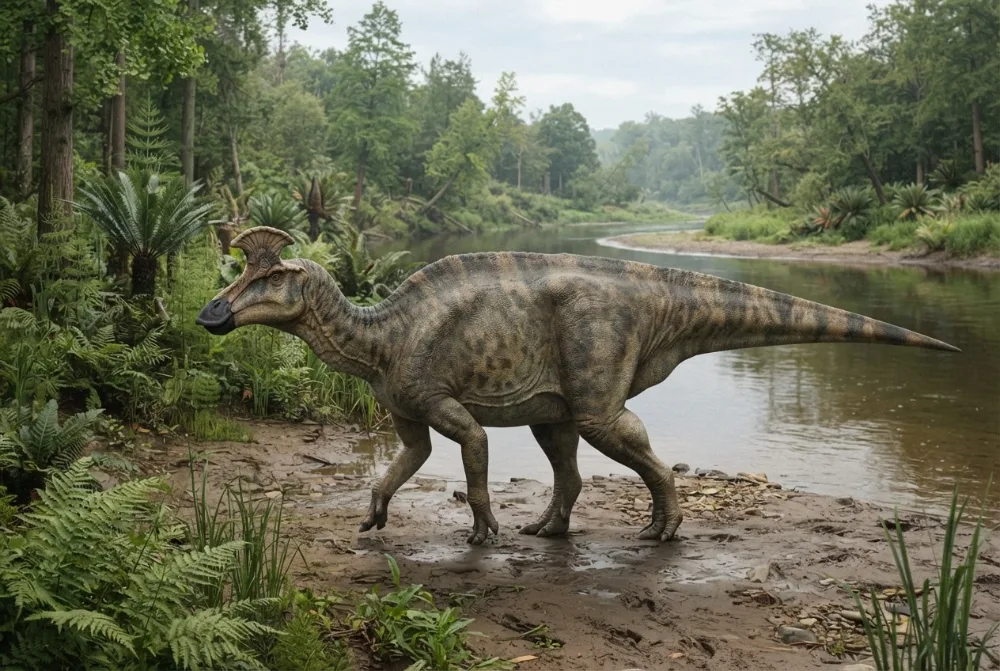
Although the crest bones are missing, the skull roof shows it likely had a hollow crest like other lambeosaurines.1
Amurosaurus had a relatively large brain compared to some other plant-eaters, which might mean it lived in groups.1
Ebibuuzo ebisinga okubuuzibwa ku Amurosaurus
?How big was Amurosaurus?
About 8 metres (26 feet) long and around 3 metric tons (3.3 short tons) in weight, though one source says it may have been up to 12 metres (39 feet) long.12
?What did Amurosaurus eat?
It was a plant-eater, or herbivore, like all hadrosaurid dinosaurs.1
?Did Amurosaurus have a crest?
Yes, it probably had a hollow crest on its head, even though the crest bones themselves have not been found yet.1
?When did Amurosaurus live?
It lived during the Late Cretaceous period, about 70 to 66 million years ago.1
?Where was Amurosaurus found?
All its fossils come from a single bonebed in Blagoveschensk, Russia, near the Amur River.1
?Was Amurosaurus a dinosaur?
Yes, it was a lambeosaurine hadrosaurid dinosaur.1
Omumenyi w'enfumo
Enfumo: Amurosaurus was a meat-eater because it had sharp teeth.
Amazima: Amurosaurus was a plant-eater, as shown by its beak and teeth made for grinding plants.1
Eri abakugu mu dayinoso
- Erinnya lya ssaayansi
- Amurosaurus
- Yatuumibwa
- Bolotsky and Kurzanov 19913
- Ekibinja
- Ez'emimwa gy'embaata
- Ekika / ekibinja
- Hadrosauridae3
- Engabanya
- Ornithischia > Ornithopoda > Iguanodontia > Hadrosauridae3
- Emyaka gy'enjazi
- emyaka obukadde 72 okutuuka ku 66 (Maastrichtian)3
- Ensengeka z'enjazi
- Udurchukan, Yuliangzi3
- Ensi
- Rwasha, Cayina3
- Ebisigalira ebyazuulibwa
- 2 mu The Paleobiology Database3
- Era emanyiddwa nga
- Sahaliyania (amannya ag'edda kati gabalibwa ng'ekisolo kye kimu)3
- Okuzuulibwa
- Russian paleontologists Yuri Bolotsky and Sergei Kurzanov named Amurosaurus in 1991. The first fossils were found in 1984 in a bonebed inside the city of Blagoveschensk, Russia.1
- Kikyakubaganyizibwako ebirowoozo
- Scientists are still debating whether Amurosaurus had a crest and what it looked like, because the crest bones have not been found.1
Ebituufu gye biva
- Amurosaurus (en.wikipedia.org)
- Amurosaurus State Darwin Museum (darwinmuseum.ru)
- Amurosaurus in The Paleobiology Database (CC BY 4.0): emyaka, ebifo, ensengeka z'enjazi, engabanya.
Buli kituufu ku lupapula luno kirina ennamba eraga ensibuko yaakyo. Bwe tuba nga tukoze ensobi, tusonyiwe, ffe tuli bawagizi ba dayinoso, so si magazini ya ssaayansi. Tubuulire ku [email protected] tujja kugitereeza.
 Rex alumwa enjala! Dino Wiki pulojekiti ya taata eri mutabani we ayagala ennyo dayinoso, ya bwereere, tewali bulango era tewali bikulondoola. Abakulu basobola okuwa Rex akantu ak'okulya okuyamba okugikuuma ku mutimbagano.Liisa Rex
 Parasaurolophus
 Edmontosaurus
 Saurolophus
 Hypacrosaurus
 Corythosaurus
 Kritosaurus
 Tyrannosaurus
 Triceratops
 Velociraptor
 Spinosaurus
 Ankylosaurus
 Pteranodon