 Kwizi: Oli dayinoso ki?
 Olutalo lwa dayinoso
 Empaka z'emisinde gya dayinoso
 Emizannyo emitono egya dayinoso
 Alubaamu ya sitika
 Enkalala za dayinoso eza TOP
 Mpa ekyewuunyisa!
Yabeerawo ddi?

Yali munene atya?
Yali muwanvu kwenkana wa?
Yali mugulumivu kwenkana wa?
kuteebereza
Yali muzito kwenkana wa?
 obuwanvu ng'embwa 6, ennyindo ku mukira🍌obuwanvu ng'amenvu 33 nga gaddiriŋŋana🍉obuzito ng'obwa wotamerooni 240🧸obuzito ng'obw'abaana 63 ab'omu nnasale🎒obuzito ng'obw'abaana b'essomero 38🐻❄️obuzito ng'obwa ddubu enjeru 2.5🏃yandidduse mita 100 mu sikonda 9.5 (omuntu asinga embiro yeetaaga 9.6)
Anchiceratops yali munene atya bw'ogeraageranya ku GGWE?
Kubala kwokka mu browser yo. Tewali kiterekebwa wadde okusindikibwa wonna.
Yali wa mbiro kwenkana wa?


Ebyewuunyisa
Anchiceratops is rare compared to other horned dinosaurs in the same area, and its fossils are often found near ancient marine sediments.1
The name Anchiceratops means 'near horned face' because Barnum Brown thought it was a close relative of Triceratops.1
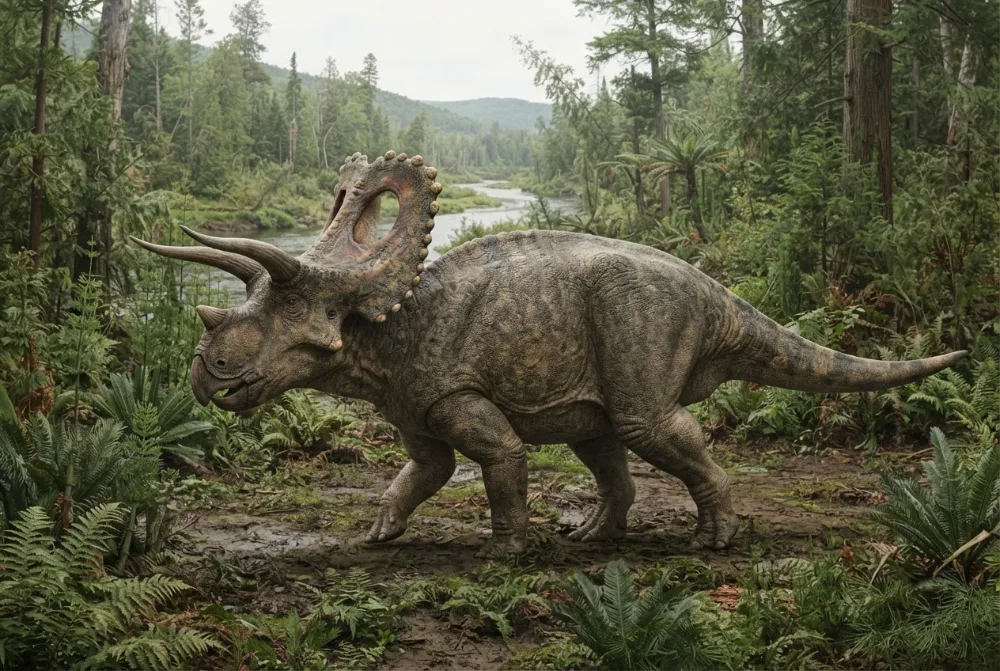
Its frill had coarse triangular projections along the edge, which is why the species name ornatus means 'ornate'.1
Anchiceratops lived in estuaries and coastal areas, where other ceratopsids did not live.1
The first fossils were found along the Red Deer River in Alberta, Canada, in 1912 by an expedition led by Barnum Brown.1
Anchiceratops shared its environment with dinosaurs like Albertosaurus, Edmontosaurus, and Pachyrhinosaurus.1
Ebibuuzo ebisinga okubuuzibwa ku Anchiceratops
?How big was Anchiceratops?
About 4.3 metres long and weighed around 1.2 tonnes.1
?What did Anchiceratops eat?
It was a herbivore, eating plants like conifers, cycads, and ferns.1
?Could Anchiceratops swim?
Some scientists think it may have lived in swamps and estuaries like a hippopotamus, but others disagree.1
?Why did Anchiceratops have a frill?
Probably for display and to recognize other members of its species, not for defense.1
?How many horns did Anchiceratops have?
Three: two long horns above its eyes and a short horn on its nose.1
Eri abakugu mu dayinoso
- Erinnya lya ssaayansi
- Anchiceratops
- Yatuumibwa
- Brown 19143
- Ekibinja
- Dayinoso ez'amayembe
- Ekika / ekibinja
- Ceratopsidae3
- Engabanya
- Ornithischia > Ceratopsia > Ceratopsidae3
- Emyaka gy'enjazi
- emyaka obukadde 84 okutuuka ku 66 (Campanian / Maastrichtian)3
- Ensengeka z'enjazi
- Horseshoe Canyon, St. Mary River3
- Ensi
- Kanada3
- Ebisigalira ebyazuulibwa
- 7 mu The Paleobiology Database3
- Okuzuulibwa
- Anchiceratops was named by American paleontologist Barnum Brown in 1914. He found the first fossils in 1912 along the Red Deer River in Alberta, Canada.1
- Kikyakubaganyizibwako ebirowoozo
- Scientists still debate whether some frill fragments from older rock formations belong to Anchiceratops or to a different, related species.1
Ebituufu gye biva
- Anchiceratops (en.wikipedia.org)
- Anchiceratops | Natural History Museum (nhm.ac.uk)
- Anchiceratops in The Paleobiology Database (CC BY 4.0): emyaka, ebifo, ensengeka z'enjazi, engabanya.
Buli kituufu ku lupapula luno kirina ennamba eraga ensibuko yaakyo. Bwe tuba nga tukoze ensobi, tusonyiwe, ffe tuli bawagizi ba dayinoso, so si magazini ya ssaayansi. Tubuulire ku [email protected] tujja kugitereeza.
 Rex alumwa enjala! Dino Wiki pulojekiti ya taata eri mutabani we ayagala ennyo dayinoso, ya bwereere, tewali bulango era tewali bikulondoola. Abakulu basobola okuwa Rex akantu ak'okulya okuyamba okugikuuma ku mutimbagano.Liisa Rex
 Triceratops
 Protoceratops
 Ojoceratops
 Tatankaceratops
 Psittacosaurus
 Centrosaurus
 Tyrannosaurus
 Velociraptor
 Spinosaurus
 Ankylosaurus
 Parasaurolophus
 Pteranodon