 Kwizi: Oli dayinoso ki?
 Olutalo lwa dayinoso
 Empaka z'emisinde gya dayinoso
 Emizannyo emitono egya dayinoso
 Alubaamu ya sitika
 Enkalala za dayinoso eza TOP
 Mpa ekyewuunyisa!
Yabeerawo ddi?

Yali munene atya?
Yali muwanvu kwenkana wa?
Yali mugulumivu kwenkana wa?
Yali muzito kwenkana wa?

 obuwanvu ng'embwa 6, ennyindo ku mukira🍌obuwanvu ng'amenvu 33 nga gaddiriŋŋanaobuzito ng'obw'embwa 100🍉obuzito ng'obwa wotamerooni 400🎒obuzito ng'obw'ebibiina 2.5 ebijjuvu eby'abaana b'essomero🐻❄️obuzito ng'obwa ddubu enjeru 4🏃yandidduse mita 100 mu sikonda 12 (omuntu asinga embiro yeetaaga 9.6)
Aquilarhinus yali munene atya bw'ogeraageranya ku GGWE?
Kubala kwokka mu browser yo. Tewali kiterekebwa wadde okusindikibwa wonna.
Yali wa mbiro kwenkana wa?


Ebyewuunyisa
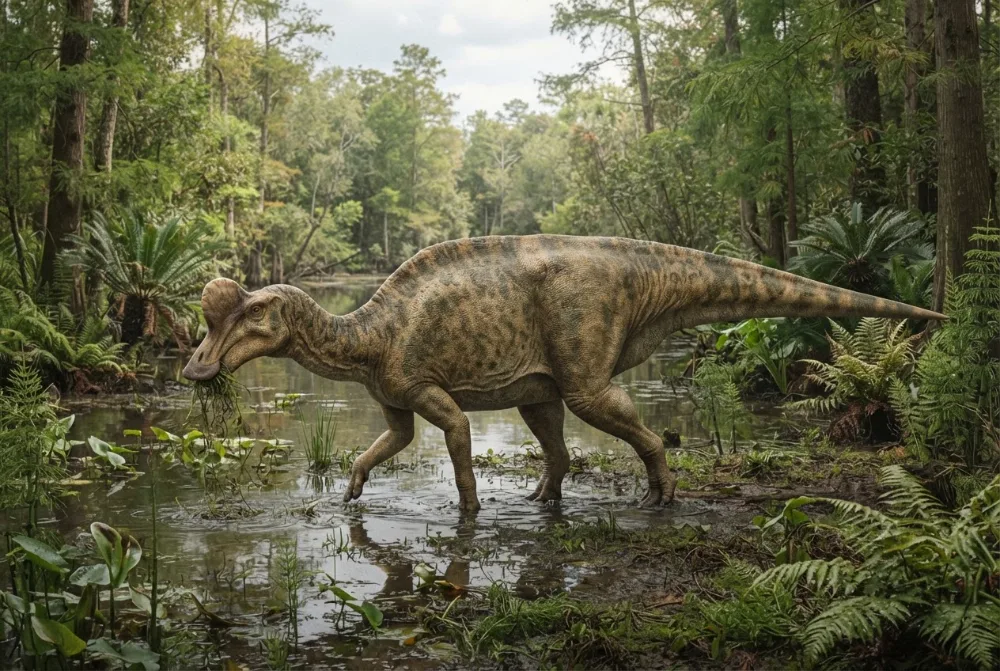
Aquilarhinus had a beak shaped like a shovel, which was different from the flat beaks of most duck-billed dinosaurs.12
Its lower jaw bones met in a W shape at the front, which helped it scoop up plants.2
The name Aquilarhinus means 'eagle snout' because its nose bones were arched like an eagle's beak.1
This dinosaur lived during the Campanian stage of the Late Cretaceous, between 83.6 and 72.2 million years ago.3
Aquilarhinus was first thought to be a species of Kritosaurus, but scientists later realized it was a new genus.1
Ebibuuzo ebisinga okubuuzibwa ku Aquilarhinus
?How big was Aquilarhinus?
Scientists have not published a specific length or weight for Aquilarhinus, but as a hadrosaurid it was probably similar in size to other duck-billed dinosaurs, around 7 to 9 metres (23 to 30 feet) long.1
?What did Aquilarhinus eat?
It ate soft plants, scooping up semiaquatic vegetation from swamps and rivers with its shovel-shaped beak.12
?Why did Aquilarhinus have a shovel beak?
Its lower jaw bones met in a W shape, forming a wide, flattened scoop that helped it shovel out and scoop up loose, wet sediment and aquatic plants.12
?When did Aquilarhinus live?
It lived about 80 million years ago, during the Campanian stage of the Late Cretaceous.1
Omumenyi w'enfumo
Enfumo: Some people think all duck-billed dinosaurs had flat, duck-like beaks.
Amazima: Aquilarhinus had a shovel-shaped beak, not flat like a duck's. It used it to dig and scoop plants.2
Eri abakugu mu dayinoso
- Erinnya lya ssaayansi
- Aquilarhinus
- Yatuumibwa
- Prieto-Márquez et al. 20204
- Ekibinja
- Ez'emimwa gy'embaata
- Ekika / ekibinja
- Hadrosauridae4
- Engabanya
- Ornithischia > Ornithopoda > Iguanodontia > Hadrosauridae4
- Emyaka gy'enjazi
- emyaka obukadde 84 okutuuka ku 72 (Campanian)4
- Ensengeka z'enjazi
- Aguja4
- Ensi
- Amerika4
- Ebisigalira ebyazuulibwa
- 1 mu The Paleobiology Database4
- Okuzuulibwa
- The first fossil of Aquilarhinus was found in 1983 in Big Bend National Park, Texas. More bones were dug up in 1999. It was named Aquilarhinus palimentus in 2019 by scientists Prieto-Márquez, Wagner, and Lehman.1
- Kikyakubaganyizibwako ebirowoozo
- Scientists are still debating exactly how Aquilarhinus used its shovel-shaped beak. It might have scooped plants from water or dug in mud.2
Ebituufu gye biva
- Aquilarhinus (en.wikipedia.org)
- An unusual ‘shovel-billed’ dinosaur with trophic specializations from the early Campanian of Trans-Pecos Texas, and the ancestral hadrosaurian crest: Journal of Systematic Palaeontology: Vol 18 , No 6 - Get Access (tandfonline.com)
- PBDB Taxon (paleobiodb.org)
- Aquilarhinus in The Paleobiology Database (CC BY 4.0): emyaka, ebifo, ensengeka z'enjazi, engabanya.
Buli kituufu ku lupapula luno kirina ennamba eraga ensibuko yaakyo. Bwe tuba nga tukoze ensobi, tusonyiwe, ffe tuli bawagizi ba dayinoso, so si magazini ya ssaayansi. Tubuulire ku [email protected] tujja kugitereeza.
 Rex alumwa enjala! Dino Wiki pulojekiti ya taata eri mutabani we ayagala ennyo dayinoso, ya bwereere, tewali bulango era tewali bikulondoola. Abakulu basobola okuwa Rex akantu ak'okulya okuyamba okugikuuma ku mutimbagano.Liisa Rex
 Parasaurolophus
 Edmontosaurus
 Saurolophus
 Hypacrosaurus
 Corythosaurus
 Kritosaurus
 Tyrannosaurus
 Triceratops
 Velociraptor
 Spinosaurus
 Ankylosaurus
 Pteranodon