 Kwizi: Oli dayinoso ki?
 Olutalo lwa dayinoso
 Empaka z'emisinde gya dayinoso
 Emizannyo emitono egya dayinoso
 Alubaamu ya sitika
 Enkalala za dayinoso eza TOP
 Mpa ekyewuunyisa!
Yabeerawo ddi?

Yali munene atya?
Yali muwanvu kwenkana wa?
Yali mugulumivu kwenkana wa?
kuteebereza
Yali muzito kwenkana wa?
 obuwanvu nga kkapa 2 ab'awaka, ennyindo ku mukira🍌obuwanvu ng'amenvu 6 nga gaddiriŋŋanaobuzito ng'obwa kkapa ow'awaka🍌obuzito ng'obw'amenvu 42🏊yandiwuze obuwanvu bw'ekidiba ekinene (50 m) mu sikonda 16
Baptornis yali munene atya bw'ogeraageranya ku GGWE?
Kubala kwokka mu browser yo. Tewali kiterekebwa wadde okusindikibwa wonna.
Yali wa mbiro kwenkana wa?


Ebyewuunyisa
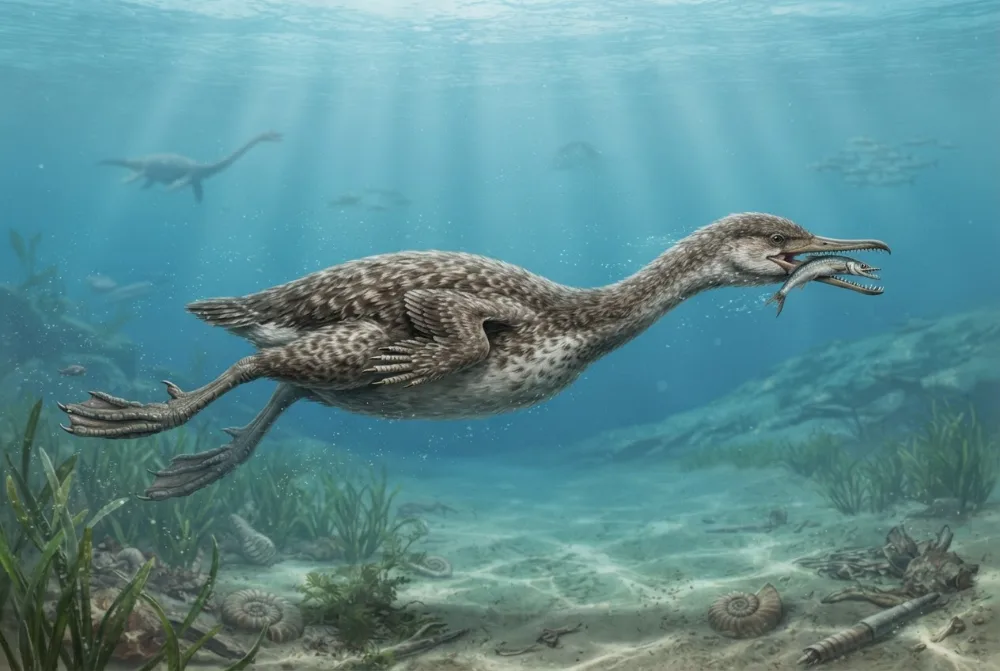
Baptornis had teeth in its beak, which is rare for birds. Most modern birds have no teeth.1
It was a strong swimmer and diver, but on land it was clumsy. It probably pushed itself along on its belly or did small hops.1
Fossils of young Baptornis have been found in Canada and Alaska, suggesting these birds migrated north to breed in summer, like some penguins do today.1
Baptornis lived about 87 to 80 million years ago, when a shallow sea covered much of central North America.1
One Baptornis fossil was found with tiny round coprolites (fossil poop) inside. The poop contained remains of a small sabre-toothed herring.1
Baptornis was one of the first Mesozoic birds discovered, along with Archaeopteryx. It was named by famous fossil hunter Othniel Charles Marsh in 1877.1
A second, much larger species of Baptornis was once named (Baptornis varneri), but later scientists moved it to a different genus called Brodavis.1
Ebibuuzo ebisinga okubuuzibwa ku Baptornis
?How big was Baptornis?
About the size of a loon, which is roughly 0.7 to 1 metre long. It was a medium-sized bird among its relatives.12
?Could Baptornis fly?
No, Baptornis was flightless. It was a strong swimmer and diver instead.1
?What did Baptornis eat?
It ate fish, especially small sabre-toothed herring called Enchodus. It caught them with its beak and swallowed them whole or in pieces.1
?Did Baptornis have teeth?
Yes, Baptornis had teeth in its beak, which is unusual for birds. Most modern birds have no teeth.1
Eri abakugu mu dayinoso
- Erinnya lya ssaayansi
- Baptornis
- Yatuumibwa
- Marsh 18773
- Ekibinja
- Ebinyonyi eby'olubereberye
- Ekika / ekibinja
- Baptornithidae3
- Engabanya
- Theropoda > Avialae3
- Emyaka gy'enjazi
- emyaka obukadde 90 okutuuka ku 72 (Coniacian / Campanian)3
- Ensengeka z'enjazi
- Dinosaur Park, Niobrara, Judith River3
- Ensi
- Kanada, Amerika, Swiidi3
- Ebisigalira ebyazuulibwa
- 10 mu The Paleobiology Database3
- Era emanyiddwa nga
- Parascaniornis (amannya ag'edda kati gabalibwa ng'ekisolo kye kimu)3
- Okuzuulibwa
- Othniel Charles Marsh discovered the first fossils of Baptornis in Kansas in the 1870s. He named it in 1877.1
- Kikyakubaganyizibwako ebirowoozo
- Scientists are not sure if a fossil from Sweden called Parascaniornis stensioi is actually a second species of Baptornis or just the same species.1
Ebituufu gye biva
- Baptornis (en.wikipedia.org)
- The Skeleton of Baptornis advenus (Aves: Hesperornithiformes) (exa.ai)
- Baptornis in The Paleobiology Database (CC BY 4.0): emyaka, ebifo, ensengeka z'enjazi, engabanya.
Buli kituufu ku lupapula luno kirina ennamba eraga ensibuko yaakyo. Bwe tuba nga tukoze ensobi, tusonyiwe, ffe tuli bawagizi ba dayinoso, so si magazini ya ssaayansi. Tubuulire ku [email protected] tujja kugitereeza.
 Rex alumwa enjala! Dino Wiki pulojekiti ya taata eri mutabani we ayagala ennyo dayinoso, ya bwereere, tewali bulango era tewali bikulondoola. Abakulu basobola okuwa Rex akantu ak'okulya okuyamba okugikuuma ku mutimbagano.Liisa Rex
 Archaeopteryx
 Hesperornis
 Ichthyornis
 Jurapteryx
 Gobipteryx
 Martinavis
 Tyrannosaurus
 Triceratops
 Velociraptor
 Spinosaurus
 Ankylosaurus
 Parasaurolophus