 Kwizi: Oli dayinoso ki?
 Olutalo lwa dayinoso
 Empaka z'emisinde gya dayinoso
 Emizannyo emitono egya dayinoso
 Alubaamu ya sitika
 Enkalala za dayinoso eza TOP
 Mpa ekyewuunyisa!
Beg
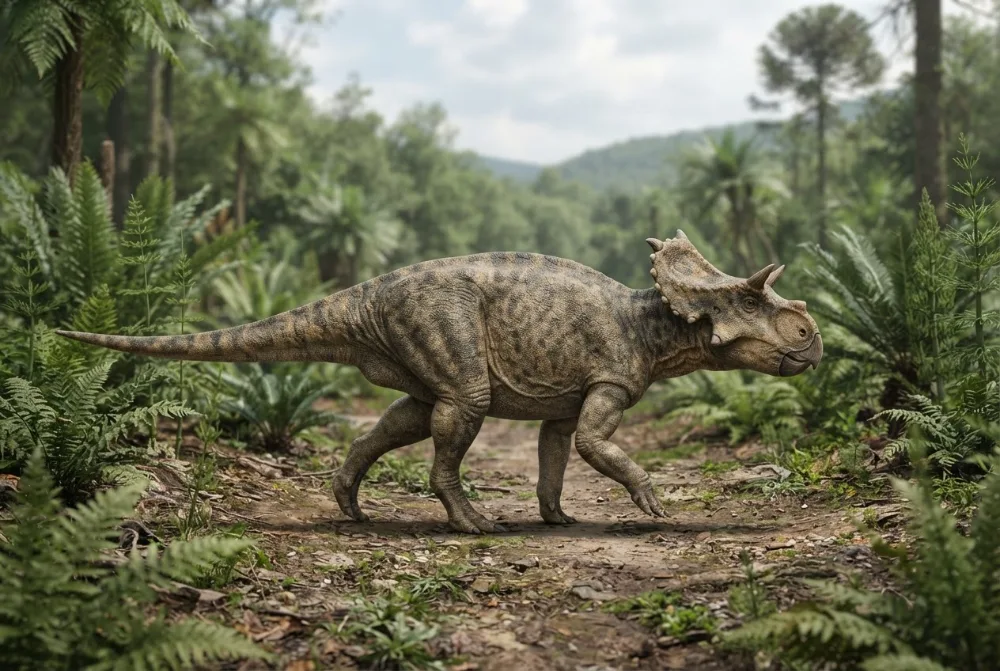
Beg was a small, plant-eating dinosaur that lived in what is now Mongolia. It had a beak and cheek teeth for chewing tough plants, and its skull had bumpy, armor-like bones. Beg is one of the earliest horned dinosaurs ever found in Mongolia.12
Yabeerawo ddi?
Yali wa mbiro kwenkana wa?


Ebyewuunyisa
Beg is the oldest known neoceratopsian dinosaur from Mongolia. Before its discovery, neoceratopsians were only known from younger, Late Cretaceous rocks in that region.1
The only fossil of Beg is a partial skull and a few other bones, including a rib and part of a shoulder blade. It was found by a joint Mongolian-American expedition in 2015.1
Beg had a unique skull with five equally spaced bumps on the side of its lower jaw. These bumps may have been covered by a horny sheath.1
Beg lived around 100 million years ago, right at the boundary between the Early and Late Cretaceous. Its age is estimated between 113 and 94 million years old.1
The name Beg comes from a Mongolian war god, Beg-tse, who is often shown with armor and bumpy skin, similar to the rough bones on Beg's skull.1
Beg had four large, cylindrical teeth in its upper jaw (premaxilla), which is a primitive feature not seen in later horned dinosaurs.1
Eri abakugu mu dayinoso
- Erinnya lya ssaayansi
- Beg
- Yatuumibwa
- Yu et al. 20202
- Ekibinja
- Dayinoso ez'amayembe
- Ekika / ekibinja
- Neoceratopsia2
- Engabanya
- Ornithischia > Ceratopsia2
- Emyaka gy'enjazi
- emyaka obukadde 106 okutuuka ku 94 (Albian / Cenomanian)2
- Ensengeka z'enjazi
- Ulaanoosh2
- Ensi
- Mongoliya2
- Ebisigalira ebyazuulibwa
- 1 mu The Paleobiology Database2
- Okuzuulibwa
- Beg was named in 2020 by Yu and colleagues based on a partial skeleton found in 2015 during a joint Mongolian Academy of Sciences and American Museum of Natural History expedition near Tsogt-Ovoo, Mongolia.12
- Kikyakubaganyizibwako ebirowoozo
- Scientists are not sure exactly how big Beg was because only a partial skull and a few other bones have been found. They also debate its exact age because the rocks where it was found are difficult to date.1
Ebituufu gye biva
- A neoceratopsian dinosaur from the early Cretaceous of Mongolia and the early evolution of ceratopsia (pmc.ncbi.nlm.nih.gov)
- Beg in The Paleobiology Database (CC BY 4.0): emyaka, ebifo, ensengeka z'enjazi, engabanya.
Buli kituufu ku lupapula luno kirina ennamba eraga ensibuko yaakyo. Bwe tuba nga tukoze ensobi, tusonyiwe, ffe tuli bawagizi ba dayinoso, so si magazini ya ssaayansi. Tubuulire ku [email protected] tujja kugitereeza.
 Rex alumwa enjala! Dino Wiki pulojekiti ya taata eri mutabani we ayagala ennyo dayinoso, ya bwereere, tewali bulango era tewali bikulondoola. Abakulu basobola okuwa Rex akantu ak'okulya okuyamba okugikuuma ku mutimbagano.Liisa Rex
 Triceratops
 Protoceratops
 Ojoceratops
 Tatankaceratops
 Psittacosaurus
 Centrosaurus
 Tyrannosaurus
 Velociraptor
 Spinosaurus
 Ankylosaurus
 Parasaurolophus
 Pteranodon