 Kwizi: Oli dayinoso ki?
 Olutalo lwa dayinoso
 Empaka z'emisinde gya dayinoso
 Emizannyo emitono egya dayinoso
 Alubaamu ya sitika
 Enkalala za dayinoso eza TOP
 Mpa ekyewuunyisa!
Cyamodus
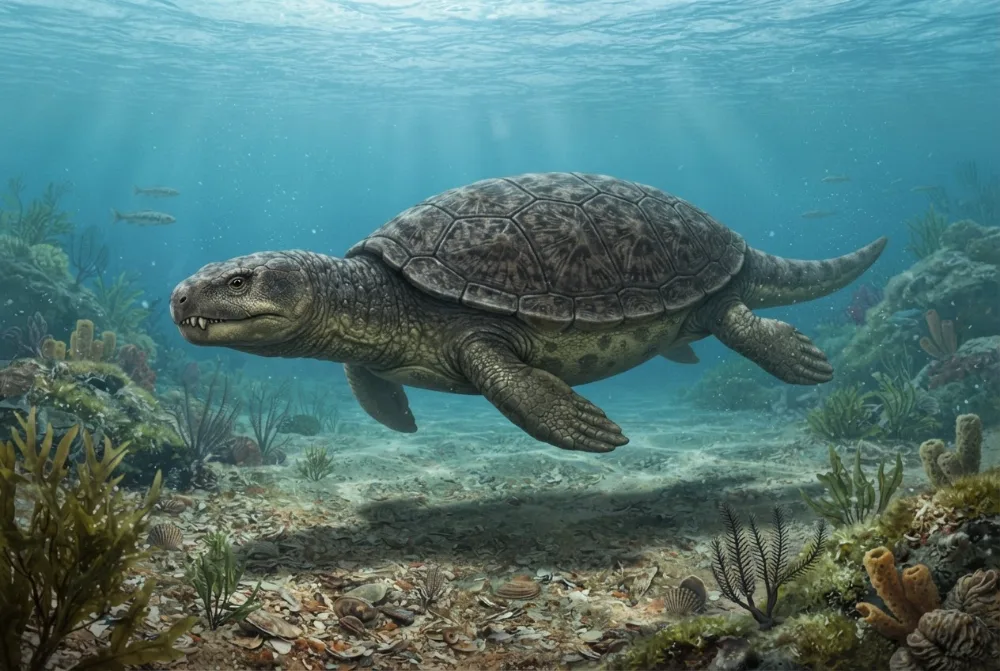
Cyamodus was a turtle-like marine reptile that lived in the Triassic seas. It had a hard shell made of bony plates and used its blunt teeth to crush shellfish. It was not a dinosaur, but a type of placodont.1
Yabeerawo ddi?
Yali munene atya?
Yali muwanvu kwenkana wa?
Yali muzito kwenkana wa?
 obuwanvu nga kkapa 3 ab'awaka, ennyindo ku mukira🍌obuwanvu ng'amenvu 8 nga gaddiriŋŋana🍉obuzito ng'obwa wotamerooni 5🏊yandiwuze obuwanvu bw'ekidiba ekinene (50 m) mu sikonda 20
Cyamodus yali munene atya bw'ogeraageranya ku GGWE?
Kubala kwokka mu browser yo. Tewali kiterekebwa wadde okusindikibwa wonna.
Yali wa mbiro kwenkana wa?


Ebyewuunyisa
Cyamodus had a two-part shell: a big plate covered its body from neck to hips, and a smaller plate covered its hips and tail base.1
Its shell was made of many hexagonal or circular bony plates that made it heavy, helping it sink and stay underwater to find food.1
Fossils of two baby Cyamodus were found inside the stomach of a Lariosaurus, a large marine reptile that ate them.1
Cyamodus lived about 245 to 235 million years ago, during the Middle and Late Triassic.1
Its skull was heart-shaped and broad, and its limbs were short so it probably only came on land to rest.1
The first Cyamodus fossils were found in Germany and were originally thought to be from fish.1
Ebibuuzo ebisinga okubuuzibwa ku Cyamodus
?How big was Cyamodus?
Most Cyamodus species were about 1.3 to 1.5 metres (4.3 to 4.9 feet) long and weighed 20 to 25 kilograms (44 to 55 pounds). The smallest species, C. rostratus, was about 0.9 metres (3.0 feet) long and weighed 5 kilograms (11 pounds).1
?What did Cyamodus eat?
Cyamodus ate shellfish, which it crushed with its blunt teeth. It lived near the sea floor, vacuuming up various shellfish and crushing them between its teeth.1
?Was Cyamodus a dinosaur?
No, Cyamodus was not a dinosaur. It was a type of placodont, a marine reptile related to turtles, and it lived during the Triassic period.1
Omumenyi w'enfumo
Enfumo: Cyamodus was an ancient turtle.
Amazima: It was not a turtle, but a placodont, a different group of marine reptiles that lived at the same time.1
Eri abakugu mu dayinoso
- Erinnya lya ssaayansi
- Cyamodus
- Yatuumibwa
- von Meyer 18633
- Ekibinja
- Ebyewalula eby'omu nnyanja
- Ekika / ekibinja
- Cyamodontidae3
- Engabanya
- Placodontia > Sauropterygia3
- Emyaka gy'enjazi
- emyaka obukadde 247 okutuuka ku 227 ()3
- Ensengeka z'enjazi
- Besano, Meissner, Templomhegy Dolomite3
- Ensi
- Bugirimaani, Bufalansa, Sulovenia, Swizirandi, Polandi, Hangare3
- Ebisigalira ebyazuulibwa
- 18 mu The Paleobiology Database3
- Okuzuulibwa
- The genus Cyamodus was named by German scientist Christian Erich Hermann von Meyer in 1863, based on fossils from Germany.12
- Kikyakubaganyizibwako ebirowoozo
- Scientists debate whether Cyamodus ate only shellfish or also grazed on algae.1
Ebituufu gye biva
- Cyamodus (en.wikipedia.org)
- PBDB Taxon (paleobiodb.org)
- Cyamodus in The Paleobiology Database (CC BY 4.0): emyaka, ebifo, ensengeka z'enjazi, engabanya.
Buli kituufu ku lupapula luno kirina ennamba eraga ensibuko yaakyo. Bwe tuba nga tukoze ensobi, tusonyiwe, ffe tuli bawagizi ba dayinoso, so si magazini ya ssaayansi. Tubuulire ku [email protected] tujja kugitereeza.
 Rex alumwa enjala! Dino Wiki pulojekiti ya taata eri mutabani we ayagala ennyo dayinoso, ya bwereere, tewali bulango era tewali bikulondoola. Abakulu basobola okuwa Rex akantu ak'okulya okuyamba okugikuuma ku mutimbagano.Liisa Rex
 Nothosaurus
 Placodus
 Lariosaurus
 Cymatosaurus
 Proneusticosaurus
 Simosaurus
 Chonespondylus
 Cymbospondylus
 Phalarodon
 Mixosaurus
 Chaohusaurus
 Chensaurus