 Kwizi: Oli dayinoso ki?
 Olutalo lwa dayinoso
 Empaka z'emisinde gya dayinoso
 Emizannyo emitono egya dayinoso
 Alubaamu ya sitika
 Enkalala za dayinoso eza TOP
 Mpa ekyewuunyisa!
Simosaurus
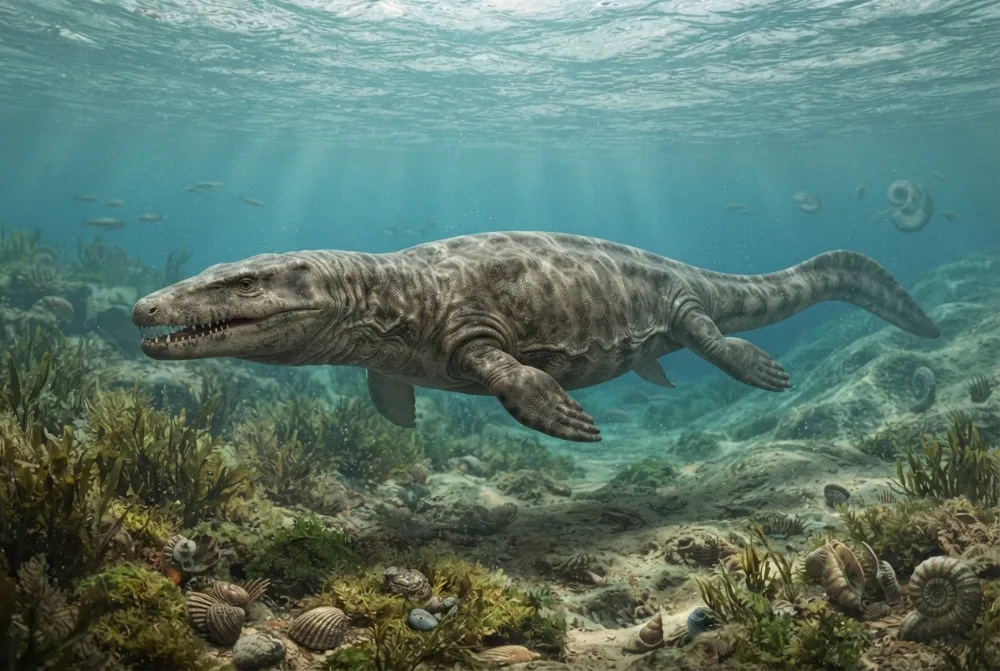
Simosaurus was a marine reptile that swam in warm, shallow seas during the Middle Triassic, about 240 to 230 million years ago. It had a blunt, flattened head and blunt teeth for crushing hard-shelled prey like clams and ammonites.1
Yabeerawo ddi?
Yali munene atya?
Yali muwanvu kwenkana wa?
Yali muzito kwenkana wa?
 obuwanvu ng'embwa 4, ennyindo ku mukira🍌obuwanvu ng'amenvu 22 nga gaddiriŋŋana🍉obuzito ng'obwa wotamerooni 26🧸obuzito ng'obw'abaana 7 ab'omu nnasale🎒obuzito ng'obw'abaana b'essomero 4🏊yandiwuze obuwanvu bw'ekidiba ekinene (50 m) mu sikonda 7.8
Simosaurus yali munene atya bw'ogeraageranya ku GGWE?
Kubala kwokka mu browser yo. Tewali kiterekebwa wadde okusindikibwa wonna.
Yali wa mbiro kwenkana wa?


Ebyewuunyisa
Simosaurus had large openings behind its eyes called upper temporal fossae, which were bigger than its eye sockets.1
Its jaw joint was set far back, projecting beyond the main part of the skull, giving it a unique bite.1
Simosaurus had a flattened trunk that prevented side-to-side swimming, unlike most other nothosaurs.1
It swam using powerful downstrokes of its forelimbs, but its upstroke was weak, making it a moderately strong swimmer.1
The first Simosaurus fossils were found in Lunéville, France, and described by German paleontologist Hermann von Meyer in 1842.1
Simosaurus is known from the Muschelkalk deposits in Germany, where it appears in layers marked by the ammonite Ceratites nodosus.1
Ebibuuzo ebisinga okubuuzibwa ku Simosaurus
?How big was Simosaurus?
Simosaurus grew from 3 to 4 metres (9.8 to 13.1 ft) in length.1
?What did Simosaurus eat?
It ate hard-shelled organisms like ammonites and holostean fish, using its blunt teeth to crush them.1
?How did Simosaurus swim?
It swam with powerful downstrokes of its forelimbs, but its upstroke was weak, making it a moderately strong swimmer.1
Eri abakugu mu dayinoso
- Erinnya lya ssaayansi
- Simosaurus
- Yatuumibwa
- Meyer 18423
- Ekibinja
- Ebyewalula eby'omu nnyanja
- Ekika / ekibinja
- Simosauridae3
- Engabanya
- Nothosauria > Sauropterygia3
- Emyaka gy'enjazi
- emyaka obukadde 247 okutuuka ku 201 ()3
- Ensengeka z'enjazi
- Jilh, Erfurt, Gevanim3
- Ensi
- Bugirimaani, Bufalansa, Sawudi Arabiya, Isirayeri, Yitale3
- Ebisigalira ebyazuulibwa
- 15 mu The Paleobiology Database3
- Okuzuulibwa
- German paleontologist Christian Erich Hermann von Meyer named Simosaurus in 1842 based on a skull from Lunéville, France. That original skull has since been lost.1
- Kikyakubaganyizibwako ebirowoozo
- Scientists debate whether Simosaurus was a nothosaur, a pachypleurosaur, or a more primitive sauropterygian.1
Ebituufu gye biva
- Simosaurus (en.wikipedia.org)
- Bone histology, microanatomy, and growth of the nothosauroid Simosaurus gaillardoti (Sauropterygia) from the Upper Muschelkalk of southern Germany/Baden-Württemberg - Scientific Publications of the Muséum national d'Histoire naturelle, Paris (sciencepress.mnhn.fr)
- Simosaurus in The Paleobiology Database (CC BY 4.0): emyaka, ebifo, ensengeka z'enjazi, engabanya.
Buli kituufu ku lupapula luno kirina ennamba eraga ensibuko yaakyo. Bwe tuba nga tukoze ensobi, tusonyiwe, ffe tuli bawagizi ba dayinoso, so si magazini ya ssaayansi. Tubuulire ku [email protected] tujja kugitereeza.
 Rex alumwa enjala! Dino Wiki pulojekiti ya taata eri mutabani we ayagala ennyo dayinoso, ya bwereere, tewali bulango era tewali bikulondoola. Abakulu basobola okuwa Rex akantu ak'okulya okuyamba okugikuuma ku mutimbagano.Liisa Rex
 Nothosaurus
 Placodus
 Lariosaurus
 Cyamodus
 Cymatosaurus
 Proneusticosaurus
 Massospondylus
 Plateosaurus
 Coelophysis
 Podokesaurus
 Thecodontosaurus
 Eudimorphodon