 Kwizi: Oli dayinoso ki?
 Olutalo lwa dayinoso
 Empaka z'emisinde gya dayinoso
 Emizannyo emitono egya dayinoso
 Alubaamu ya sitika
 Enkalala za dayinoso eza TOP
 Mpa ekyewuunyisa!
Yabeerawo ddi?

Yali munene atya?
Yali muwanvu kwenkana wa?
Yali mugulumivu kwenkana wa?
Yali muzito kwenkana wa?
 obuwanvu ng'emmotoka 2 ezisimbiddwa mu lunyiriri🍌obuwanvu ng'amenvu 56 nga gaddiriŋŋana
 obuzito ng'obw'enjovu 1.5🍉obuzito ng'obwa wotamerooni 2000🎒obuzito ng'obw'ebibiina 12 ebijjuvu eby'abaana b'essomero🐻❄️obuzito ng'obwa ddubu enjeru 22🏃yandidduse mita 100 mu sikonda 15 (omuntu asinga embiro yeetaaga 9.6)
Deinocheirus yali munene atya bw'ogeraageranya ku GGWE?
Kubala kwokka mu browser yo. Tewali kiterekebwa wadde okusindikibwa wonna.
Yali wa mbiro kwenkana wa?


Ebyewuunyisa
For a long time, scientists only had a pair of arm bones with huge claws to study Deinocheirus. They did not know what the rest of the dinosaur looked like until 2014.1
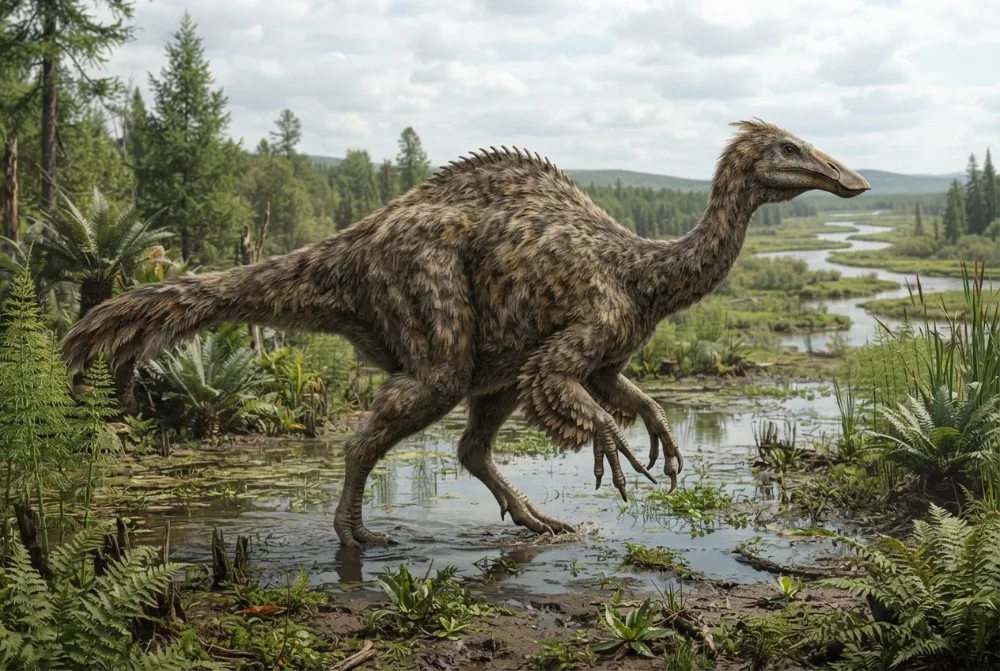
Deinocheirus had a large hump on its back, supported by its backbone. This made it look a bit like a camel.1
Its hands were huge and had long, sharp claws. The name Deinocheirus means 'terrible hand'.1
Deinocheirus lived during the Late Cretaceous period, about 70 to 66 million years ago.1
It was an omnivore, meaning it ate both plants and meat. Scientists think it used its beak to eat plants and small animals.15
Deinocheirus belonged to a group of dinosaurs called ornithomimosaurs, which are often called 'ostrich dinosaurs' because they looked a bit like ostriches.5
Ebibuuzo ebisinga okubuuzibwa ku Deinocheirus
?How big was Deinocheirus?
It was about 11 metres (36 feet) long and weighed around 6.5 tonnes (7.2 short tons). That is as long as a big bus.4
?What did Deinocheirus eat?
It was an omnivore, meaning it ate both plants and meat. It had a duck-like beak for cropping soft plants, and fish scales found with one specimen show it also ate fish.4
?Did Deinocheirus have feathers?
Yes, it probably had a fan of feathers on its tail. The tail ended in pygostyle-like vertebrae, which is a sign of feathers.4
?Why did Deinocheirus have such big claws?
Its huge, blunt claws were probably used for digging and gathering plants. The name Deinocheirus means 'terrible hand' because of those big claws.4
?Was Deinocheirus a dinosaur?
Yes, it was a dinosaur. It belonged to a group called ornithomimosaurs, which are often called 'ostrich dinosaurs'.41
?When did Deinocheirus live?
It lived during the Late Cretaceous period, about 70 to 66 million years ago.1
?Could Deinocheirus run fast?
No, it was not built for speed. It had short legs and a bulky body, so it moved slowly.4
?What hunted Deinocheirus?
Bite marks on its bones show that the tyrannosaurid Tarbosaurus probably attacked or scavenged it.4
Eri abakugu mu dayinoso
- Erinnya lya ssaayansi
- Deinocheirus
- Yatuumibwa
- Kielan-Jaworowska 19695
- Ekibinja
- Dayinoso ezifaanana ostrich
- Ekika / ekibinja
- Deinocheiridae5
- Engabanya
- Theropoda > Ornithomimosauria5
- Emyaka gy'enjazi
- emyaka obukadde 100 okutuuka ku 66 (Cenomanian / Maastrichtian)5
- Ensengeka z'enjazi
- Nemegt, Baynshire5
- Ensi
- Mongoliya5
- Ebisigalira ebyazuulibwa
- 5 mu The Paleobiology Database5
- Okuzuulibwa
- Deinocheirus was named by Polish paleontologist Zofia Kielan-Jaworowska in 1969. The first fossils were found in the Gobi Desert in Mongolia.51
Ebituufu gye biva
- Deinocheirus | Natural History Museum (nhm.ac.uk)
- PBDB Taxon (paleobiodb.org)
- Deinocheirus — size, diet & habitat | DinoLifePedia (dinolifepedia.com)
- Deinocheirus (en.wikipedia.org)
- Deinocheirus in The Paleobiology Database (CC BY 4.0): emyaka, ebifo, ensengeka z'enjazi, engabanya.
Buli kituufu ku lupapula luno kirina ennamba eraga ensibuko yaakyo. Bwe tuba nga tukoze ensobi, tusonyiwe, ffe tuli bawagizi ba dayinoso, so si magazini ya ssaayansi. Tubuulire ku [email protected] tujja kugitereeza.
 Rex alumwa enjala! Dino Wiki pulojekiti ya taata eri mutabani we ayagala ennyo dayinoso, ya bwereere, tewali bulango era tewali bikulondoola. Abakulu basobola okuwa Rex akantu ak'okulya okuyamba okugikuuma ku mutimbagano.Liisa Rex
 Gallimimus
 Ornithomimus
 Struthiomimus
 Dromiceiomimus
 Archaeornithomimus
 Anserimimus
 Tyrannosaurus
 Triceratops
 Velociraptor
 Spinosaurus
 Ankylosaurus
 Parasaurolophus