 Kwizi: Oli dayinoso ki?
 Olutalo lwa dayinoso
 Empaka z'emisinde gya dayinoso
 Emizannyo emitono egya dayinoso
 Alubaamu ya sitika
 Enkalala za dayinoso eza TOP
 Mpa ekyewuunyisa!
Dunhuangia
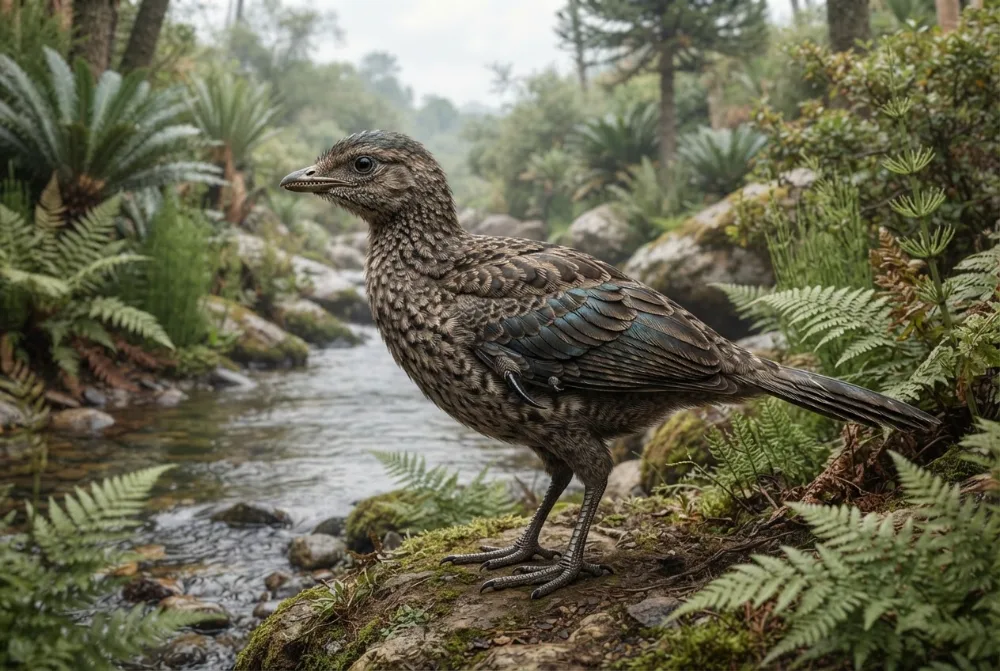
Dunhuangia was a bird that lived during the Early Cretaceous, about 121 to 113 million years ago. It was a medium-sized enantiornithine bird, a group that was very common during the time of dinosaurs. Dunhuangia had special bones in its chest that made it different from other birds.21
Yabeerawo ddi?
Yali wa mbiro kwenkana wa?


Ebyewuunyisa
Dunhuangia is only the second enantiornithine bird species ever named from the Changma Basin in China.1
Its fossil includes parts of the forelimbs, shoulder girdle, and breastbone, but the skull is missing.3
The end of its breastbone had a deep notch with two side projections, a feature that helps scientists tell it apart from other enantiornithine birds.1
Dunhuangia lived alongside many other animals, including fish, salamanders, turtles, and other birds like Gansus.1
The Changma Basin where Dunhuangia was found is one of the few places where more advanced ornithuromorph birds outnumbered enantiornithines like Dunhuangia.1
Scientists think Dunhuangia was a ground-dwelling bird that could fly actively.2
Eri abakugu mu dayinoso
- Erinnya lya ssaayansi
- Dunhuangia
- Yatuumibwa
- Wang et al. 20154
- Ekibinja
- Ebinyonyi eby'olubereberye
- Ekika / ekibinja
- Enantiornithes4
- Engabanya
- Theropoda > Avialae4
- Emyaka gy'enjazi
- emyaka obukadde 121 okutuuka ku 113 (Aptian)4
- Ensengeka z'enjazi
- Xiagou4
- Ensi
- Cayina4
- Ebisigalira ebyazuulibwa
- 1 mu The Paleobiology Database4
- Okuzuulibwa
- Dunhuangia was named and described in 2015 by Wang Min, Li Daqing, Jingmai Kathleen O'Connor, Zhou Zhonghe, and You Hailu. The species name cuii honors Cui Guihai, who prepared many bird fossils from the Changma Basin.31
- Kikyakubaganyizibwako ebirowoozo
- Scientists are still debating whether the Changma avifauna represents a transitional stage in the dominance of ornithuromorph birds over enantiornithines like Dunhuangia.1
Ebituufu gye biva
- Second species of enantiornithine bird from the Lower Cretaceous Changma Basin, northwestern China with implications for the taxonomic diversity of the Changma avifauna (sciencedirect.com)
- PBDB Taxon (paleobiodb.org)
- Dunhuangia (en.wikipedia.org)
- Dunhuangia in The Paleobiology Database (CC BY 4.0): emyaka, ebifo, ensengeka z'enjazi, engabanya.
Buli kituufu ku lupapula luno kirina ennamba eraga ensibuko yaakyo. Bwe tuba nga tukoze ensobi, tusonyiwe, ffe tuli bawagizi ba dayinoso, so si magazini ya ssaayansi. Tubuulire ku [email protected] tujja kugitereeza.
 Rex alumwa enjala! Dino Wiki pulojekiti ya taata eri mutabani we ayagala ennyo dayinoso, ya bwereere, tewali bulango era tewali bikulondoola. Abakulu basobola okuwa Rex akantu ak'okulya okuyamba okugikuuma ku mutimbagano.Liisa Rex
 Archaeopteryx
 Hesperornis
 Ichthyornis
 Baptornis
 Jurapteryx
 Gobipteryx
 Stegosaurus
 Iguanodon
 Giganotosaurus
 Microraptor
 Deinonychus
 Baryonyx