 Kwizi: Oli dayinoso ki?
 Olutalo lwa dayinoso
 Empaka z'emisinde gya dayinoso
 Emizannyo emitono egya dayinoso
 Alubaamu ya sitika
 Enkalala za dayinoso eza TOP
 Mpa ekyewuunyisa!
Edmontonia
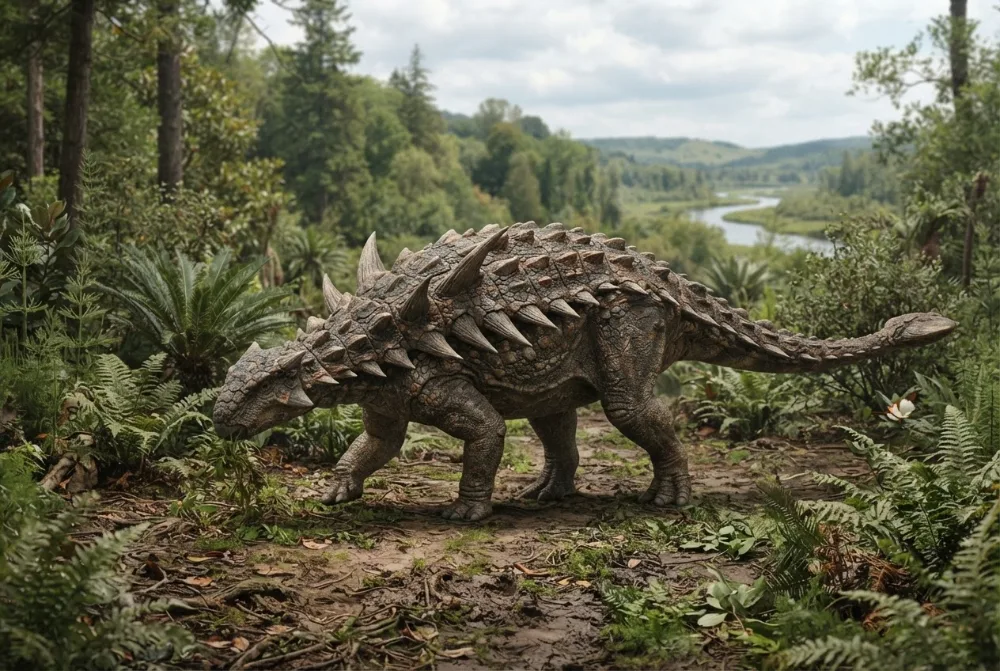
Edmontonia was a tank-like dinosaur covered in bony plates and sharp spikes. It walked on four legs and munched on low-growing plants. This nodosaurid dinosaur lived in western North America near the end of the Age of Dinosaurs.1
Yabeerawo ddi?
Yali munene atya?
Yali muwanvu kwenkana wa?
Yali mugulumivu kwenkana wa?
Yali muzito kwenkana wa?

 obuwanvu ng'embwa 7, ennyindo ku mukira🍌obuwanvu ng'amenvu 37 nga gaddiriŋŋanaobuzito ng'obw'embwa 150🍉obuzito ng'obwa wotamerooni 600🎒obuzito ng'obw'ebibiina 4 ebijjuvu eby'abaana b'essomero🐻❄️obuzito ng'obwa ddubu enjeru 7🏃yandidduse mita 100 mu sikonda 28 (omuntu asinga embiro yeetaaga 9.6)
Edmontonia yali munene atya bw'ogeraageranya ku GGWE?
Kubala kwokka mu browser yo. Tewali kiterekebwa wadde okusindikibwa wonna.
Yali wa mbiro kwenkana wa?


Ebyewuunyisa
Edmontonia had four huge spikes sticking out from each shoulder, the largest of any nodosaurid. These spikes could have been used to fight other Edmontonia or to stab attacking predators.1
Its back and head were covered with small, oval bony plates that had a ridge down the middle. Its neck and shoulders were protected by three half-rings made of large keeled plates.1
Edmontonia lived alongside many other giant plant-eaters like the duck-billed dinosaurs Gryposaurus and Corythosaurus, and the horned dinosaurs Centrosaurus and Chasmosaurus.1
The only large predators that lived with Edmontonia were the tyrannosaurids Gorgosaurus and Daspletosaurus.1
Scientists think Edmontonia might have crouched down to protect its soft belly from predators, making it hard for a predator to flip it over.1
One species of Edmontonia, E. rugosidens, lived about 76.5 to 75 million years ago. The other species, E. longiceps, lived about 72 million years ago.1
Ebibuuzo ebisinga okubuuzibwa ku Edmontonia
?How big was Edmontonia?
Edmontonia was about 6 to 6.6 metres (20 to 22 ft) long and weighed around 3 tonnes (about 6,600 lb).15
?What did Edmontonia eat?
Edmontonia was an herbivore that ate low-growing plants like ferns and cycads. Its small teeth and weak jaws suggest it processed food differently than modern mammals.156
?Did Edmontonia have armor?
Yes, Edmontonia was covered in small oval bony plates on its back and head, and had three half-rings of large keeled plates protecting its neck and shoulders. It also had four huge spikes on each shoulder.15
?How fast could Edmontonia run?
No source gives a speed for Edmontonia, but its heavy armor and short, thick legs suggest it was slow-moving, like a tank.15
?Was Edmontonia bigger than T. rex?
No, Edmontonia was much smaller. T. rex could be over 12 metres (40 ft) long, while Edmontonia was only about 6 to 6.6 metres (20 to 22 ft) long.1
?When did Edmontonia live?
Edmontonia lived during the Late Cretaceous Period, about 76.5 to 68 million years ago.16
?Where was Edmontonia found?
Edmontonia fossils have been found in western North America, especially in Alberta, Canada, and also in the Talkeetna Mountains near Denali National Park in Alaska.15
?Could Edmontonia swim?
No source says Edmontonia could swim. Its heavy armor and short legs probably kept it on land.1
Omumenyi w'enfumo
Enfumo: Edmontonia could swing its tail like a club to defend itself.
Amazima: Edmontonia was a nodosaurid, not an ankylosaurid. Nodosaurids did not have a tail club. Instead, Edmontonia relied on its shoulder spikes and body armor for protection.1
Eri abakugu mu dayinoso
- Erinnya lya ssaayansi
- Edmontonia
- Yatuumibwa
- Sternberg 19287
- Ekibinja
- Dayinoso ez'engabo
- Ekika / ekibinja
- Nodosauridae7
- Engabanya
- Ornithischia > Ankylosauria > Nodosauridae > Thyreophora7
- Emyaka gy'enjazi
- emyaka obukadde 84 okutuuka ku 66 (Campanian / Maastrichtian)7
- Ensengeka z'enjazi
- Judith River, Aguja, Hell Creek7
- Ensi
- Amerika, Kanada7
- Ebisigalira ebyazuulibwa
- 16 mu The Paleobiology Database7
- Era emanyiddwa nga
- Chassternbergia, Denversaurus (amannya ag'edda kati gabalibwa ng'ekisolo kye kimu)7
- Okuzuulibwa
- Edmontonia was named by Charles M. Sternberg in 1928. The first fossils, including a skull and much of the skeleton, were found near Morrin, Alberta, Canada in 1924 by George Paterson.1
- Kikyakubaganyizibwako ebirowoozo
- Scientists still debate whether the fossils called Denversaurus and Chassternbergia are really separate dinosaurs or just different species of Edmontonia.2
Ebituufu gye biva
- Edmontonia (en.wikipedia.org)
- PBDB Taxon (paleobiodb.org)
- EDMONTONIA - DinoChecker dinosaur archive (dinochecker.com)
- Edmontonia | Dino Tail - Dinosaur Encyclopedia (dino-tail.com)
- Edmontonia - Denali National Park & Preserve (U.S. National Park Service) (nps.gov)
- enchantedlearning.com (enchantedlearning.com)
- Edmontonia in The Paleobiology Database (CC BY 4.0): emyaka, ebifo, ensengeka z'enjazi, engabanya.
Buli kituufu ku lupapula luno kirina ennamba eraga ensibuko yaakyo. Bwe tuba nga tukoze ensobi, tusonyiwe, ffe tuli bawagizi ba dayinoso, so si magazini ya ssaayansi. Tubuulire ku [email protected] tujja kugitereeza.
 Rex alumwa enjala! Dino Wiki pulojekiti ya taata eri mutabani we ayagala ennyo dayinoso, ya bwereere, tewali bulango era tewali bikulondoola. Abakulu basobola okuwa Rex akantu ak'okulya okuyamba okugikuuma ku mutimbagano.Liisa Rex
 Ankylosaurus
 Sauropelta
 Pinacosaurus
 Scutellosaurus
 Struthiosaurus
 Euoplocephalus
 Tyrannosaurus
 Triceratops
 Velociraptor
 Spinosaurus
 Parasaurolophus
 Pteranodon