 Kwizi: Oli dayinoso ki?
 Olutalo lwa dayinoso
 Empaka z'emisinde gya dayinoso
 Emizannyo emitono egya dayinoso
 Alubaamu ya sitika
 Enkalala za dayinoso eza TOP
 Mpa ekyewuunyisa!
Epidexipteryx
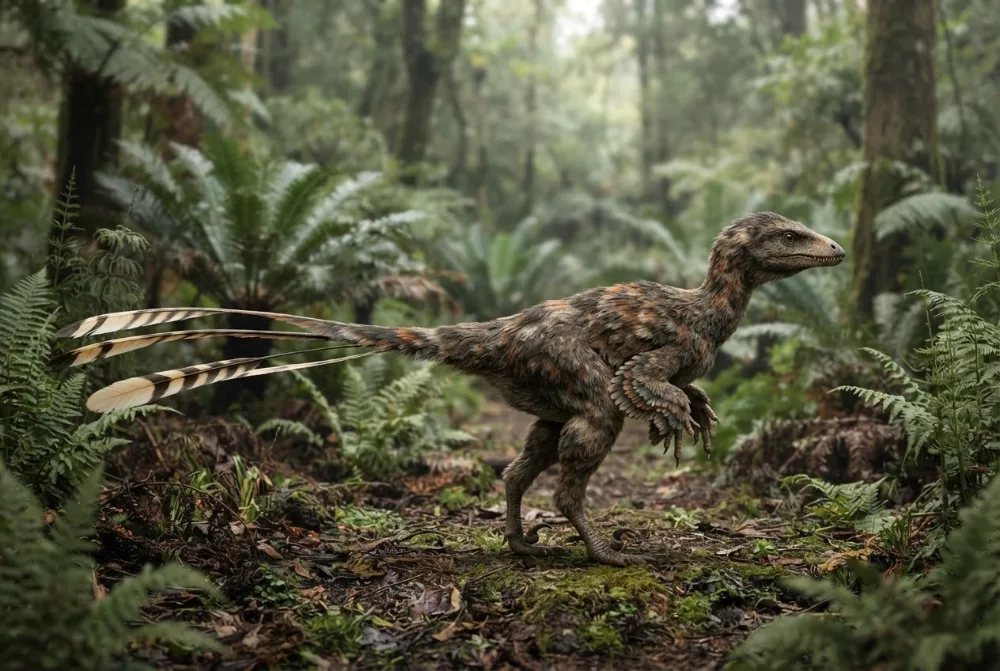
Epidexipteryx was a tiny, pigeon-sized dinosaur that lived in the Jurassic period. It had four long, ribbon-like feathers on its tail that it probably used to show off, not to fly. This little dinosaur was a meat-eater and is one of the oldest known dinosaurs with display feathers.1
Yabeerawo ddi?
Yali munene atya?
Yali muwanvu kwenkana wa?
Yali mugulumivu kwenkana wa?
kuteebereza
Yali muzito kwenkana wa?
Epidexipteryx yali munene atya bw'ogeraageranya ku GGWE?
Kubala kwokka mu browser yo. Tewali kiterekebwa wadde okusindikibwa wonna.
Yali wa mbiro kwenkana wa?


Ebyewuunyisa
Epidexipteryx had four long, ribbon-like feathers on its tail that were probably used for display, not for flying.1
It weighed only about 164 grams, which is less than a can of soda.1
Its front teeth were much larger than its back teeth, and they stuck out forward, similar to the dinosaur Masiakasaurus.1
Epidexipteryx lived about 165 to 161 million years ago, during the Middle to Late Jurassic.6
The only known fossil is a nearly complete skeleton of a young individual, found in Inner Mongolia, China.1
It had a short tail compared to its close relative Epidendrosaurus, with only 16 tail bones instead of more than 40.1
Epidexipteryx could not fly because it lacked the long flight feathers on its arms that birds use.1
Ebibuuzo ebisinga okubuuzibwa ku Epidexipteryx
?How big was Epidexipteryx?
It was tiny, about 25 to 30 cm long, not counting the tail feathers. That is about the size of a pigeon.3
?Did Epidexipteryx have feathers?
Yes, it had four long, ribbon-like feathers on its tail and a covering of simpler body feathers. The tail feathers were probably used for display, not for flying.34
?Could Epidexipteryx fly?
No, it could not fly. It lacked the long flight feathers on its arms that birds use, though it may have had a membrane wing for gliding.35
?What did Epidexipteryx eat?
It was a meat-eater. It may have used its long claws to rummage through trees for grubs, like an aye-aye.3
?When did Epidexipteryx live?
It lived during the Middle to Late Jurassic, about 165 to 154 million years ago, in what is now Inner Mongolia, China.3
Eri abakugu mu dayinoso
- Erinnya lya ssaayansi
- Epidexipteryx
- Yatuumibwa
- Zhang et al. 20086
- Ekibinja
- Dayinoso ezirya ennyama
- Ekika / ekibinja
- Paraves6
- Engabanya
- Theropoda6
- Emyaka gy'enjazi
- emyaka obukadde 165 okutuuka ku 162 (Callovian)6
- Ensengeka z'enjazi
- Tiaojishan6
- Ensi
- Cayina6
- Ebisigalira ebyazuulibwa
- 1 mu The Paleobiology Database6
- Okuzuulibwa
- Epidexipteryx was named in 2008 by scientists Fucheng Zhang, Zhonghe Zhou, Xing Xu, Xiaolin Wang, and Corwin Sullivan. The name honors the late paleontologist Yaoming Hu. The fossil was found in the Daohugou area of Inner Mongolia, China.1
- Kikyakubaganyizibwako ebirowoozo
- Scientists are not sure exactly how old the rocks where Epidexipteryx was found are. They could be from the Middle Jurassic or the Late Jurassic, between 152 and 168 million years old.1
Ebituufu gye biva
- LETTERS (ivpp.cas.cn)
- Epidexipteryx Zhang et al. 2008 - Encyclopedia of Life (eol.org)
- Epidexipteryx (en.wikipedia.org)
- Access : A bizarre Jurassic maniraptoran from China with elongate ribbon-like feathers : Nature (web.archive.org)
- nature.com (nature.com)
- Epidexipteryx in The Paleobiology Database (CC BY 4.0): emyaka, ebifo, ensengeka z'enjazi, engabanya.
Buli kituufu ku lupapula luno kirina ennamba eraga ensibuko yaakyo. Bwe tuba nga tukoze ensobi, tusonyiwe, ffe tuli bawagizi ba dayinoso, so si magazini ya ssaayansi. Tubuulire ku [email protected] tujja kugitereeza.
 Rex alumwa enjala! Dino Wiki pulojekiti ya taata eri mutabani we ayagala ennyo dayinoso, ya bwereere, tewali bulango era tewali bikulondoola. Abakulu basobola okuwa Rex akantu ak'okulya okuyamba okugikuuma ku mutimbagano.Liisa Rex
 Allosaurus
 Carnotaurus
 Dilophosaurus
 Giganotosaurus
 Compsognathus
 Paronychodon
 Ichthyosaurus
 Khudiakovia
 Ophthalmosaurus
 Pterodactylus
 Peloneustes
 Rhamphocephalus