 Kwizi: Oli dayinoso ki?
 Olutalo lwa dayinoso
 Empaka z'emisinde gya dayinoso
 Emizannyo emitono egya dayinoso
 Alubaamu ya sitika
 Enkalala za dayinoso eza TOP
 Mpa ekyewuunyisa!
Eremiasaurus
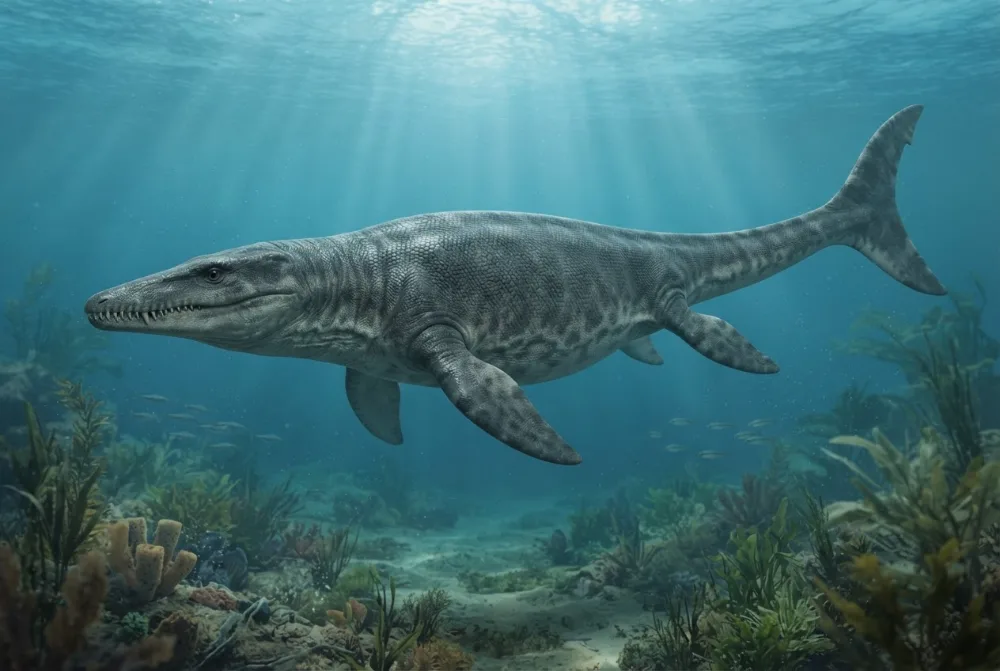
Eremiasaurus was a marine reptile that swam in warm seas during the time of the dinosaurs. It was a mosasaur, not a dinosaur, and it lived about 70 to 66 million years ago. This predator had a streamlined body and a long tail to help it zoom through the water.1
Yabeerawo ddi?
Yali munene atya?
Yali muwanvu kwenkana wa?
 obuwanvu ng'embwa 5, ennyindo ku mukira🍌obuwanvu ng'amenvu 28 nga gaddiriŋŋana🏊yandiwuze obuwanvu bw'ekidiba ekinene (50 m) mu sikonda 4.7
Eremiasaurus yali munene atya bw'ogeraageranya ku GGWE?
Kubala kwokka mu browser yo. Tewali kiterekebwa wadde okusindikibwa wonna.
Yali wa mbiro kwenkana wa?


Ebyewuunyisa
Eremiasaurus had very different-shaped teeth in its jaws, a rare trait for mosasaurs. Its species name heterodontus means 'different teeth'.1
The first fossils of Eremiasaurus were teeth found in Morocco in 1952. Scientists at first thought they belonged to another mosasaur called Mosasaurus.1
Eremiasaurus was named in 2012 from two nearly complete skeletons. One skeleton was found by a scientist, and the other came from a commercial fossil collector.1
This mosasaur had a tail that bent downward and a fan of bones in its tail, which helped it swim fast. Its tail was similar to the fast-swimming mosasaur Plotosaurus.1
Eremiasaurus lived in a warm, shallow sea called the Mediterranean Tethys. Many other mosasaurs and fish lived there too.1
Scientists think Eremiasaurus ate different food than its larger mosasaur neighbors, like Thalassotitan and Prognathodon. This helped them avoid competing for the same prey.1
Ebibuuzo ebisinga okubuuzibwa ku Eremiasaurus
?How big was Eremiasaurus?
About 5 metres (16 feet) long, which is a bit shorter than a minibus.1
?What did Eremiasaurus eat?
Nobody knows for sure. Its different-shaped teeth make it unclear what prey it ate.1
?Could Eremiasaurus swim fast?
Yes. Its tail bones suggest it was a high-speed pursuit predator, built for fast swimming.1
?Where did Eremiasaurus live?
It lived in a warm, shallow sea called the Mediterranean Tethys, near what is now Morocco.1
Eri abakugu mu dayinoso
- Erinnya lya ssaayansi
- Eremiasaurus
- Yatuumibwa
- LeBlanc et al. 20122
- Ekibinja
- Mosasawulu
- Ekika / ekibinja
- Mosasauridae2
- Engabanya
- Mosasauroidea2
- Emyaka gy'enjazi
- emyaka obukadde 72 okutuuka ku 66 (Maastrichtian)2
- Ensengeka z'enjazi
- Phosphates, Couche III2
- Ensi
- Moroko2
- Ebisigalira ebyazuulibwa
- 7 mu The Paleobiology Database2
- Okuzuulibwa
- Eremiasaurus was named in 2012 by paleontologists Aaron LeBlanc, Michael Caldwell, and Nathalie Bardet. They described it from two skeletons found in the phosphate mines of the Ouled Abdoun Basin in Morocco.1
- Kikyakubaganyizibwako ebirowoozo
- Scientists are not sure exactly what Eremiasaurus ate. Its unusual teeth make it hard to guess its favorite prey.1
Ebituufu gye biva
- Eremiasaurus (en.wikipedia.org)
- Eremiasaurus in The Paleobiology Database (CC BY 4.0): emyaka, ebifo, ensengeka z'enjazi, engabanya.
Buli kituufu ku lupapula luno kirina ennamba eraga ensibuko yaakyo. Bwe tuba nga tukoze ensobi, tusonyiwe, ffe tuli bawagizi ba dayinoso, so si magazini ya ssaayansi. Tubuulire ku [email protected] tujja kugitereeza.
 Rex alumwa enjala! Dino Wiki pulojekiti ya taata eri mutabani we ayagala ennyo dayinoso, ya bwereere, tewali bulango era tewali bikulondoola. Abakulu basobola okuwa Rex akantu ak'okulya okuyamba okugikuuma ku mutimbagano.Liisa Rex
 Mosasaurus
 Prognathodon
 Tylosaurus
 Platecarpus
 Clidastes
 Globidens
 Tyrannosaurus
 Triceratops
 Velociraptor
 Spinosaurus
 Ankylosaurus
 Parasaurolophus