 Kwizi: Oli dayinoso ki?
 Olutalo lwa dayinoso
 Empaka z'emisinde gya dayinoso
 Emizannyo emitono egya dayinoso
 Alubaamu ya sitika
 Enkalala za dayinoso eza TOP
 Mpa ekyewuunyisa!
Falcarius
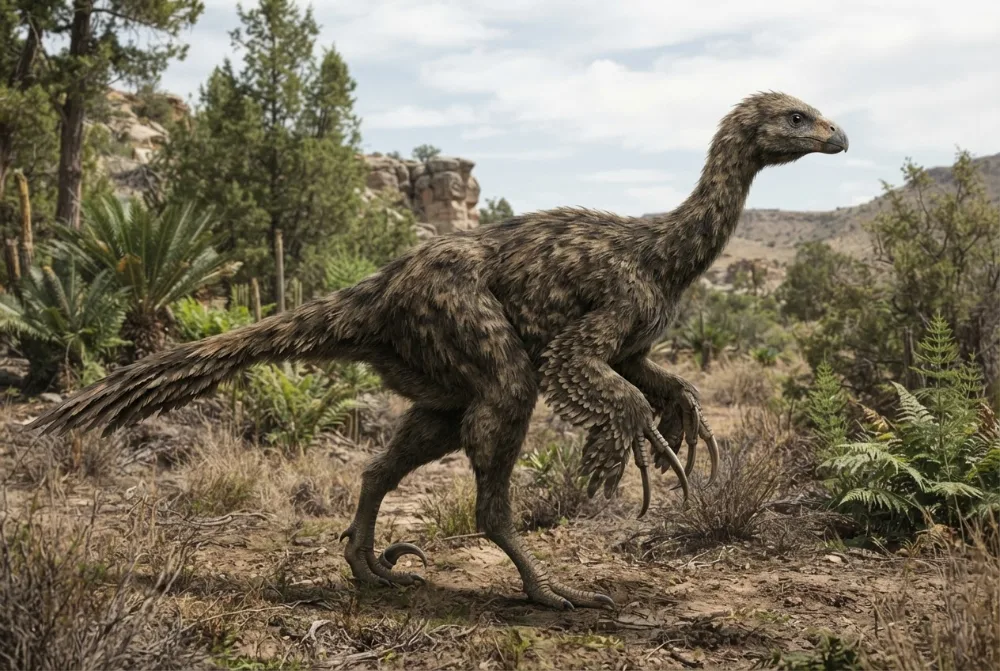
Falcarius was a strange dinosaur that looked like a mix between an ostrich, a gorilla, and Edward Scissorhands! It had a small head, a long neck, and huge curved claws on its hands. This dinosaur lived in what is now Utah, USA, about 139 to 134 million years ago.1
Yabeerawo ddi?
Yali munene atya?
Yali muwanvu kwenkana wa?
Yali mugulumivu kwenkana wa?
Yali muzito kwenkana wa?
 obuwanvu ng'embwa 5, ennyindo ku mukira🍌obuwanvu ng'amenvu 28 nga gaddiriŋŋana🍉obuzito ng'obwa wotamerooni 20🧸obuzito ng'obw'abaana 5 ab'omu nnasale🎒obuzito ng'obw'abaana b'essomero 3🏃yandidduse mita 100 mu sikonda 12 (omuntu asinga embiro yeetaaga 9.6)
Falcarius yali munene atya bw'ogeraageranya ku GGWE?
Kubala kwokka mu browser yo. Tewali kiterekebwa wadde okusindikibwa wonna.
Yali wa mbiro kwenkana wa?


Ebyewuunyisa
Falcarius is one of the most primitive therizinosaurs ever found. It helps scientists understand how meat-eating dinosaurs turned into plant-eaters.2
Over 3,000 bones of Falcarius have been dug up from a single quarry in Utah. That's a lot of fossils!1
Falcarius had a long neck that let it reach leaves about 1.5 metres (5 feet) off the ground.1
Its hand claws were huge and curved, like sickles. That's how it got its name, which means 'sickle cutter'.1
Falcarius probably had feathers, like its close relatives from Asia.1
The smallest Falcarius was less than 1 metre (3.3 feet) long, but adults grew to about 4 to 5 metres (13 to 16 feet).1
Ebibuuzo ebisinga okubuuzibwa ku Falcarius
?How big was Falcarius?
About 4 metres (13 feet) long and about 1.4 metres (4.5 feet) tall at the hip, weighing around 100 kilograms (220 pounds). The smallest known individual was less than 1 metre (3.3 feet) long.14
?What did Falcarius eat?
Mostly plants. Its leaf-shaped, serrated teeth were good for shredding leaves, but the pointed front teeth suggest it might have also eaten small animals like lizards sometimes.1
?Did Falcarius have feathers?
Scientists think yes. No feathers were found with its fossils, but its close feathered relatives from China make it very likely Falcarius had shaggy, hair-like proto-feathers.4
?How fast could Falcarius run?
Probably not very fast. Its lower legs were stubby, which suggests it no longer needed to run after prey like its meat-eating relatives did.4
Eri abakugu mu dayinoso
- Erinnya lya ssaayansi
- Falcarius
- Yatuumibwa
- Kirkland et al. 20055
- Ekibinja
- Dayinoso ez'ebyoya ez'enjawulo
- Ekika / ekibinja
- Therizinosauria5
- Engabanya
- Theropoda > Therizinosauria5
- Emyaka gy'enjazi
- emyaka obukadde 143 okutuuka ku 133 (Berriasian / Valanginian)5
- Ensengeka z'enjazi
- Cedar Mountain5
- Ensi
- Amerika5
- Ebisigalira ebyazuulibwa
- 2 mu The Paleobiology Database5
- Okuzuulibwa
- Falcarius was discovered in 1999 by fossil collector Lawrence Walker in Utah. Scientists named it in 2005.1
- Kikyakubaganyizibwako ebirowoozo
- Scientists are not sure if Falcarius was a pure plant-eater or if it also ate meat. Its front teeth are sharp and pointed, which might mean it ate small animals too.1
Ebituufu gye biva
- Falcarius (en.wikipedia.org)
- A primitive therizinosauroid dinosaur from the Early Cretaceous of Utah | Nature (nature.com)
- A Primitive Therizinosauroid Dinosaur from the Early Cretaceous of Utah - DocsLib (docslib.org)
- Falcarius Utahensis - Utah Geological Survey (geology.utah.gov)
- Falcarius in The Paleobiology Database (CC BY 4.0): emyaka, ebifo, ensengeka z'enjazi, engabanya.
Buli kituufu ku lupapula luno kirina ennamba eraga ensibuko yaakyo. Bwe tuba nga tukoze ensobi, tusonyiwe, ffe tuli bawagizi ba dayinoso, so si magazini ya ssaayansi. Tubuulire ku [email protected] tujja kugitereeza.
 Rex alumwa enjala! Dino Wiki pulojekiti ya taata eri mutabani we ayagala ennyo dayinoso, ya bwereere, tewali bulango era tewali bikulondoola. Abakulu basobola okuwa Rex akantu ak'okulya okuyamba okugikuuma ku mutimbagano.Liisa Rex
 Therizinosaurus
 Oviraptor
 Chirostenotes
 Citipes
 Leptorhynchos
 Avimimus
 Stegosaurus
 Iguanodon
 Archaeopteryx
 Giganotosaurus
 Microraptor
 Deinonychus