 Kwizi: Oli dayinoso ki?
 Olutalo lwa dayinoso
 Empaka z'emisinde gya dayinoso
 Emizannyo emitono egya dayinoso
 Alubaamu ya sitika
 Enkalala za dayinoso eza TOP
 Mpa ekyewuunyisa!
Yabeerawo ddi?

Yali munene atya?
Yali muwanvu kwenkana wa?
Yali mugulumivu kwenkana wa?
kuteebereza
Yali muzito kwenkana wa?

 obuwanvu ng'embwa 8, ennyindo ku mukira🍌obuwanvu ng'amenvu 44 nga gaddiriŋŋanaobuzito ng'obw'embwa 150🍉obuzito ng'obwa wotamerooni 600🎒obuzito ng'obw'ebibiina 4 ebijjuvu eby'abaana b'essomero🐻❄️obuzito ng'obwa ddubu enjeru 7🏃yandidduse mita 100 mu sikonda 14 (omuntu asinga embiro yeetaaga 9.6)
Gryposaurus yali munene atya bw'ogeraageranya ku GGWE?
Kubala kwokka mu browser yo. Tewali kiterekebwa wadde okusindikibwa wonna.
Yali wa mbiro kwenkana wa?


Ebyewuunyisa
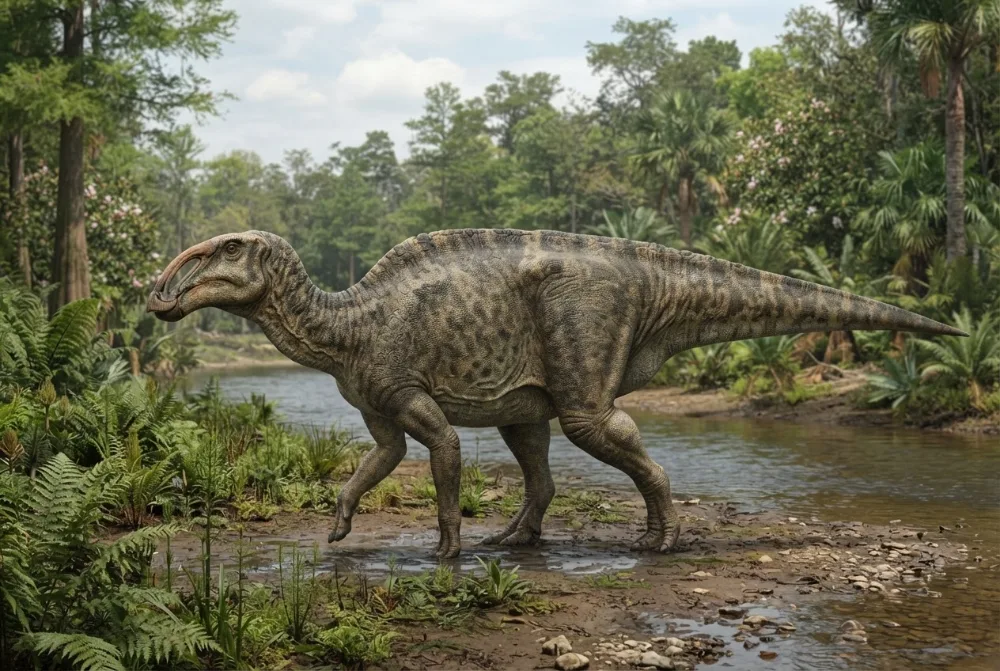
Gryposaurus had a narrow, arching hump on its nose that looked like a Roman nose, which might have been used to tell species apart or to fight others of the same kind.1
Some Gryposaurus fossils even include skin impressions that show it had pyramid-shaped scales running along the middle of its back.1
Its teeth were packed into batteries of hundreds, and only a few were in use at a time, constantly being replaced like a conveyor belt.1
Gryposaurus probably lived near rivers, and it disappeared from the Dinosaur Park Formation before another duckbill called Prosaurolophus showed up.1
The species G. monumentensis was named one of the top 10 new species of 2008 by the International Institute for Species Exploration.1
Gryposaurus could reach food from the ground up to about 4 metres (13 feet) high, using its beak and cheek-like organs to hold plants.1
Ebibuuzo ebisinga okubuuzibwa ku Gryposaurus
?How big was Gryposaurus?
Gryposaurus was about 8 meters (26 feet) long. One nearly complete skeleton measured about 8.2 meters (27 feet) long.1
?What did Gryposaurus eat?
Gryposaurus was a herbivore that ate plants. It had hundreds of teeth in dental batteries and could feed from the ground up to about 4 meters (13 feet) high.1
?Did Gryposaurus have a crest?
Gryposaurus had a narrow, arching hump on its nose, often described as a 'Roman nose.' It might have been used for species recognition or combat.1
?Could Gryposaurus swim?
Gryposaurus probably lived near rivers and may have preferred river settings. It could walk on two legs or all fours, but there is no direct evidence it swam.1
?When did Gryposaurus live?
Gryposaurus lived about 80 to 75 million years ago, during the Late Cretaceous. A possible species from Texas may have lived until 66 million years ago.1
?Was Gryposaurus a dinosaur?
Yes, Gryposaurus was a duck-billed dinosaur, a type of hadrosaurid. It was a plant-eating dinosaur that lived in North America.1
Eri abakugu mu dayinoso
- Erinnya lya ssaayansi
- Gryposaurus
- Yatuumibwa
- Lambe 19142
- Ekibinja
- Ez'emimwa gy'embaata
- Ekika / ekibinja
- Hadrosauridae2
- Engabanya
- Ornithischia > Ornithopoda > Iguanodontia > Hadrosauridae2
- Emyaka gy'enjazi
- emyaka obukadde 84 okutuuka ku 66 (Campanian / Maastrichtian)2
- Ensengeka z'enjazi
- Dinosaur Park, Kaiparowits, Two Medicine2
- Ensi
- Kanada, Amerika2
- Ebisigalira ebyazuulibwa
- 22 mu The Paleobiology Database2
- Okuzuulibwa
- Gryposaurus was named by Lawrence Lambe in 1914, based on a skull and partial skeleton collected by George F. Sternberg in 1913 from the Dinosaur Park Formation in Alberta, Canada.12
- Kikyakubaganyizibwako ebirowoozo
- Scientists still debate whether Gryposaurus and Kritosaurus are the same dinosaur, because their skulls are very similar.1
Ebituufu gye biva
- Gryposaurus (en.wikipedia.org)
- Gryposaurus in The Paleobiology Database (CC BY 4.0): emyaka, ebifo, ensengeka z'enjazi, engabanya.
Buli kituufu ku lupapula luno kirina ennamba eraga ensibuko yaakyo. Bwe tuba nga tukoze ensobi, tusonyiwe, ffe tuli bawagizi ba dayinoso, so si magazini ya ssaayansi. Tubuulire ku [email protected] tujja kugitereeza.
 Rex alumwa enjala! Dino Wiki pulojekiti ya taata eri mutabani we ayagala ennyo dayinoso, ya bwereere, tewali bulango era tewali bikulondoola. Abakulu basobola okuwa Rex akantu ak'okulya okuyamba okugikuuma ku mutimbagano.Liisa Rex
 Parasaurolophus
 Edmontosaurus
 Saurolophus
 Hypacrosaurus
 Corythosaurus
 Kritosaurus
 Tyrannosaurus
 Triceratops
 Velociraptor
 Spinosaurus
 Ankylosaurus
 Pteranodon