 Kwizi: Oli dayinoso ki?
 Olutalo lwa dayinoso
 Empaka z'emisinde gya dayinoso
 Emizannyo emitono egya dayinoso
 Alubaamu ya sitika
 Enkalala za dayinoso eza TOP
 Mpa ekyewuunyisa!
Yabeerawo ddi?

Yali munene atya?
Yali muwanvu kwenkana wa?
Yali mugulumivu kwenkana wa?
kuteebereza
Halszkaraptor yali munene atya bw'ogeraageranya ku GGWE?
Kubala kwokka mu browser yo. Tewali kiterekebwa wadde okusindikibwa wonna.
Yali wa mbiro kwenkana wa?


Ebyewuunyisa
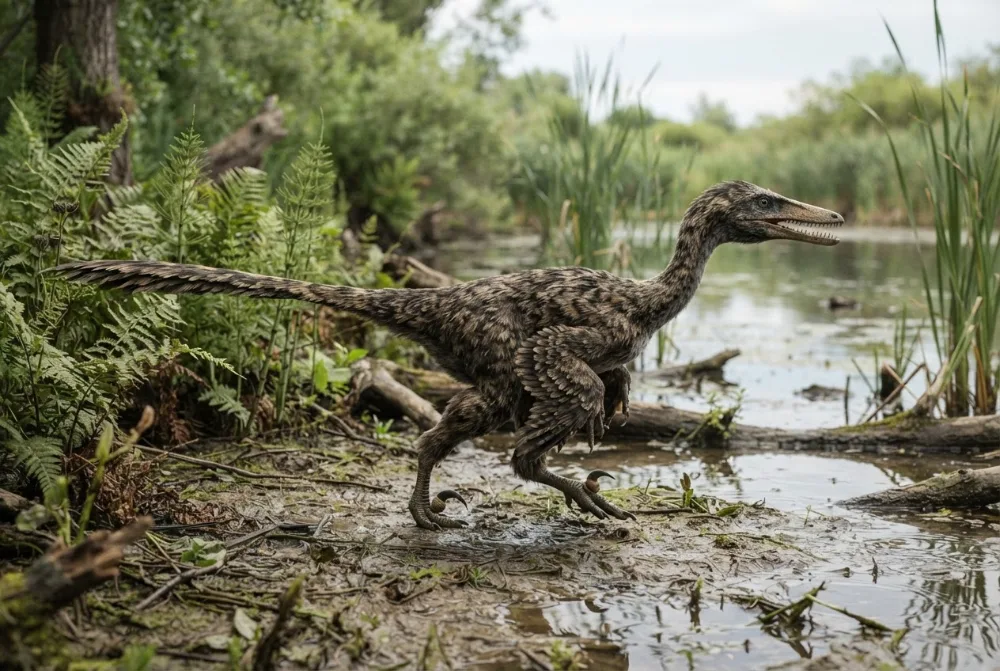
Halszkaraptor had a very long neck for a dinosaur, about 20 cm (7.9 in) long, which is almost half its total body length.1
Its front limbs were short and flipper-like, which scientists think it may have used to paddle in water.1
The snout had many tiny holes that might have held sensors to detect vibrations in water, like a crocodile.1
The only known fossil was smuggled out of Mongolia and later returned after scientists proved it was real using a powerful X-ray scanner.1
It lived about 75 million years ago, during the Late Cretaceous period.1
Some scientists think Halszkaraptor was an insectivore that hunted small bugs in murky water or at night, because its eyes were large.1
Ebibuuzo ebisinga okubuuzibwa ku Halszkaraptor
?Was Halszkaraptor a dinosaur?
Yes, Halszkaraptor was a small, duck-sized dromaeosaurid dinosaur from the Late Cretaceous.1
?How big was Halszkaraptor?
About the size of a mallard duck. Its head was 7 cm long and its neck was 20 cm long.1
?Could Halszkaraptor swim?
Some scientists think it could swim using flipper-like forelimbs and a long neck, but others disagree because its bones were not dense enough.12
?What did Halszkaraptor eat?
It likely ate small fish or insects. Its sharp, backward-curving teeth and snout sensors helped it catch prey in water.13
?Why did Halszkaraptor have a long neck?
Its long, swan-like neck helped it strike at prey in the water, similar to how herons hunt today.13
?When did Halszkaraptor live?
It lived about 75 million years ago, during the Late Cretaceous period.1
Omumenyi w'enfumo
Enfumo: Halszkaraptor was a fully aquatic dinosaur like a dolphin.
Amazima: Scientists debate whether it was semi-aquatic. It had some adaptations for water, like a long neck and flipper-like arms, but also strong legs for running on land. It likely spent time both in water and on land.1
Eri abakugu mu dayinoso
- Erinnya lya ssaayansi
- Halszkaraptor
- Yatuumibwa
- Cau et al. 20174
- Ekibinja
- Raputa
- Ekika / ekibinja
- Dromaeosauridae4
- Engabanya
- Theropoda > Dromaeosauridae4
- Emyaka gy'enjazi
- emyaka obukadde 84 okutuuka ku 72 (Campanian)4
- Ensengeka z'enjazi
- Djadokhta4
- Ensi
- Mongoliya4
- Ebisigalira ebyazuulibwa
- 1 mu The Paleobiology Database4
- Okuzuulibwa
- The fossil was found by poachers in Mongolia before 2011, then bought by a dealer who showed it to scientists in 2015. It was named Halszkaraptor escuilliei in 2017 by Andrea Cau and colleagues.1
- Kikyakubaganyizibwako ebirowoozo
- Scientists are still debating whether Halszkaraptor was truly semi-aquatic or mainly lived on land and ate insects.1
Ebituufu gye biva
- Halszkaraptor (en.wikipedia.org)
- Synchrotron scanning reveals amphibious ecomorphology in a new clade of bird-like dinosaurs | Nature (nature.com)
- Duck-Like Dinosaur Is Among Oddest Fossils Yet Found | National Geographic (nationalgeographic.com)
- Halszkaraptor in The Paleobiology Database (CC BY 4.0): emyaka, ebifo, ensengeka z'enjazi, engabanya.
Buli kituufu ku lupapula luno kirina ennamba eraga ensibuko yaakyo. Bwe tuba nga tukoze ensobi, tusonyiwe, ffe tuli bawagizi ba dayinoso, so si magazini ya ssaayansi. Tubuulire ku [email protected] tujja kugitereeza.
 Rex alumwa enjala! Dino Wiki pulojekiti ya taata eri mutabani we ayagala ennyo dayinoso, ya bwereere, tewali bulango era tewali bikulondoola. Abakulu basobola okuwa Rex akantu ak'okulya okuyamba okugikuuma ku mutimbagano.Liisa Rex
 Velociraptor
 Microraptor
 Deinonychus
 Asiamericana
 Richardoestesia
 Saurornitholestes
 Tyrannosaurus
 Triceratops
 Spinosaurus
 Ankylosaurus
 Parasaurolophus
 Pteranodon