 Kwizi: Oli dayinoso ki?
 Olutalo lwa dayinoso
 Empaka z'emisinde gya dayinoso
 Emizannyo emitono egya dayinoso
 Alubaamu ya sitika
 Enkalala za dayinoso eza TOP
 Mpa ekyewuunyisa!
Yabeerawo ddi?

Yali munene atya?
Yali muwanvu kwenkana wa?
 obuwanvu nga kkapa 5 ab'awaka, ennyindo ku mukira🍌obuwanvu ng'amenvu 14 nga gaddiriŋŋana🏃yandidduse mita 100 mu sikonda 8.8 (omuntu asinga embiro yeetaaga 9.6)
Haolong yali munene atya bw'ogeraageranya ku GGWE?
Kubala kwokka mu browser yo. Tewali kiterekebwa wadde okusindikibwa wonna.
Yali wa mbiro kwenkana wa?


Ebyewuunyisa
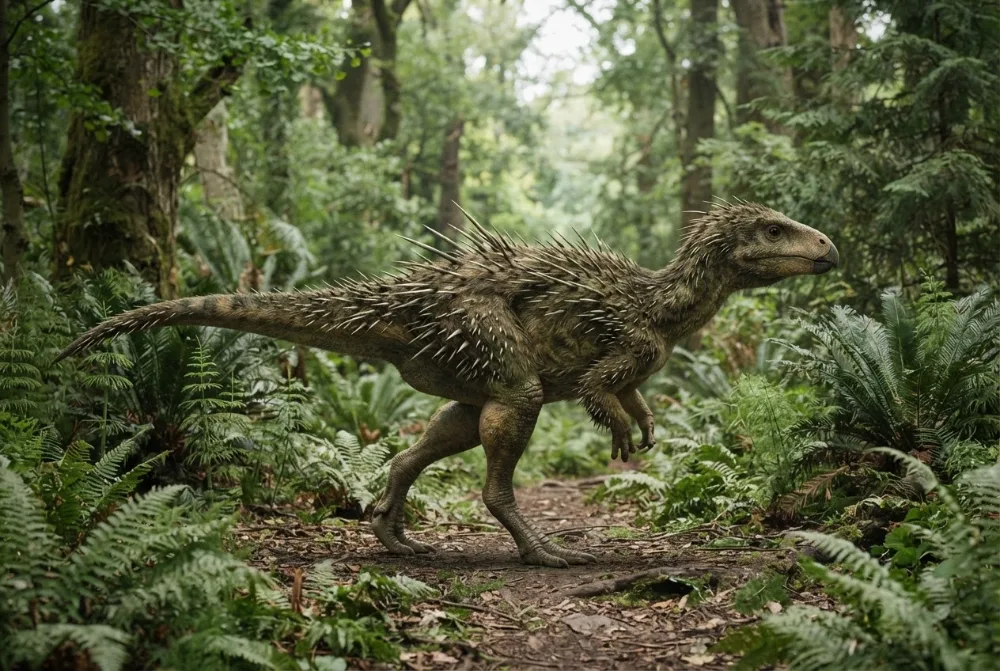
Haolong's skin had large overlapping scales on its tail and smaller bumpy scales around its neck and chest.2
The spikes on Haolong were hollow and made of keratin, the same stuff as your fingernails.2
Scientists could see the preserved nuclei of skin cells in Haolong's spikes under a microscope.2
Haolong's spikes were different from the feathers of meat-eating dinosaurs and the spines of modern lizards.12
Ebibuuzo ebisinga okubuuzibwa ku Haolong
?How big was Haolong?
About 2.45 metres (8 feet) long. That is about the size of a small motorcycle.1
?Did Haolong have feathers?
No. Its skin had scales and hollow spikes made of keratin, not feathers.12
?What did Haolong eat?
It was a plant-eater, so it ate leaves and other plants.3
?When did Haolong live?
About 125 million years ago, during the Early Cretaceous period.1
?Where was Haolong found?
In Liaoning Province, northeastern China, in the Yixian Formation.1
Eri abakugu mu dayinoso
- Erinnya lya ssaayansi
- Haolong
- Yatuumibwa
- Huang et al. 20264
- Ekibinja
- Ezirya ebimera ez'omumwa ng'ogw'ekinyonyi
- Ekika / ekibinja
- Hadrosauroidea4
- Engabanya
- Ornithischia > Ornithopoda > Iguanodontia4
- Emyaka gy'enjazi
- emyaka obukadde 126 okutuuka ku 121 (Barremian)4
- Ensengeka z'enjazi
- Yixian4
- Ensi
- Cayina4
- Ebisigalira ebyazuulibwa
- 1 mu The Paleobiology Database4
- Okuzuulibwa
- Haolong was named in 2026 by a team of scientists led by J. Huang. The name honors the famous Chinese paleontologist Dong Zhiming.14
- Kikyakubaganyizibwako ebirowoozo
- Scientists are not sure if adult Haolong also had spikes, because the only known fossil is a juvenile.1
Ebituufu gye biva
- Haolong (en.wikipedia.org)
- Cellular-level preservation of cutaneous spikes in an Early Cretaceous iguanodontian dinosaur | Nature Ecology & Evolution (nature.com)
- A dinosaur with spikes exhibiting unprecedented properties discovered in China | CNRS (cnrs.fr)
- Haolong in The Paleobiology Database (CC BY 4.0): emyaka, ebifo, ensengeka z'enjazi, engabanya.
Buli kituufu ku lupapula luno kirina ennamba eraga ensibuko yaakyo. Bwe tuba nga tukoze ensobi, tusonyiwe, ffe tuli bawagizi ba dayinoso, so si magazini ya ssaayansi. Tubuulire ku [email protected] tujja kugitereeza.
 Rex alumwa enjala! Dino Wiki pulojekiti ya taata eri mutabani we ayagala ennyo dayinoso, ya bwereere, tewali bulango era tewali bikulondoola. Abakulu basobola okuwa Rex akantu ak'okulya okuyamba okugikuuma ku mutimbagano.Liisa Rex
Endala okuva mu kibinja kye kimu: Ezirya ebimera ez'omumwa ng'ogw'ekinyonyi
 IguanodonEzirya ebimera ez'omumwa ng'ogw'ekinyonyi
 TenontosaurusEzirya ebimera ez'omumwa ng'ogw'ekinyonyi
 ThescelosaurusEzirya ebimera ez'omumwa ng'ogw'ekinyonyi
 ZalmoxesEzirya ebimera ez'omumwa ng'ogw'ekinyonyi
 CamptosaurusEzirya ebimera ez'omumwa ng'ogw'ekinyonyi
 RhabdodonEzirya ebimera ez'omumwa ng'ogw'ekinyonyi
 Stegosaurus
 Archaeopteryx
 Giganotosaurus
 Microraptor
 Deinonychus
 Baryonyx