 Kwizi: Oli dayinoso ki?
 Olutalo lwa dayinoso
 Empaka z'emisinde gya dayinoso
 Emizannyo emitono egya dayinoso
 Alubaamu ya sitika
 Enkalala za dayinoso eza TOP
 Mpa ekyewuunyisa!
Jiuquanornis
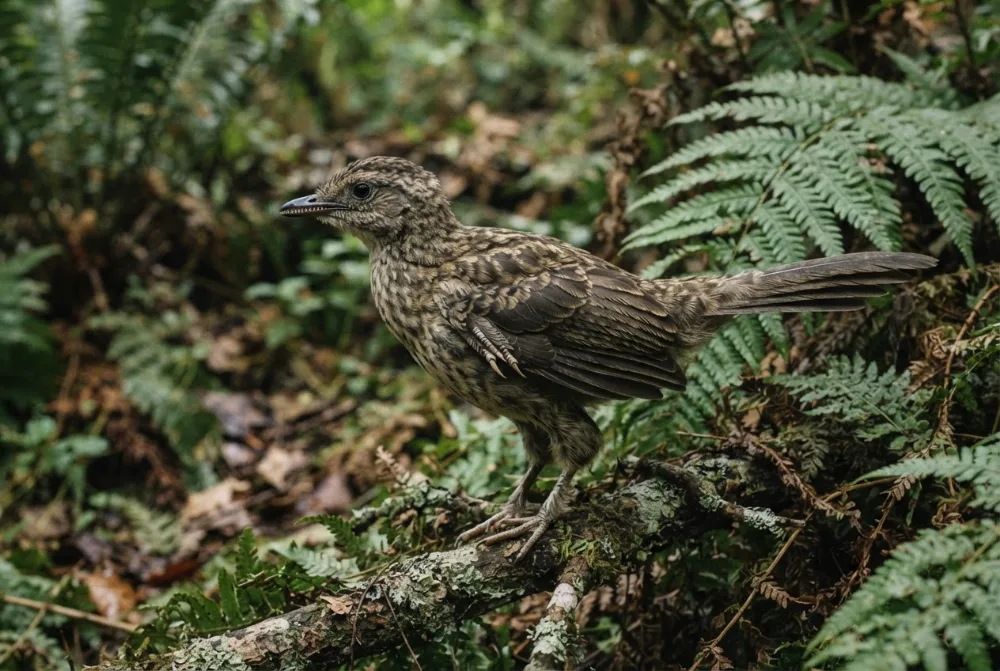
Jiuquanornis was a small, bird-like dinosaur that lived about 120 million years ago. It had a U-shaped wishbone and a sternum that looked like those of some modern ground birds. Scientists think it might have been a fast runner that ate meat.12
Yabeerawo ddi?
Yali wa mbiro kwenkana wa?


Ebyewuunyisa
Jiuquanornis is known from a single fossil that was first described in 2013. The fossil includes parts of the sternum, furcula, and forelimb.1
Its sternum had long, thin projections called trabeculae, which are also seen in modern ground-dwelling birds like chickens and tinamous.1
Jiuquanornis had a U-shaped furcula (wishbone) with a low angle of about 36 degrees, and it lacked a hypocleidium, a small projection found in some birds.1
Scientists think Jiuquanornis was a basal ornithuromorph, meaning it was an early relative of modern birds but not a direct ancestor.1
The fossil of Jiuquanornis was found in the Xiagou Formation, which is about 121 to 113 million years old, from the Early Cretaceous period.21
Jiuquanornis was named after the city of Jiuquan, which is near the fossil site. The species name niui honors Professor Shao-Wu Niu for his geological work.1
The fossil of Jiuquanornis was originally thought to be too incomplete to name, but scientists later decided it was different enough from other birds to be a new species.1
Eri abakugu mu dayinoso
- Erinnya lya ssaayansi
- Jiuquanornis
- Yatuumibwa
- Wang et al. 20132
- Ekibinja
- Ebinyonyi eby'olubereberye
- Ekika / ekibinja
- Ornithuromorpha2
- Engabanya
- Theropoda > Avialae2
- Emyaka gy'enjazi
- emyaka obukadde 121 okutuuka ku 113 (Aptian)2
- Ensengeka z'enjazi
- Xiagou2
- Ensi
- Cayina2
- Ebisigalira ebyazuulibwa
- 1 mu The Paleobiology Database2
- Okuzuulibwa
- Jiuquanornis was named in 2013 by Wang and colleagues. The fossil, specimen GSGM-05-CM-021, was found in the Xiagou Formation near Changma in Gansu Province, China. It was first described as an unnamed bird in 2005, but later recognized as a new species.12
- Kikyakubaganyizibwako ebirowoozo
- Scientists are not sure whether Jiuquanornis lived on the ground or in the water, because its fossil is too incomplete to tell. Its sternum shape suggests it might have been a fast runner, but more fossils are needed.1
Ebituufu gye biva
- Previously Unrecognized Ornithuromorph Bird Diversity in the Early Cretaceous Changma Basin, Gansu Province, Northwestern China (journals.plos.org)
- Jiuquanornis in The Paleobiology Database (CC BY 4.0): emyaka, ebifo, ensengeka z'enjazi, engabanya.
Buli kituufu ku lupapula luno kirina ennamba eraga ensibuko yaakyo. Bwe tuba nga tukoze ensobi, tusonyiwe, ffe tuli bawagizi ba dayinoso, so si magazini ya ssaayansi. Tubuulire ku [email protected] tujja kugitereeza.
 Rex alumwa enjala! Dino Wiki pulojekiti ya taata eri mutabani we ayagala ennyo dayinoso, ya bwereere, tewali bulango era tewali bikulondoola. Abakulu basobola okuwa Rex akantu ak'okulya okuyamba okugikuuma ku mutimbagano.Liisa Rex
 Archaeopteryx
 Hesperornis
 Ichthyornis
 Baptornis
 Jurapteryx
 Gobipteryx
 Stegosaurus
 Iguanodon
 Giganotosaurus
 Microraptor
 Deinonychus
 Baryonyx