 Kwizi: Oli dayinoso ki?
 Olutalo lwa dayinoso
 Empaka z'emisinde gya dayinoso
 Emizannyo emitono egya dayinoso
 Alubaamu ya sitika
 Enkalala za dayinoso eza TOP
 Mpa ekyewuunyisa!
Jormungandr
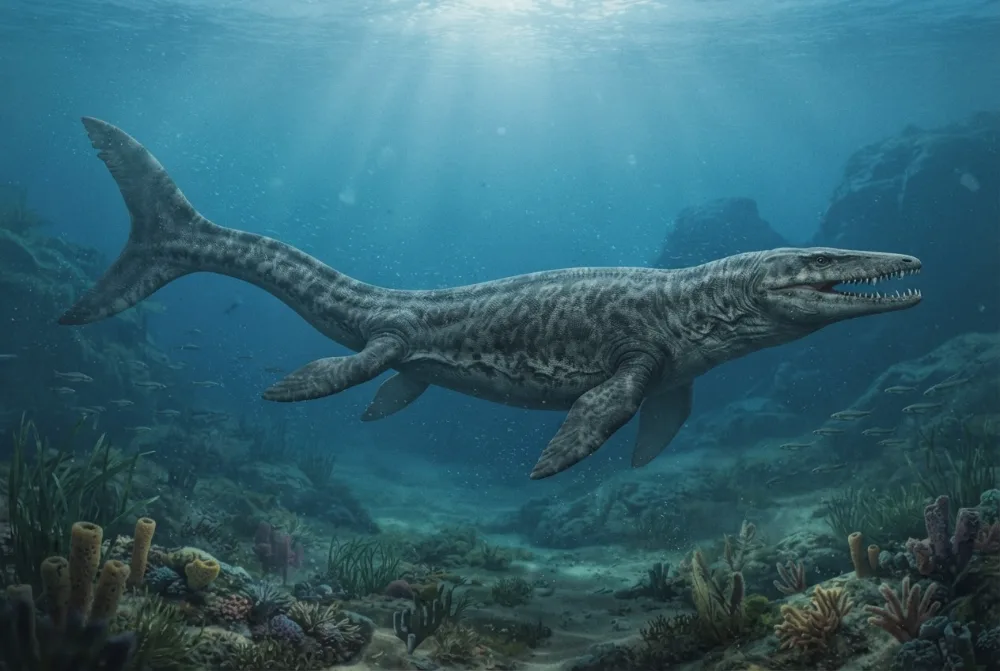
Jormungandr was a huge, swimming lizard that lived in the sea during the time of dinosaurs. It had a long body, strong jaws, and sharp teeth for catching fish and other sea creatures. This marine reptile was not a dinosaur, but a fierce predator of the ancient oceans.1
Yabeerawo ddi?
Yali munene atya?
Yali muwanvu kwenkana wa?
 obuwanvu ng'embwa 7, ennyindo ku mukira🍌obuwanvu ng'amenvu 41 nga gaddiriŋŋana🏊yandiwuze obuwanvu bw'ekidiba ekinene (50 m) mu sikonda 4.9
Jormungandr yali munene atya bw'ogeraageranya ku GGWE?
Kubala kwokka mu browser yo. Tewali kiterekebwa wadde okusindikibwa wonna.
Yali wa mbiro kwenkana wa?


Ebyewuunyisa
Jormungandr's skull was about 72 centimeters (28 inches) long, and its lower jaw measured 80.8 centimeters (31.8 inches).1
The fossil was discovered in 2015 by a fossil collector named Deborah Shepherd near Walhalla, North Dakota.1
Jormungandr lived about 80 million years ago, during the Late Cretaceous period.1
The fourth dorsal vertebra of Jormungandr has marks that scientists think are bite marks from another mosasaur, possibly from a fight or scavenging.1
Jormungandr shares features with both primitive mosasaurs like Clidastes and more advanced ones like Mosasaurus, making it a 'missing link' in mosasaur evolution.1
The species name walhallaensis comes from the town of Walhalla, which is named after Valhalla, the hall of slain warriors in Norse mythology.1
Omumenyi w'enfumo
Enfumo: Some people think Jormungandr was a dinosaur.
Amazima: Jormungandr was a mosasaur, a type of marine lizard, not a dinosaur. Mosasaurs are reptiles but belong to a different group than dinosaurs.1
Eri abakugu mu dayinoso
- Erinnya lya ssaayansi
- Jormungandr
- Yatuumibwa
- Zietlow et al. 20232
- Ekibinja
- Mosasawulu
- Ekika / ekibinja
- Mosasauridae2
- Engabanya
- Mosasauroidea2
- Emyaka gy'enjazi
- emyaka obukadde 84 okutuuka ku 72 (Campanian)2
- Ensengeka z'enjazi
- Pierre Shale2
- Ensi
- Amerika2
- Ebisigalira ebyazuulibwa
- 1 mu The Paleobiology Database2
- Okuzuulibwa
- The only known fossil of Jormungandr was found in 2015 by fossil collector Deborah Shepherd near Walhalla, North Dakota. It was later described and named by paleontologists Amelia Zietlow, Clint Boyd, and Nathan Van Vranken in 2023.1
- Kikyakubaganyizibwako ebirowoozo
- Scientists are not sure if Jormungandr is a distinct genus or just a new species of Clidastes. Some researchers think it might be renamed Clidastes walhallaensis in the future.1
Ebituufu gye biva
- Jormungandr walhallaensis (en.wikipedia.org)
- Jormungandr in The Paleobiology Database (CC BY 4.0): emyaka, ebifo, ensengeka z'enjazi, engabanya.
Buli kituufu ku lupapula luno kirina ennamba eraga ensibuko yaakyo. Bwe tuba nga tukoze ensobi, tusonyiwe, ffe tuli bawagizi ba dayinoso, so si magazini ya ssaayansi. Tubuulire ku [email protected] tujja kugitereeza.
 Rex alumwa enjala! Dino Wiki pulojekiti ya taata eri mutabani we ayagala ennyo dayinoso, ya bwereere, tewali bulango era tewali bikulondoola. Abakulu basobola okuwa Rex akantu ak'okulya okuyamba okugikuuma ku mutimbagano.Liisa Rex
 Mosasaurus
 Prognathodon
 Tylosaurus
 Platecarpus
 Clidastes
 Globidens
 Tyrannosaurus
 Triceratops
 Velociraptor
 Spinosaurus
 Ankylosaurus
 Parasaurolophus