 Kwizi: Oli dayinoso ki?
 Olutalo lwa dayinoso
 Empaka z'emisinde gya dayinoso
 Emizannyo emitono egya dayinoso
 Alubaamu ya sitika
 Enkalala za dayinoso eza TOP
 Mpa ekyewuunyisa!
Keichousaurus
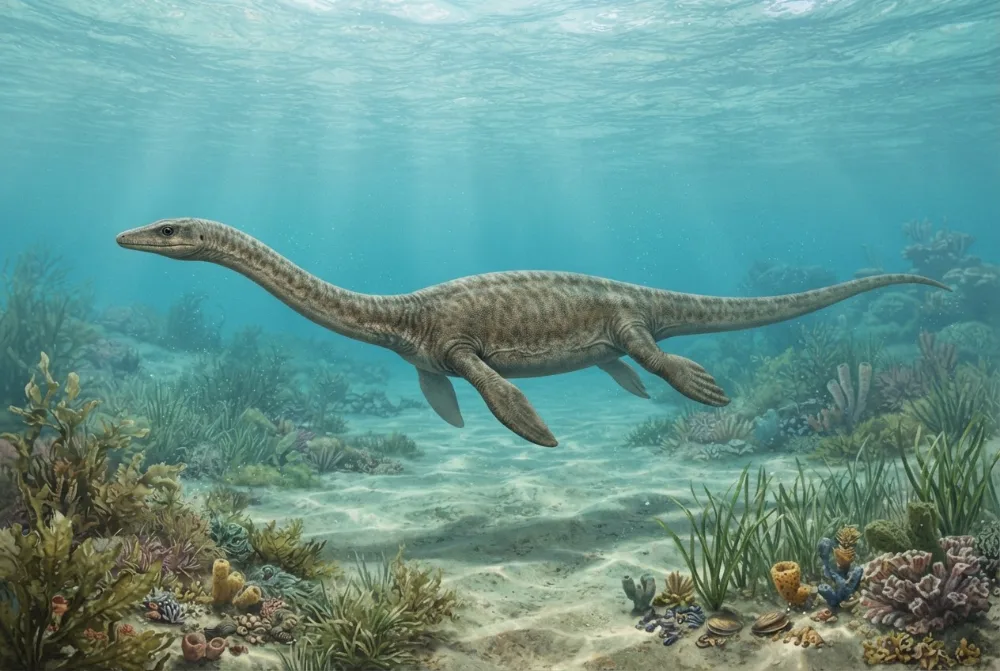
Keichousaurus was a small marine reptile that swam in warm seas during the Triassic Period. It had a long neck, a long tail, and paddle-like limbs to row through the water.1
Yabeerawo ddi?
Yali munene atya?
Yali muwanvu kwenkana wa?
Keichousaurus yali munene atya bw'ogeraageranya ku GGWE?
Kubala kwokka mu browser yo. Tewali kiterekebwa wadde okusindikibwa wonna.
Yali wa mbiro kwenkana wa?


Ebyewuunyisa
Keichousaurus gave birth to live young instead of laying eggs. Baby fossils have been found inside adult females.1
This reptile had very broad ulna bones in its forelimbs, which helped make its paddles more effective for swimming.1
Males grew slightly larger than females. Mature males reached about 16 cm snout-vent length, while females reached about 15 cm.1
Keichousaurus is one of the most common sauropterygian fossils found in China. Many complete skeletons have been collected.1
It had a long, serpentine neck and a small head, similar to other pachypleurosaurs.1
Keichousaurus probably used a rowing motion with its paddle-like limbs to move through the water.1
Ebibuuzo ebisinga okubuuzibwa ku Keichousaurus
?Is Keichousaurus a dinosaur?
No, Keichousaurus is not a dinosaur. It is a marine reptile called a sauropterygian.1
?How big was Keichousaurus?
Keichousaurus was very small. Mature males reached about 16 cm snout-vent length, and females about 15 cm.1
?What did Keichousaurus eat?
It ate fish. It had pointed teeth and backward-curved teeth at the front of its mouth to catch and swallow prey whole.1
?Did Keichousaurus lay eggs?
No. Fossil evidence shows that Keichousaurus gave birth to live young, not eggs. Babies have been found inside adult females.143
?Could Keichousaurus swim?
Yes, it was a good swimmer. It used its paddle-like limbs to row through the water, similar to underwater flight.1
?When did Keichousaurus live?
Keichousaurus lived during the Triassic Period, from about 251 to 227 million years ago.1
Eri abakugu mu dayinoso
- Erinnya lya ssaayansi
- Keichousaurus
- Yatuumibwa
- Young 19585
- Ekibinja
- Ebyewalula eby'omu nnyanja
- Ekika / ekibinja
- Keichousauridae5
- Engabanya
- Sauropterygia5
- Emyaka gy'enjazi
- emyaka obukadde 251 okutuuka ku 237 ()5
- Ensengeka z'enjazi
- Falang, Jialingjiang, Gejiu5
- Ensi
- Cayina5
- Ebisigalira ebyazuulibwa
- 7 mu The Paleobiology Database5
- Okuzuulibwa
- The first fossil of Keichousaurus was found in 1957 in Guizhou Province, China, by Hu Chengzhi. It was named by Chinese paleontologist Young Chung-chien in 1958.1
- Kikyakubaganyizibwako ebirowoozo
- Scientists are not sure whether Keichousaurus was viviparous (giving birth to live young) or ovoviviparous (eggs hatching inside the mother).3
Ebituufu gye biva
- Keichousaurus (en.wikipedia.org)
- PBDB Taxon (paleobiodb.org)
- Morphology of Keichousaurus hui from the Middle Triassic of Xingyi, Guizhou Province with Comments on Its Reproduction Mode (xbna.pku.edu.cn)
- Triassic marine reptiles gave birth to live young | Nature (nature.com)
- Keichousaurus in The Paleobiology Database (CC BY 4.0): emyaka, ebifo, ensengeka z'enjazi, engabanya.
Buli kituufu ku lupapula luno kirina ennamba eraga ensibuko yaakyo. Bwe tuba nga tukoze ensobi, tusonyiwe, ffe tuli bawagizi ba dayinoso, so si magazini ya ssaayansi. Tubuulire ku [email protected] tujja kugitereeza.
 Rex alumwa enjala! Dino Wiki pulojekiti ya taata eri mutabani we ayagala ennyo dayinoso, ya bwereere, tewali bulango era tewali bikulondoola. Abakulu basobola okuwa Rex akantu ak'okulya okuyamba okugikuuma ku mutimbagano.Liisa Rex
 Nothosaurus
 Placodus
 Lariosaurus
 Cyamodus
 Cymatosaurus
 Proneusticosaurus
 Chonespondylus
 Cymbospondylus
 Phalarodon
 Mixosaurus
 Chaohusaurus
 Chensaurus